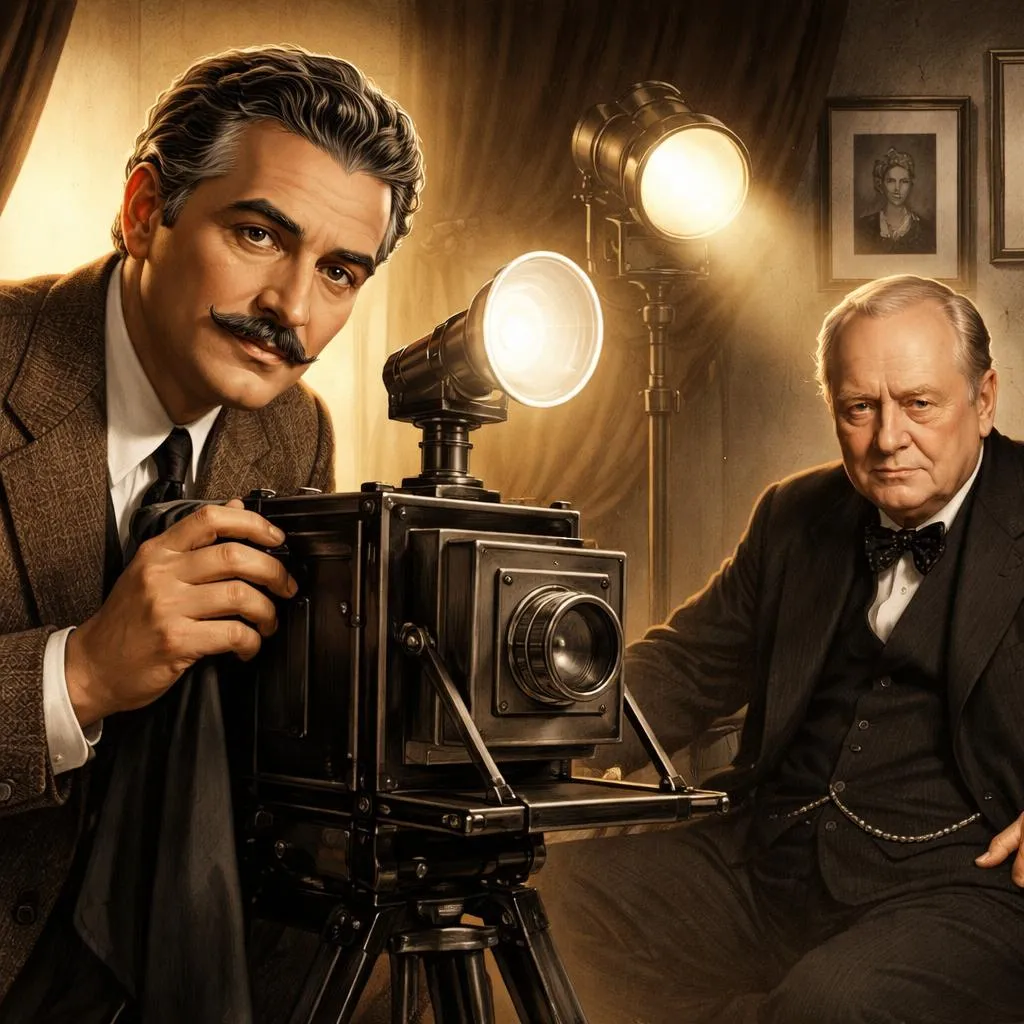

Have you ever seen a photo of Winston Churchill looking angry? His brow is furrowed. His lips are pressed together. He looks like a bulldog. That is a Yousuf Karsh photograph. Karsh took that picture in 1941. Churchill had just given a speech. He was not in a good mood. Karsh walked up to him and said, "Forgive me, sir." Then he took the cigar out of Churchill's mouth. Churchill glared. Karsh clicked his camera. The photo became one of the most famous portraits in history. This Celebrity Story: Yousuf Karsh will introduce you to a photographer who fled Armenia as a boy. He became the most famous portrait photographer of the 20th century. He photographed everyone: Albert Einstein, Ernest Hemingway, Albert Schweitzer, and John F. Kennedy.
Let us meet the master of light. Yousuf Karsh believed that every face tells a story.
Who Is This Celebrity?
Yousuf Karsh was an Armenian-Canadian portrait photographer. He lived from 1908 to 2002. He is considered one of the greatest portrait photographers of all time. He photographed the most famous people of the 20th century. His portraits are in the National Gallery of Canada and the Museum of Modern Art in New York.
Why is he famous? He took the iconic portrait of Winston Churchill. That image is the most reproduced portrait in the history of photography. It appeared on the cover of Life magazine. It was used on British postage stamps. It became a symbol of British defiance during World War II. He also photographed dozens of other world leaders, artists, and scientists. He had a studio in Ottawa, Canada. World leaders would come to him.
Early Life and Childhood
Yousuf Karsh was born in Mardin, Armenia. His family was Armenian Christian. The Ottoman Empire was persecuting Armenians. His family fled.
He grew up in the city of Diyarbakir. It was a dangerous time. He was a quiet boy. He loved to draw. He loved to read.
When he was 14 years old, his family sent him to Canada. He was sent to live with his uncle, George Nakash. George was a photographer in Sherbrooke, Quebec. He had a small studio.
Yousuf worked for his uncle. He learned the basics of photography. He learned to develop film. He learned to print. He also went to school. He learned English.
He showed talent. His uncle encouraged him. He sent him to Boston to apprentice with a famous portrait photographer named John Garo. Garo was also an Armenian immigrant. He taught Karsh about light. He taught him about posing. He taught him about psychology. He said, "You must learn to see the soul."
Education and Learning Journey
Yousuf Karsh apprenticed with John Garo for three years. Garo was a master of lighting. He used large, soft light sources. He created shadows that added drama. Karsh learned his techniques.
He also studied art history. He looked at paintings by Rembrandt and Vermeer. Those painters used light to create mood. He borrowed their ideas.
In 1931, he returned to Canada. He opened his own studio in Ottawa. He was 23 years old. He was young. He was unknown.
He photographed local politicians and businessmen. He built a reputation. He was careful. He was patient. He was skilled.
In 1941, he got his big break. Winston Churchill came to Ottawa. He was the Prime Minister of Britain. He had come to speak to the Canadian Parliament. Karsh requested a session. He was granted five minutes.
Churchill was not happy. He had just spoken. He was tired. He refused to smile. He lit a cigar. Karsh waited. Then he stepped forward. He said, "Forgive me, sir." He took the cigar from Churchill's mouth. Churchill glared. Karsh clicked the shutter. He captured the moment. The photo was published around the world. Karsh became famous overnight.
How Did They Become Successful?
Yousuf Karsh became successful after the Churchill photograph. His name was known worldwide. World leaders wanted to be photographed by him.
He photographed Albert Einstein in 1948. He waited for hours for the perfect light. Einstein was impatient. He finally sat. Karsh took the photo. It shows Einstein's wisdom and his weariness.
He photographed Ernest Hemingway in 1957. Hemingway was a famous writer. He was also a drunk. He showed up late. He was belligerent. Karsh was patient. He finally got the photo. It shows Hemingway's strength and his sadness.
He photographed John F. Kennedy in 1960. Kennedy was a young senator. He was running for president. Karsh took a simple portrait. Kennedy looks confident. He looks young. The photo was used on campaign posters.
He photographed the Queen of England. He photographed Fidel Castro. He photographed Albert Schweitzer. He photographed Pablo Picasso. He photographed every major figure of the 20th century.
He wrote several books. His most famous is "Karsh Portraits." It features over 100 of his best images.
He received the Order of Canada. He also received the Order of the British Empire. He was a fellow of the Royal Photographic Society.
Big Ideas and Achievements
Yousuf Karsh's biggest idea was that a portrait should reveal the inner person. He said, "The portrait is a mirror of the soul." He did not just photograph faces. He photographed character.
His greatest achievement is the Churchill portrait. That single image is a masterpiece. It captures the defiance of Britain against Nazi Germany. Churchill looks angry. He looks determined. He looks like he will never surrender.
Another huge achievement is his body of work. He created a visual history of the 20th century. When we want to remember what Einstein looked like, we look at Karsh. When we want to remember Hemingway, we look at Karsh.
He also influenced portrait photography. Before him, portraits were stiff. People sat up straight. They looked at the camera. Karsh made them relax. He made them be themselves.
His studio in Ottawa is now a museum. You can visit it. You can see his cameras. You can see his lights.
Challenges and Difficult Times
Yousuf Karsh faced many challenges. First, he was a refugee. He fled his homeland. He had to learn a new language. He had to build a new life.
Second, he was unknown for many years. He struggled. He worked hard. He did not give up.
Third, he had to travel constantly. He was on the road for weeks at a time. He missed his family.
Fourth, he had a heart condition. He had a heart attack in his 60s. He kept working.
Fifth, he died in 2002. He was 93 years old. He had outlived almost all of his subjects.
Fun Facts About the Celebrity
Yousuf Karsh was only five feet tall. He was a small man. He photographed giants.
Another fun fact: He used an 8x10 view camera. It was huge. It weighed 50 pounds.
He was terrified of flying. He traveled by train.
He loved to garden. He grew roses.
One more fact: He took the first official portrait of Canada's Prime Minister. Every prime minister since has been photographed by Karsh or his assistants.
Why Is This Celebrity Important Today?
Yousuf Karsh is important because he showed us the character of the 20th century. When you look at his photos, you see not just faces. You see souls. Churchill's defiance. Einstein's wisdom. Hemingway's pain. Kennedy's youth.
He is also important because of his craft. His use of light is studied. His posing is studied. His patience is studied.
His influence is seen in portrait photography today. Every photographer who tries to capture the essence of a person is following Karsh.
Parents can use his story to teach children about patience and preparation. Karsh waited for hours for the right moment.
What Can Kids Learn from This Story?
Kids can learn powerful lessons from Yousuf Karsh. First, be patient. Karsh waited for the right light. He waited for the right expression. Do not rush. Wait for the moment.
Second, look for the soul. Karsh did not just see a face. He saw a person. When you draw a portrait, think about the person inside. What are they feeling? What are they thinking?
Third, take a risk. Karsh took Churchill's cigar. He could have been thrown out. He took the risk. He got the picture.
Finally, be polite. Karsh said "Forgive me, sir." He was respectful. You can be bold and polite at the same time.
Quick Quiz or Practice Time
Let us see what you learned from this Celebrity Story: Yousuf Karsh. Answer these questions with a parent or by yourself.
What famous British leader did Karsh photograph looking angry?
What country did Karsh flee as a child?
What did Karsh remove from Churchill's mouth before taking the photo?
Where did Karsh have his studio?
What did Karsh study in Boston that taught him about light?
Here is a fun activity. Take a portrait of a family member. Ask them to think about something serious. Do not ask them to smile. Ask them to show you their thinking face. Use natural light from a window. You are photographing like Yousuf Karsh.
Another activity. Look up Yousuf Karsh's portrait of Albert Einstein. Look at Einstein's eyes. They look tired. They look wise. Then draw a portrait of someone you think is wise. Your grandparent. Your teacher. Try to capture their wisdom.
Yousuf Karsh was an Armenian refugee. He fled to Canada. He learned photography from his uncle. He studied light in Boston. He opened a studio in Ottawa. He photographed Winston Churchill. He took Churchill's cigar. He captured Churchill's glare. The photo became famous. He photographed everyone: Einstein, Hemingway, Kennedy. He became the greatest portrait photographer of the 20th century. His story teaches us to be patient. To see the soul. To take risks. To be polite. That is the real lesson of this celebrity story.