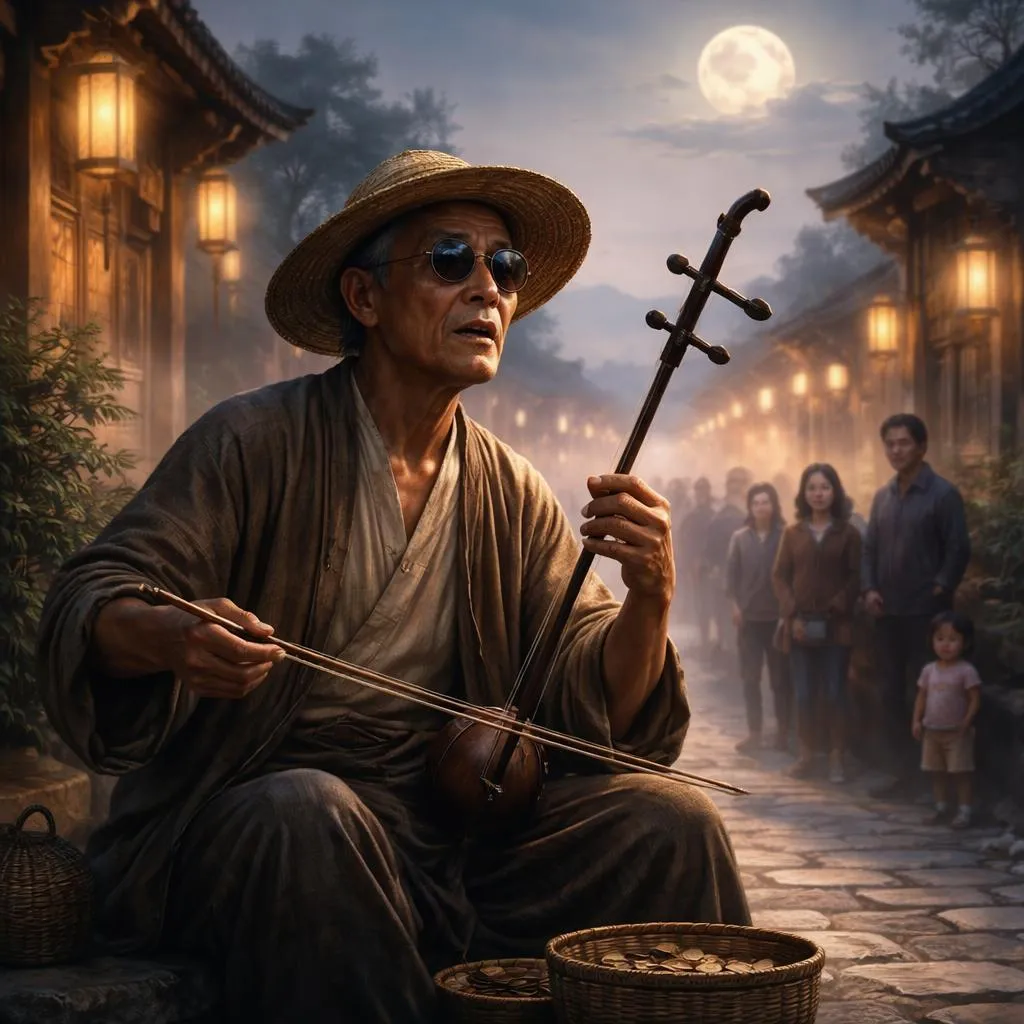

Who Is This Celebrity?
Abing was a blind street musician who became one of China's most famous composers. He lived from 1893 to 1950. His real name was Hua Yanjun. He lost his eyesight at age 34. He spent his final decades playing erhu on street corners. People threw coins at his feet. He composed over 270 pieces of music. Only six survive. The most famous is "Moon Reflected on the Second Spring." This melody is so sad and beautiful that it brings listeners to tears. His story shows that art can come from the deepest suffering.
Early Life and Childhood
Abing was born in 1893 in Wuxi, Jiangsu Province, China. His father was a Taoist priest and musician. Young Abing grew up in a Taoist temple. He learned to play the erhu and pipa from his father. He also learned to chant scriptures and perform rituals. He showed great musical talent from a very young age. He could memorize a melody after hearing it once. He loved wandering the streets and listening to folk songs. He dreamed of becoming a great musician like his father. He also learned to make and repair instruments.
Education and Learning Journey
Abing received no formal education in music. His father taught him at home. He practiced for hours every day, often until his fingers bled. He learned the classical repertoire of Taoist music. He also studied folk music from street performers. He would listen to a song once and then play it back perfectly. He could imitate any instrument with his voice. He learned to compose by improvising. His father died when Abing was around 20. Abing took over the temple duties. But he could not manage the temple well. He began to gamble and drink.
How Did They Become Successful?
Abing became successful only after he lost everything. In his late 20s, he contracted a disease that damaged his eyes. By age 34, he was completely blind. He could no longer perform temple rituals. His wife left him. He had no money and no home. He became a street musician. He sat on street corners and played his erhu. Passersby threw coins at his feet. He played the same songs every day. But he also composed new ones. He could not write them down. He memorized them. He played from memory. People in his neighborhood knew him. They called him "Blind Abing."
Big Ideas and Achievements
Abing's biggest achievement was "Moon Reflected on the Second Spring." He composed this piece in 1939. He was sitting outside a temple in Wuxi. The moon reflected in a nearby pool. The water was dirty and polluted. But the moonlight was still beautiful. Abing could not see the moon. He could only hear the water. He picked up his erhu and played. The melody starts slow and low. It rises and falls like a sob. It sounds like a person crying. It sounds like the moon shining on dark water. Musicologists call it one of the most beautiful erhu pieces ever written. He also composed "Listening to the Pines," "The Horse Race," and three other surviving pieces.
Challenges and Difficult Times
Abing faced blindness, poverty, and social rejection. He could not see the faces of his listeners. He could not see the coins they threw. He had to feel for them on the ground. He could not afford decent food or warm clothes. He slept in temples and alleyways. People saw him as a beggar, not an artist. They did not know he was composing masterpieces. He also faced the challenge of losing his music. He could not write down his compositions. He had to memorize everything. If he forgot a melody, it was gone forever. In 1950, a music professor visited Abing. He recorded six of his pieces on a tape recorder. Abing died three months later. The rest of his music died with him.
Fun Facts About the Celebrity
Abing loved eating steamed buns filled with pork. He could not afford them often. He also enjoyed drinking weak tea. He never drank alcohol after losing his eyesight. He said it made his playing worse. He kept a small wooden box where he stored coins. He would shake it to count his earnings. He also loved telling stories to children on the street. They would gather around him before he played. He never owned a new instrument. He played an old erhu with worn strings. He kept a pet mouse that lived in his sleeve. He said the mouse's movements helped him feel the rhythm.
Why Is This Celebrity Important Today?
Abing's "Moon Reflected on the Second Spring" is a classic of Chinese music. It is performed by erhu players around the world. The piece is taught in every Chinese music conservatory. It has been arranged for orchestra and film. In 2008, a recording of Abing playing the piece was sent into space on a Chinese satellite. His life story has been the subject of films, books, and plays. He is remembered as a symbol of artistic integrity. He never sold his art for money. He played what he felt, even when no one was listening. His grave in Wuxi is a pilgrimage site for musicians.
What Can Kids Learn from This Story?
You can learn that art can come from suffering. Abing's best music came after he lost his sight. You can also learn that you do not need an audience to create. He played on empty streets. You can learn that simple tools can create beauty. He played a worn-out erhu. You can learn that memory is powerful. He memorized over 270 pieces. You can also learn that fame can come too late. He died three months after being recorded. He never knew he would become famous.
Quick Quiz or Practice Time
Let's see what you remember about Abing.
Question 1: What is Abing's most famous piece of music?
Answer: Moon Reflected on the Second Spring.
Question 2: How old was Abing when he lost his eyesight?
Answer: 34 years old.
Question 3: What instrument did Abing play on the street?
Answer: The erhu (two-stringed fiddle).
Question 4: What food did Abing love eating but could not afford often?
Answer: Steamed buns filled with pork.
Question 5: What pet lived in Abing's sleeve?
Answer: A mouse.
Activity: Listen to a recording of "Moon Reflected on the Second Spring." Close your eyes. Imagine a blind man sitting by a pool on a moonlit night. Imagine the sadness and the beauty in his heart. Draw a picture of the scene you imagined. This is the power of music to paint pictures without colors. You are experiencing Abing's art.
Abing died in poverty. He wore rags. He slept in cold temples. He ate when strangers gave him coins. He had no family. He had no friends. He had no future. But he had his erhu. He had his music. He had his memories. Every day, he sat on the same street corner. He lifted his erhu to his blind eyes. He drew the bow across the strings. The melody floated into the air. People walked past. Some stopped. Some threw coins. Most did not notice. They did not know they were hearing a masterpiece. They did not know that blind beggar was a genius. They did not know that future generations would travel across the world to hear his recordings. Abing did not know either. He died without fame. He died without fortune. He died without knowing he had created something immortal. But he played anyway. He played because music was his only comfort. He played because the melody in his head needed to escape. He played because that was who he was. A musician. Blind. Poor. Forgotten. But a musician to the end. His story teaches us that you do not need an audience to create. You do not need recognition to make art. You do not need success to find meaning. You just need your instrument, your hands, and your heart. Abing had those. Now it is your turn. Pick up your instrument. Play for yourself. Play for the moon. Play for the empty street. That is the way of Abing. That is your way too. Now go make some music, even if no one is listening.