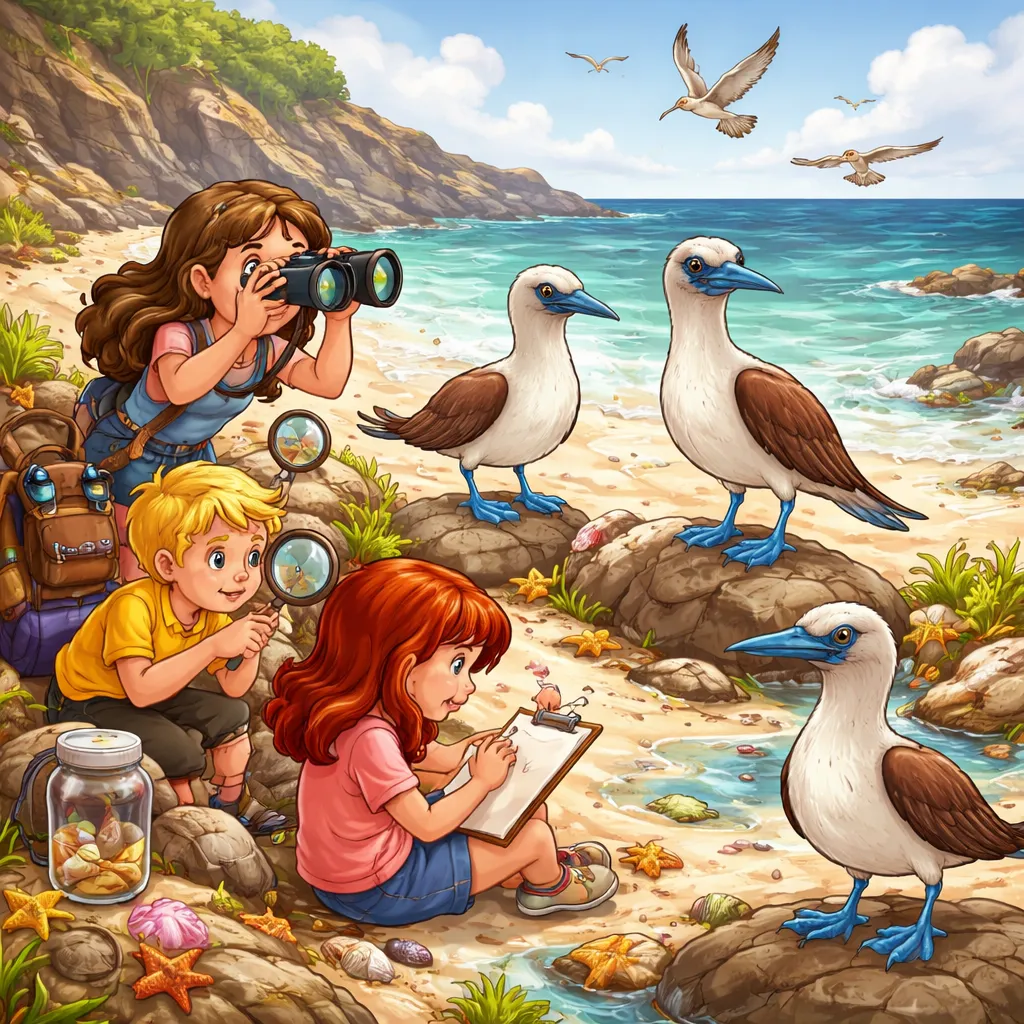

What Is This Animal?
A booby is a seabird with long wings, a pointed beak, and a streamlined body. It is built for diving. It plunges into the ocean from great heights to catch fish. Some boobies have bright blue feet. Others have red feet or blue faces. They are named for their clumsy walk on land.
Boobies live on tropical islands around the world. They are found in the Pacific, Atlantic, and Indian Oceans. They spend most of their time at sea. They come to land to nest. They nest in large colonies. They are not afraid of people on remote islands.
These birds are excellent divers. They spot fish from the air. They fold their wings and dive. They hit the water at high speed. They use their wings to swim underwater. They catch fish in their beaks.
For children, boobies are delightful. Their bright feet and diving skills make them fun to watch. Learning about boobies teaches children about seabirds, island ecosystems, and the wonders of life on tropical coasts.
English Learning About This Animal
Let us learn the English word booby. We say it like this: /ˈbuːbi/. The boo sounds like “boo.” The by sounds like “bee.” Put them together: booby. Say it three times. Booby. Booby. Booby.
Now let us learn words about a booby’s body. The feet are bright blue or red. The beak is pointed and strong. The wings are long for soaring. The eyes are positioned for spotting fish. The chicks are baby boobies.
There is a famous saying about boobies. Sailors say, “The booby dives like an arrow and walks like a fool.” This describes their grace in water and clumsiness on land. Another saying is, “Where boobies nest, the sea is rich with fish.” This reflects their need for abundant food.
These English words help children understand booby anatomy. When they say feet, they learn about the bright colors. When they say chicks, they know the babies. Parents can practice these words while looking at pictures. Point to the parts. Say the words together.
Animal Facts and Science Knowledge
Boobies belong to the family Sulidae. There are six booby species. The blue-footed booby is the most famous. It lives in the Galapagos Islands and along the Pacific coast. The red-footed booby lives on tropical islands worldwide. The masked booby is the largest. Boobies are related to gannets.
Boobies live on tropical islands. They nest on the ground or in trees. They form large colonies. They return to the same nesting sites each year. They are active during the day. They fly out to sea to fish.
Boobies are carnivores. They eat fish and squid. They dive from heights of up to one hundred feet. They catch fish underwater. They hunt alone or in groups. They follow schools of fish.
Boobies have special abilities. Their nostrils are permanently closed. They breathe through their mouths. This prevents water from entering their nose when diving. Their eyes face forward for depth perception. Their bodies are streamlined for speed.
Blue-footed boobies have elaborate courtship dances. Males show off their blue feet. They lift one foot, then the other. They strut and whistle. Females choose males with the brightest blue feet. The color comes from the fish they eat. Healthy males have bright feet.
How to Interact With This Animal Safely
Boobies are wild seabirds. They are not afraid of people on remote islands. This does not mean they want to be touched. The best way to interact is to watch from a distance. Sit quietly. Let them come to you.
Teach children to respect boobies. Do not try to touch them. Do not chase them. They will abandon their nests if disturbed. Keep a safe distance. Use binoculars to watch.
If you visit a booby colony, follow the rules. Stay on paths. Do not approach nests. Boobies have sharp beaks. They will bite if they feel threatened. Give them space.
Boobies need healthy oceans. They need fish to eat. Overfishing harms them. Protecting the ocean protects boobies. Learning about them helps us understand why oceans matter.
In zoos, boobies are rare. They need large spaces. They need to dive. Seeing them in the wild is the best way.
What Can We Learn From This Animal
Boobies teach us about grace. They dive perfectly. They swim underwater. Children learn that grace comes with practice. Learning to do things well, practicing, and improving are important.
Boobies teach us about showing off. Males show their blue feet to attract mates. Children learn that sharing what makes us special is good. Being proud of ourselves, showing our talents, and celebrating who we are are important.
Boobies teach us about family. They nest in colonies. They raise chicks together. Children learn that families and communities help each other. Caring for others, working together, and protecting our young matter.
Boobies teach us about the ocean. They show us that the sea is full of life. Children learn that oceans are home to amazing creatures. Protecting the ocean protects boobies.
Fun Learning Activities
Let us make learning about booby fun. One activity is the booby dive game. Ask your child to stand on a stool or low platform. Spot a fish below. Fold arms like wings. Dive down. Catch the fish. Say “booby dives” and “booby catches fish.”
Another activity is the blue-footed booby dance. Ask your child to lift one foot, then the other. Strut like a booby. Show off blue socks or paper feet. Whistle. Say “booby shows its feet” and “booby dances for a mate.”
Draw a booby. Look at pictures of boobies. Notice the bright feet, pointed beak, and long wings. Draw a blue-footed booby dancing or diving. Add the ocean below. Label the parts. Say the words aloud.
Create a story about a booby family. Ask your child what the boobies do. Do they dive for fish? Do they dance on the rocks? Do they feed their chicks? Write a few sentences together. Let your child draw pictures. Read the story aloud.
Make a booby craft. Use white paper for the body. Add long, pointed wings. Add a bright blue feet from paper. Add a pointed beak. Move the craft booby. Practice saying “booby dives” and “booby shows its feet.”
Learn about seabirds. Talk about other birds that live near the ocean. Compare boobies to frigatebirds and pelicans. Use words like “dive,” “colony,” and “seabird.”
Learn about the Galapagos Islands. Talk about where blue-footed boobies live. Use words like “island,” “endemic,” and “ecosystem.”
These simple activities bring learning to life. Children build English vocabulary while playing. They learn science through understanding seabird adaptations. They develop appreciation through learning about tropical islands. Learning about booby becomes a journey to sun-warmed shores. Each moment spent together strengthens language, curiosity, and a growing appreciation for the blue-footed divers that teach us that grace, showing off, and family make life rich under the sun.