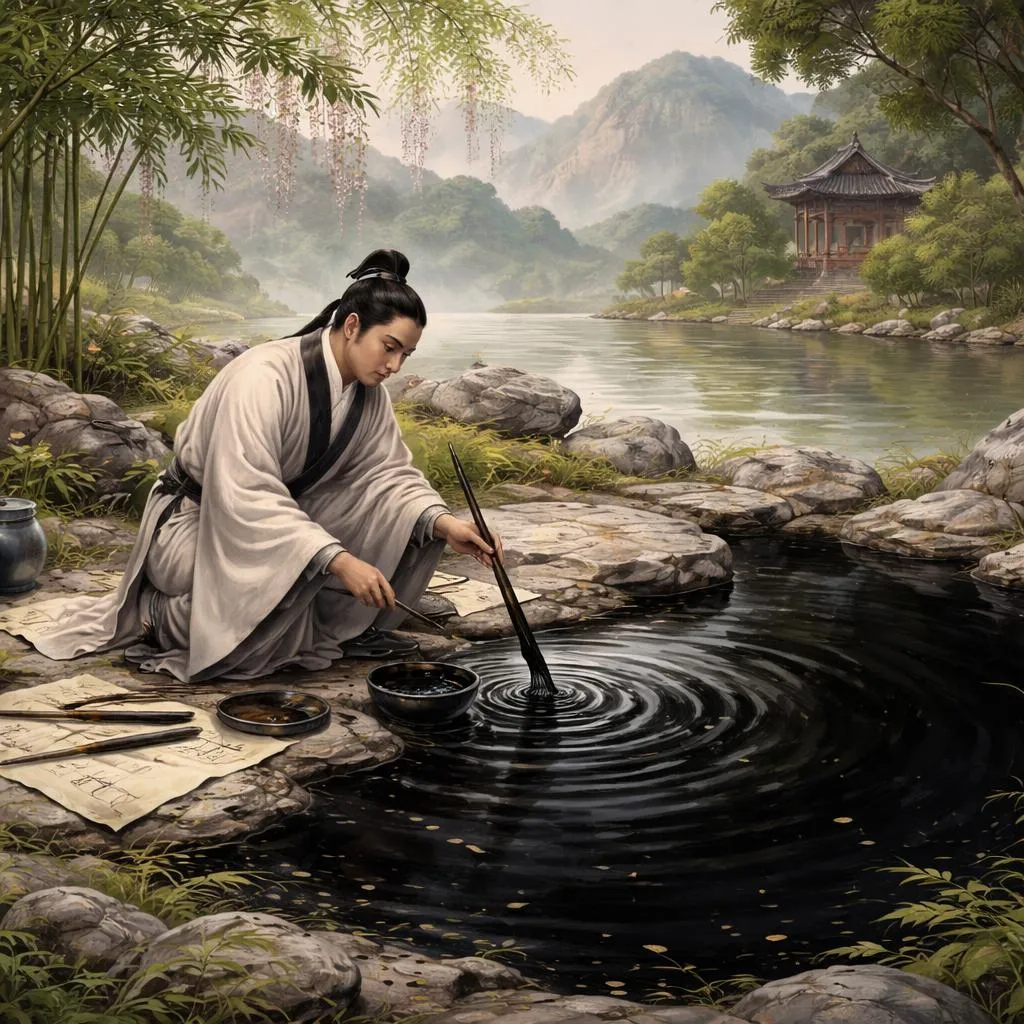

Who Is This Celebrity?
Wang Xizhi was the greatest calligrapher in Chinese history. He lived about 1,700 years ago during the Eastern Jin Dynasty. People call him the "Sage of Calligraphy." His most famous work, the "Orchid Pavilion Preface," has inspired artists for centuries. No one has ever surpassed his skill with a brush. Emperors collected his work and treasured it like gold. His story shows that talent means nothing without hard work.
Early Life and Childhood
Wang Xizhi was born around 303 CE in Linyi, Shandong Province, China. His family were government officials and scholars. Young Wang showed an early interest in calligraphy. He would watch his father write official documents. He also loved practicing with a brush on any surface he could find. He would write on bamboo slips, cloth, and even leaves. His uncle was a famous calligrapher who taught him the basics. Wang practiced every single day, no matter the weather. His family thought he was obsessed. They did not understand his passion.
Education and Learning Journey
Wang Xizhi studied with the best calligraphy teachers of his time. His first formal teacher was a famous female calligrapher named Wei Shuo. She taught him the proper way to hold a brush and control the ink. He also studied the works of ancient calligraphy masters. He copied their characters thousands of times. But Wang did not just copy. He experimented with different brush strokes and ink densities. He studied nature to understand rhythm and flow. He watched clouds move and trees sway in the wind. He observed geese swimming in ponds. He believed that good calligraphy captured the movement of living things. He practiced for hours every day. He often forgot to eat or sleep.
How Did They Become Successful?
Wang Xizhi became successful through relentless practice. He had a small pond near his home. Every day, he washed his brush and ink stone in the pond. Over time, the water turned completely black from the ink. People called it the "Ink Pond." Visitors could still see the dark color years later. Wang also practiced while lying in bed. He would trace characters on his blanket with his finger. He wore holes through several blankets. He once became so absorbed in practicing that he dipped his rice cake into a cup of ink instead of sauce. He ate the ink-soaked cake without noticing. His dedication became legendary.
Big Ideas and Achievements
Wang Xizhi's biggest achievement was his calligraphy style called "Running Script." This style connected characters smoothly like flowing water. It was faster to write than standard script but still beautiful to read. His most famous work is the "Orchid Pavilion Preface." He wrote this piece in 353 CE at a gathering of 42 poets. The poets sat by a winding stream. Cups of wine floated down the stream. Each poet drank a cup and wrote a poem. Wang was slightly drunk when he wrote his preface. He used a bamboo brush on mulberry paper. The result was spontaneous, lively, and perfect. Wang later tried to rewrite it many times. He could never match the original. The original has been lost. But copies have inspired calligraphers for 1,700 years.
Challenges and Difficult Times
Wang Xizhi faced the challenge of living during a chaotic time. The Jin Dynasty had collapsed, and China was divided. Wars and rebellions happened constantly. Wang's family had to flee their home multiple times. He lost many of his early calligraphy works during these flights. He also faced the challenge of political pressure. The emperor offered him a high government position. Wang accepted reluctantly but soon resigned. He preferred the quiet life of a scholar and artist. He also faced the challenge of his own perfectionism. He destroyed any work that did not meet his standards. Only a few hundred of his pieces survive. He likely destroyed thousands.
Fun Facts About the Celebrity
Wang Xizhi loved eating fresh lychees while he painted. He said the sweet taste inspired him. He also enjoyed drinking rice wine, but only while practicing calligraphy. He believed wine loosened his hand. He never wore bright colors. He preferred simple black and white, like his ink on paper. He kept a collection of unusual ink stones from different regions. He believed each stone affected the ink differently. He also loved watching geese. He believed their neck movements taught him how to move his brush. He kept a pond of geese near his home. He often sat for hours watching them swim. He also loved playing a flute. He would play it between writing sessions to rest his hand.
Why Is This Celebrity Important Today?
Wang Xizhi is still the model for Chinese calligraphy students. Every student copies his characters to learn proper technique. His "Orchid Pavilion Preface" is the most copied work in Chinese history. Museums in China, Japan, and Taiwan have copies of his work. The original has never been found. Many believe it is buried in an emperor's tomb. Wang's influence spread beyond China. Japanese and Korean calligraphers also study his style. His life story is taught in Chinese schools as an example of dedication. The "Ink Pond" where he washed his brush is a tourist site. His name appears on calligraphy awards and competitions. He represents the ideal of mastery through practice.
What Can Kids Learn from This Story?
You can learn that practice changes your environment. Wang turned a pond black with his dedication. You can also learn that mistakes can become art. He wrote his best work while slightly drunk and off-balance. You can learn to find teachers everywhere. He learned from a female calligrapher when most women were not teachers. You can learn to observe nature for inspiration. He watched geese to improve his brushwork. You can also learn that perfectionism has limits. He destroyed thousands of works. Only a few survive. Sometimes good enough is enough.
Quick Quiz or Practice Time
Let's see what you remember about Wang Xizhi.
Question 1: What is the name of Wang Xizhi's most famous calligraphy work?
Answer: The Orchid Pavilion Preface.
Question 2: What happened to the pond near Wang Xizhi's home?
Answer: It turned black from the ink he washed off his brush.
Question 3: What did Wang Xizhi eat instead of sauce because he was so absorbed in practice?
Answer: A rice cake dipped in ink.
Question 4: What animal did Wang Xizhi watch to learn brush movement?
Answer: Geese.
Question 5: What fruit did Wang Xizhi love eating while painting?
Answer: Fresh lychees.
Activity: Practice writing your name ten times in a row. Pay attention to how each attempt looks different. On the tenth try, see if it looks better than the first. This is what Wang Xizhi did, thousands of times, for years. Draw a picture of your practice.
Wang Xizhi could have been satisfied with talent. He was born into a family of scholars. He had famous teachers. He had natural ability. Many people would have coasted on these advantages. Wang did not. He practiced until his brush wore out. He practiced until his pond turned black. He practiced until he could write beautifully without thinking. He practiced until the act of writing became like breathing. His story teaches us that talent is cheap. Practice is expensive. Talent is given. Practice is earned. Talent fades. Practice compounds. Wang Xizhi understood this. He turned his God-given gift into a man-made masterpiece. You have gifts too. Maybe you draw well. Maybe you sing. Maybe you solve math problems quickly. Those gifts are just the beginning. Without practice, they will wither. With practice, they will bloom. Wang's pond turned black from years of washing his brush. Your hands will tire from years of practice. That is the price of greatness. It is worth paying. Now go practice. Turn your pond black. Wang Xizhi did. You can too.