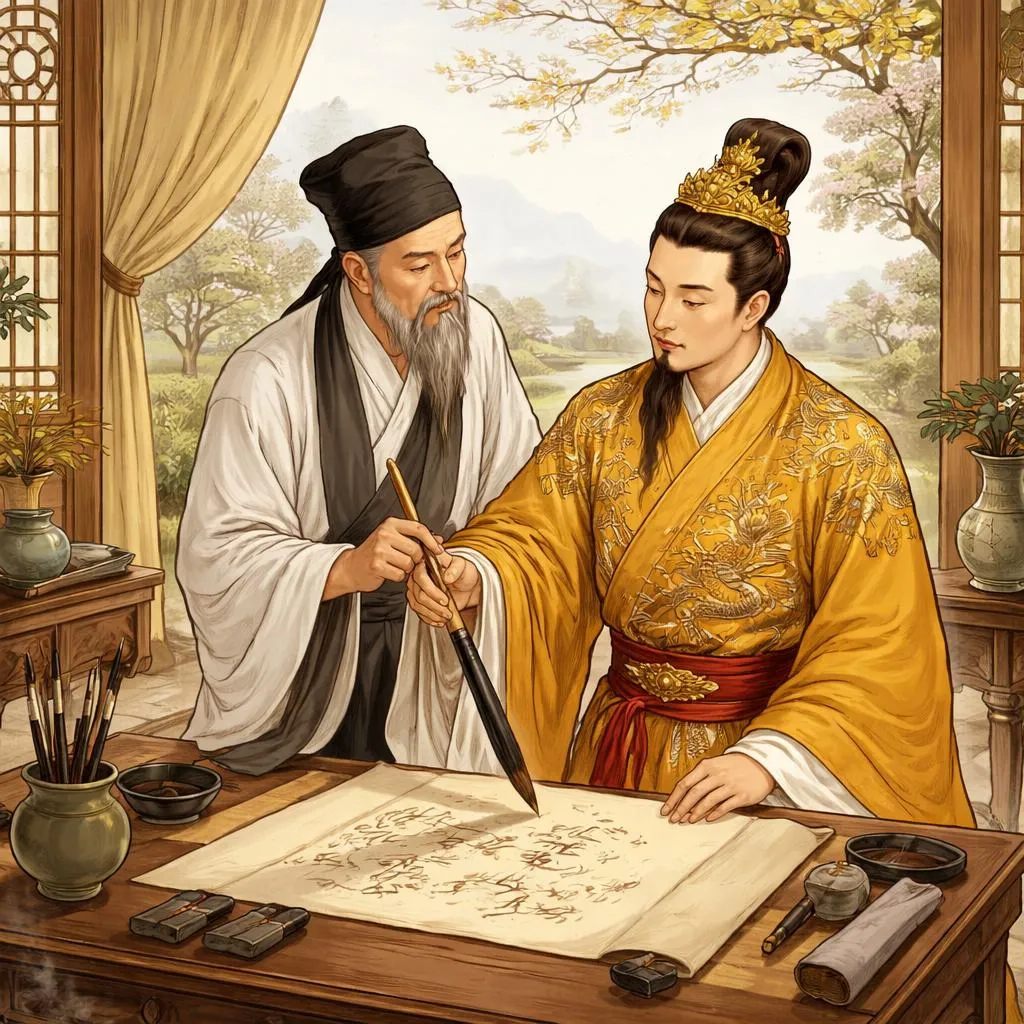

Who Is This Celebrity?
Liu Gongquan was one of the greatest calligraphers in Chinese history. He lived about 1,200 years ago during the Tang Dynasty. People called his writing the "Willow Style" because his family name meant willow tree. His characters are known for their sharp, clean, and balanced appearance. He served the emperor as a court calligrapher for over 50 years. He once told an emperor that straight writing requires a straight heart. His story shows that art and morality are connected.
Early Life and Childhood
Liu Gongquan was born in 778 CE in Hua County, Shaanxi Province, China. His family were scholars and government officials. His elder brother was already a famous calligrapher. Young Liu grew up surrounded by ink stones and brushes. He loved practicing calligraphy from the age of five. He would write characters on any surface he could find. He also enjoyed studying history and poetry. His father told him stories of loyal officials who died for their principles. He dreamed of becoming a great calligrapher and a good official. He wanted his writing to be as straight as his character.
Education and Learning Journey
Liu Gongquan received a top education at home and from private tutors. He studied the Confucian classics, history, and literature. He passed the imperial exams at a young age and became a government official. But his true passion was calligraphy. He studied the works of Wang Xizhi and Yan Zhenqing. He copied their characters thousands of times. He also studied ancient inscriptions on stone. He was not satisfied with copying. He wanted to create a style that was uniquely his own. He experimented with different brush pressures and angles. He found that holding the brush very straight created clean, sharp lines. He practiced for decades until his hand moved without thinking.
How Did They Become Successful?
Liu Gongquan became successful because of his clean and balanced style. The emperor heard about his calligraphy and summoned him to the capital. Liu became a court calligrapher, one of the highest honors for an artist. He spent over 50 years in the imperial court, serving several emperors. He wrote inscriptions for temples, monuments, and official documents. His calligraphy became famous across China. People commissioned him for important works. They paid him large sums of money. Liu gave most of this money to his relatives and to charity. He lived simply despite his fame. He spent his days practicing and teaching.
Big Ideas and Achievements
Liu Gongquan's biggest achievement was creating the "Liu Style" of calligraphy. His characters are thin, sharp, and perfectly balanced. They look like steel needles wrapped in silk. His style is the opposite of Yan Zhenqing's bold, muscular characters. Together, the Yan and Liu styles are the two most copied styles in Chinese history. Every calligraphy student learns both. Liu also taught an emperor a famous lesson. The emperor asked him, "How can I improve my calligraphy?" Liu replied, "Straight writing requires a straight heart. If your heart is straight, your writing will be straight." The emperor understood that Liu was also advising him to rule fairly. This story became a famous saying in China.
Challenges and Difficult Times
Liu Gongquan lived through a period of decline in the Tang Dynasty. Emperors came and went. Powerful eunuchs and generals fought for control. Many officials were killed or exiled. Liu survived by focusing on his art. He avoided political factions and refused to join conspiracies. He served every emperor with equal loyalty. He also faced the challenge of protecting his reputation. Some jealous officials accused him of corruption. Liu did not defend himself with words. He continued writing beautiful calligraphy. His work spoke for itself. He also faced the challenge of old age. He continued practicing even as his hands shook. He never stopped learning.
Fun Facts About the Celebrity
Liu Gongquan loved eating fresh walnuts. He believed they strengthened his memory. He also enjoyed drinking tea made from wild mint leaves. He never ate spicy food. He believed spice made his hand unsteady. He kept a small garden where he grew bamboo. He loved watching bamboo sway in the wind. He believed it taught him flexibility. He also loved playing a board game called Go. He played against other court officials to sharpen his mind. He never wore the fancy silk robes of a court official. He preferred simple cotton robes. He kept a pet crane that walked around his studio. He believed the crane's graceful movements inspired his brushwork.
Why Is This Celebrity Important Today?
Liu Gongquan's calligraphy style is still taught in Chinese schools. Students spend months learning the "Liu Style" strokes. His characters appear on signs, monuments, and computer fonts. His saying "straight writing requires a straight heart" is quoted in ethics classes. It reminds people that art reflects character. Museums in China, Japan, and Taiwan hold his original works. His most famous piece, "The Inscription on the Mysterious Pagoda," is a national treasure. His influence spread to Japan and Korea, where calligraphers also study his style. He represents the ideal of the artist who maintains integrity in corrupt times. His name is synonymous with clean, precise, and honest work.
What Can Kids Learn from This Story?
You can learn that practice must continue for decades. Liu practiced for over 50 years as a court calligrapher. You can also learn that your art reflects who you are. He told the emperor a straight heart makes straight writing. You can learn to stay out of drama and focus on your work. He survived political chaos by focusing on calligraphy. You can learn to give away your money. He earned fortunes but gave most of it away. You can also learn that old age does not stop an artist. He practiced until his hands shook.
Quick Quiz or Practice Time
Let's see what you remember about Liu Gongquan.
Question 1: What did Liu Gongquan say that straight writing requires?
Answer: A straight heart.
Question 2: What style of calligraphy is Liu Gongquan famous for creating?
Answer: The Liu Style (Willow Style).
Question 3: What food did Liu Gongquan love eating because he believed it strengthened his memory?
Answer: Fresh walnuts.
Question 4: What animal did Liu Gongquan keep in his studio?
Answer: A pet crane.
Question 5: How many years did Liu Gongquan serve as a court calligrapher?
Answer: Over 50 years.
Activity: Practice writing a single straight line with a pen or marker. Try to make it perfectly straight without a ruler. Then write a second line, but this time think about being honest and focused. Notice if the second line looks better. This is what Liu Gongquan meant about straight heart and straight writing. Draw a picture of Liu teaching the emperor.
Liu Gongquan lived through the slow death of a dynasty. He saw emperors murdered and capitals sacked. He saw friends exiled and enemies promoted. He could have played politics. He could have flattered the powerful. He could have built a faction and fought for power. Instead, he held a brush. He dipped it in ink. He painted character after character, stroke after stroke, line after line. He made each one straight, clean, and balanced. He let his art be his legacy. He let his integrity be his protection. When the emperor asked how to write better, Liu told him the truth. Straight writing requires a straight heart. The emperor could have been angry. He was not. He understood that Liu was not just talking about calligraphy. He was talking about ruling. He was talking about living. He was talking about being human. Liu's story teaches us that the small things reveal the big things. How you hold a brush shows how you hold your life. How you write a character shows how you treat people. How you practice art shows how you practice virtue. Liu Gongquan knew this. He lived it for 50 years in a corrupt court. His writing stayed straight because his heart stayed straight. Now hold your pen. Write a straight line. Then ask yourself if your heart is straight too. That is the lesson of Liu Gongquan. That is your lesson today.