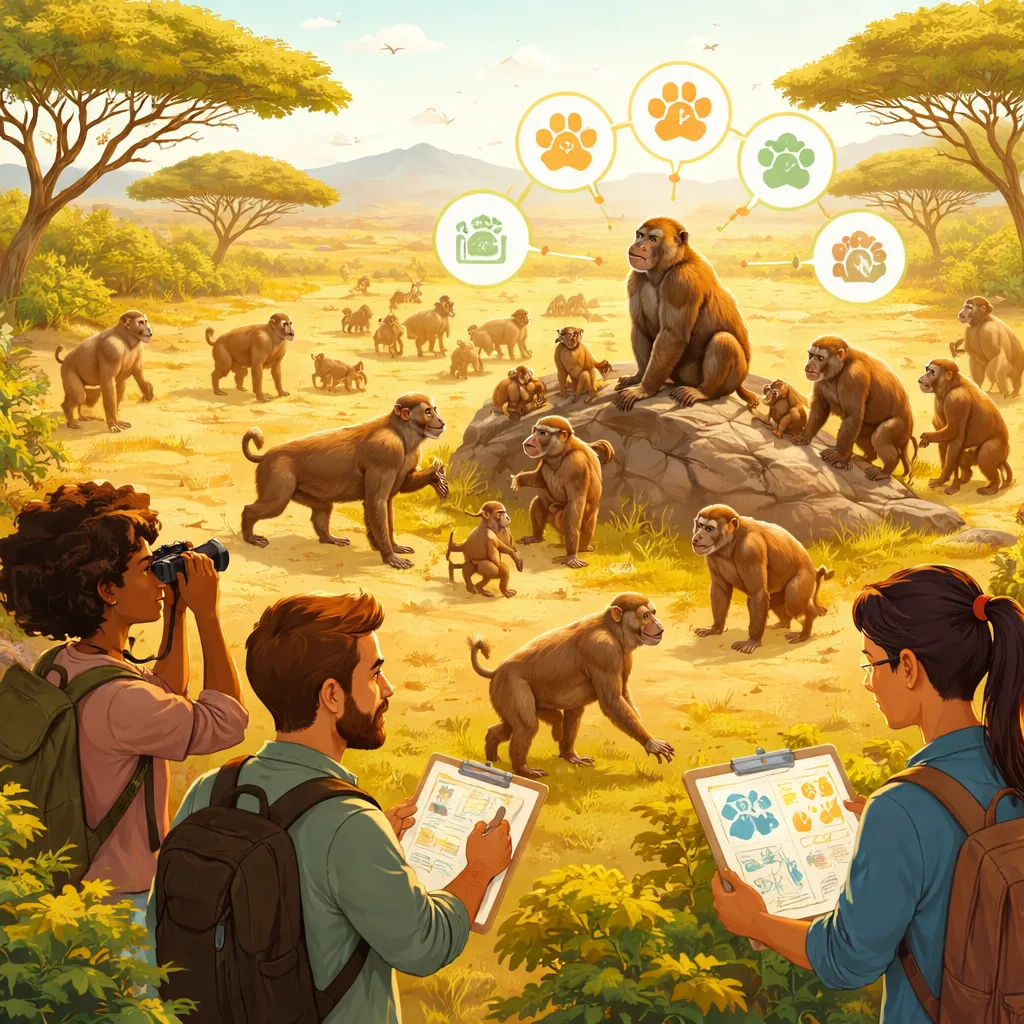

Imagine you’re watching a nature show and see a group of animals with dog-like faces and long tails, sitting together and chattering. They might be baboons! These clever, social monkeys live in large groups and are full of energy. Learning about baboons is a fascinating adventure that takes us to the African savannas. Let’s get ready to start our journey of learning about baboon life and society.
English Language Learning
Vocabulary and Spelling Our social monkey friend is called a baboon. The word "baboon" is a noun. A noun names a person, place, or thing. So, a baboon is a thing—a clever, living animal. Spelling "baboon" is fun: B-A-B-O-O-N. The 'B' starts the word, the 'A' is in the middle, and it ends with two 'O's and an 'N'. B-A-B-O-O-N spells baboon.
Sound and Pronunciation Let’s say the word correctly. It sounds like this: /bæˈbuːn/. We can say it in two clear parts. First, say "ba". It rhymes with "cat" but with a 'b'. Next, say "boon". It rhymes with "moon" or "spoon". Now, put it together! "Ba" "boon". Baboon! Great! The word "baboon" has two beats, or two syllables. Clap your hands twice: Ba-boon. It’s a fun, bouncing word.
Related Words Learning about baboons is more fun with new words! Here are some important ones. Group: A baboon family group is called a troop. A baby baboon is called an infant. Action: Baboons spend a lot of time grooming each other, which means cleaning fur. It is a way to be friendly and social. Home: The open, grassy land where baboons live is called the savanna.
A Famous Saying People sometimes say: "As social as a baboon." This is because baboons live in very large, complex groups where everyone has a role. It’s a way to describe someone who is very good at living and working with others. Say the saying with me: "As social as a baboon." It’s a compliment for being a team player!
Now you know the word "baboon"! Are you ready to learn about their amazing troop life? Let’s travel from words to wonderful knowledge!
Animal Knowledge
Who Are They? – Family and Group What kind of animal is a baboon? Baboons are mammals. They have hair, are warm-blooded, and mother baboons feed their babies milk. They are part of the Old World monkey family. Their closest relatives are other monkeys like mandrills and drills. They are not apes; they have tails and are very good at living on the ground.
What Do They Look Like? – Amazing Bodies Baboons are about the size of a large dog. They have a long, dog-like snout, sharp canine teeth, and a long tail. Their fur is usually olive-brown or gray. Male baboons are much bigger than females and have a large mane of hair. Their most famous feature is their bare, colorful bottom. The skin on their bottom is hairless and can be pink, red, or blue. This helps other baboons recognize them easily! They also have hard pads on their bottoms for sitting comfortably. Baboons have special adaptations. They are excellent ground walkers and can also climb trees. Their cheeks have pouches to store food. They have very good eyesight for spotting danger on the open plains.
Where Do They Live and How? – Home and Habits Baboons live in Africa and parts of Arabia. Their homes are savannas, open woodlands, and rocky hills. They need places with some trees and a water source. Baboons are omnivores. This means they eat both plants and animals. They eat fruits, seeds, roots, insects, and sometimes small animals. They are clever foragers and will eat almost anything they can find. Baboons are very social and live in large troops. A troop can have 20 to 200 members! They are active during the day. They spend their time foraging for food, grooming, playing, and watching for predators like lions or leopards.
A Baboon’s Life Story – Growing Up A baby baboon is called an infant. Baboons are mammals, so infants are born live from their mother. A mother baboon usually has one infant at a time. The mother baboon is a very caring parent. The infant clings to her belly for the first few weeks and later rides on her back. Other females in the troop, called "aunts," often help take care of the baby too. Infants are born with black fur and a pink face. They are the center of attention in the troop. They drink their mother’s milk for about six months but start trying solid food much earlier. They stay with their mother for over a year, learning all the social rules of the troop.
How Do They "Talk"? – Communication Baboons talk in many, many ways. They have a whole vocabulary of barks, grunts, screams, and chirps. Different sounds mean different things, like a warning or a friendly call. They use a lot of body language and facial expressions. A stare can be a threat. Showing their long teeth in a "yawn" can be a warning. Grooming is a peaceful way to make friends and relax. Their best senses are their eyesight and hearing. They have excellent vision for seeing far across the savanna. They are also very good at understanding the social signals of other baboons in the troop.
Are They Okay? – Taking Care of Them Most baboon species are common and are not endangered. But they face many challenges living near people. The main threats are losing their habitat to farms and cities, getting hit by cars, and conflicts with people when they raid crops. Sometimes they are hunted. You can be a baboon friend! You can learn about their important role in the ecosystem. If you visit Africa, you can watch them from a safe distance and never feed them. You can support groups that work to protect wild spaces and find ways for people and baboons to live safely side by side.
Life Connections and Inspiration
How to Be With Them – Safety and Love Baboons are wild animals. They are smart and strong, and can be aggressive if they feel threatened. We must always respect them and keep a safe distance. The rule is: Observe from far away and never feed them. If you see a baboon troop in the wild, watch them with binoculars. Never try to touch, feed, or get close to a baboon. Keep your food and belongings secure, as they are clever and will try to take them. Feeding baboons makes them lose their fear of people, which is dangerous for everyone. We show our love by letting them be wild. We can appreciate their complex society from a distance and protect the natural areas they call home.
Super Qualities We Learn from Them Baboons teach us incredible lessons. One super quality is complex social teamwork. Baboons live in a society with rules, friendships, and roles. They work together to find food, raise young, and stay safe. They teach us the importance of cooperation, communication, and being a responsible member of a group. Another quality is adaptable intelligence. Baboons are very smart and can solve problems. They adapt to different environments, from dry deserts to forests. This reminds us to use our intelligence, be flexible, and think of solutions to the challenges we face. Think about it: How can you be a better team player at home, in school, or in sports? How can you use your smarts to solve a problem in a new way?
Take Action! – Your "Baboon Troop" Project Let’s do a social and creative activity! Your project is to create a chart of a baboon troop’s social roles. On a large piece of paper, draw a circle for the troop. Inside, draw different baboons and label their jobs: The big male leader who watches for danger, the mothers caring for infants, the playful youngsters, and the "aunts" helping. Draw lines connecting them to show how they work together. Write one thing each role does for the troop. This shows how every member is important for the group’s success.
Closing Learning about baboon society is a thrilling adventure! We learned the word "baboon" and how to say its two-part name. We discovered amazing facts about their social troops, their clever communication, and their life on the savanna. We know that baboons are intelligent, adaptable animals who teach us about teamwork and community. You can use your new words to share the story of these social monkeys. You can use your knowledge to appreciate the importance of every member in a group, whether in a family, a class, or a team. The animal world is full of smart and social teachers. Always remember to respect wildlife from a safe distance, be a great team player, and use your intelligence to adapt and solve problems. Keep exploring with curiosity, value your friends and community, and be a friend to the wild. Your thoughtful actions and social spirit make you a true friend to the amazing baboon.