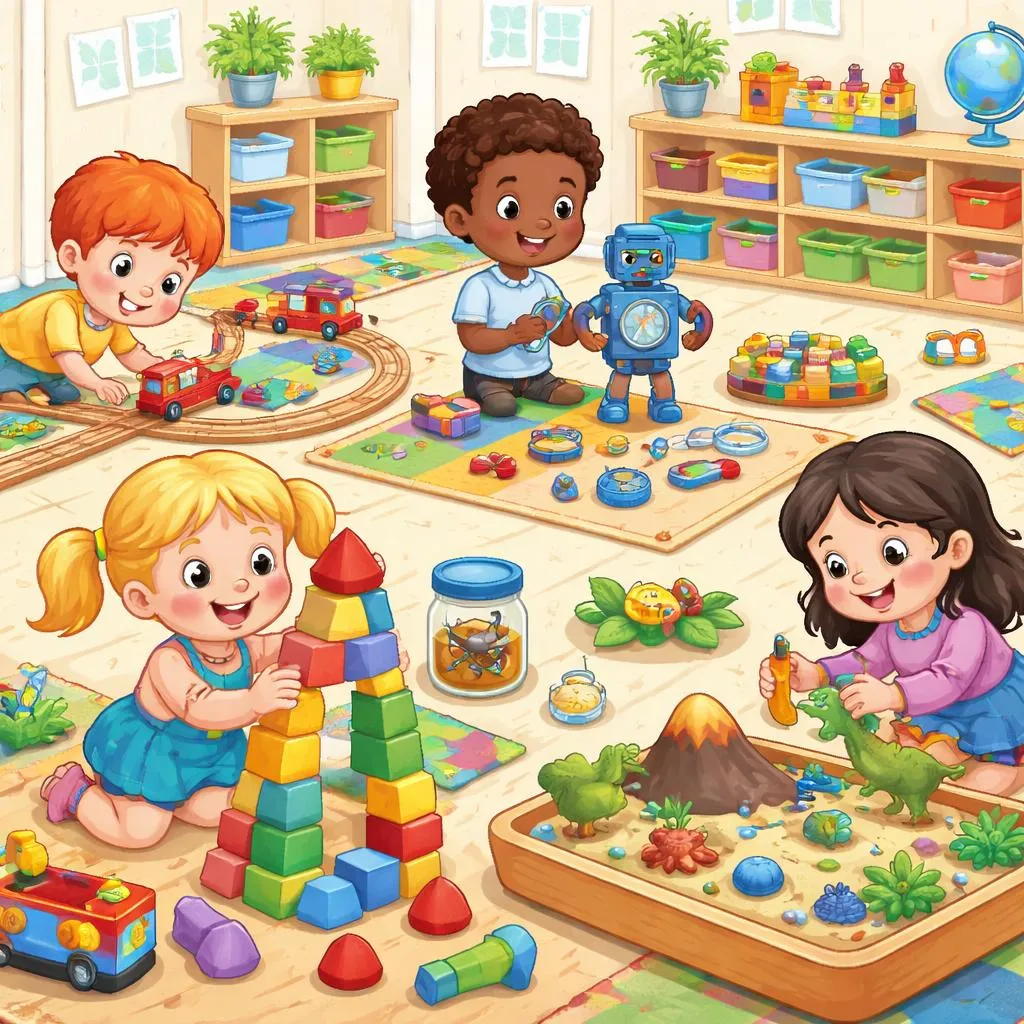

Toys fill children's worlds with joy and discovery. From stuffed animals to building blocks, each toy offers something special. But toys are more than just fun. They are powerful tools for learning. Exploring all kinds of toys helps children build vocabulary, develop social skills, and understand the world. Different toys teach different things. Some build fine motor skills. Some spark imagination. Some teach problem solving. Let us discover how to use toys as learning tools in the young learners' classroom.
What Are All Kinds of Toys? Toys are objects children play with. They come in countless forms. Each type of toy serves a different purpose in child development.
Toys for imagination: Dolls, action figures, puppets, play kitchens, tool sets. These toys let children create stories and act out scenes from life.
Toys for building: Blocks, LEGO, magnetic tiles, construction sets. These toys help children understand how things fit together.
Toys for moving: Balls, bikes, jump ropes, scooters. These toys get children active and develop physical skills.
Toys for thinking: Puzzles, memory games, matching cards, board games. These toys challenge the mind and build problem-solving skills.
Toys for creating: Crayons, paint, clay, playdough, craft supplies. These toys let children express themselves artistically.
Toys for pretending: Dress-up clothes, costumes, props, play money. These toys help children explore different roles and situations.
Toys for learning: Alphabet blocks, number puzzles, shape sorters, educational games. These toys teach specific skills while children play.
Toys for comfort: Stuffed animals, soft blankets, loveys. These toys provide emotional security.
In the classroom, having many types of toys ensures all children find something that interests them. Each child learns differently. Different toys meet different needs.
Categories of Toys for Learning Organizing toys into categories helps teachers understand their educational value. Here are useful categories with examples.
Dramatic play toys: Dolls and dollhouses Action figures and superheroes Puppets and puppet theaters Play kitchens and food Doctor kits and tool sets Dress-up clothes and costumes Cash registers and play money
These toys develop imagination, language, and social skills. Children act out real-life situations. They practice conversations. They learn about different roles.
Construction toys: Wooden blocks of all sizes LEGO and building bricks Magnetic tiles Lincoln Logs Gears and pulleys Train sets and tracks
These toys develop spatial reasoning, problem solving, and fine motor skills. Children learn about balance, stability, and how things fit together.
Manipulative toys: Puzzles of all kinds Shape sorters Beads for stringing Lacing cards Nuts and bolts sets Pattern blocks Playdough and clay
These toys develop fine motor skills, hand-eye coordination, and concentration. Children learn to use their hands with control.
Active play toys: Balls of different sizes Jump ropes Hula hoops Bean bags for tossing Balance beams Tricycles and scooters Parachutes for group play
These toys develop gross motor skills, coordination, and physical confidence. Children learn to move their bodies in different ways.
Sensory toys: Sand and water tables Sensory bins with rice or beans Playdough and clay Finger paints Water beads Texture balls Musical instruments
These toys develop sensory awareness and calm the nervous system. Children explore through touch, sight, and sound.
Games and puzzles: Board games for young children Matching games Memory cards Dominoes Simple card games Floor puzzles Cooperative games
These toys develop turn-taking, following rules, and strategic thinking. Children learn to play with others.
Art and creativity toys: Crayons and markers Paint and brushes Playdough and clay Collage materials Stickers and stamps Easels and paper Modeling clay
These toys develop creative expression and fine motor skills. Children learn to represent their ideas visually.
STEM toys: Simple magnets Magnifying glasses Balance scales Building sets with gears Simple machines Coding toys for beginners Science kits
These toys develop curiosity about how the world works. Children explore scientific and mathematical concepts.
Daily Life Examples with Toys Toys appear in every part of children's lives. Here are examples of how toys connect to daily experiences.
Morning choice time: Children choose activities during free play. Some go to the block corner. Some play with dolls. Some do puzzles. Each choice reflects their interests and needs.
Dramatic play center: The play kitchen is busy today. Children pretend to cook breakfast. They use pots and pans. They serve food to dolls. They practice words like "plate," "cup," and "spoon."
Block area: Children build a tall tower with wooden blocks. They learn about balance. When it falls, they try again. They learn that problems can be solved.
Art table: Children use playdough to make snakes and balls. They roll and shape the dough. Their hands get stronger. They learn that materials can change shape.
Sensory bin: The rice bin has scoops and containers. Children pour and measure. They feel the rice on their hands. They learn about volume and texture.
Outdoor play: Children throw balls to each other. They learn to aim and catch. They take turns. They learn that playing together requires cooperation.
Clean-up time: All toys go back to their places. Blocks on the shelf. Dolls in the basket. Puzzles on the rack. Children learn responsibility and organization.
Story time connection: The teacher reads a book about a bear. Children find their teddy bears. They hug them while listening. They learn that stories connect to real things.
Printable Flashcards for Toys Flashcards help children learn toy names and categories. Here are ideas for creating and using them.
Basic toy cards: Create cards with clear pictures of common toys. Doll, ball, blocks, puzzle, car, truck, teddy bear, book. Write the name below each picture.
Category sorting cards: Create cards for different toy categories. Dramatic play, construction, active play, art, games. Children sort toy pictures into the correct category.
Action cards: Create cards showing children playing with toys. A child building with blocks. A child throwing a ball. A child hugging a doll. Children describe what they see.
Matching cards: Create two sets of toy cards. Children play memory match, finding pairs. When they make a match, they name the toy and say something about it.
Description cards: Create cards with simple descriptions. "I am soft. Children hug me. What am I?" Children guess "teddy bear!" This builds listening and thinking skills.
Store cards: Create cards for a pretend toy store. Each card shows a toy with a price. Children "buy" toys using play money. This builds math and language skills.
Laminate the cards for durability. Keep them in a pocket chart for easy access. Use them for games, sorting, and vocabulary building.
Learning Activities with Toys Toys become powerful learning tools when used intentionally. Here are activities using different kinds of toys.
Toy Sort: Gather a collection of different toys. Children sort them into categories. Soft toys here. Hard toys there. Toys with wheels. Toys for building. This builds classification skills.
Toy Store: Set up a pretend toy store. Children take turns being the shopkeeper and customers. Customers ask for specific toys. "Do you have a doll?" "How much is the ball?" This builds language and social skills.
Toy Graph: Choose three or four toys. Ask children which one they like best. Create a graph showing preferences. Count how many children chose each toy. This builds math skills.
Toy Description Game: Place a toy in a bag without showing it. Children reach in and feel. They describe what they feel. "It is soft." "It has fur." "It has ears." Others guess the toy.
Toy Building Challenge: Give children blocks or LEGO. Give a challenge. "Build the tallest tower you can." "Build a house for the doll." "Build a bridge for the car." This builds problem-solving skills.
Toy Parade: Children choose their favorite toy from home or classroom. They walk in a parade showing their toys. They tell one thing about their toy. This builds confidence and language.
Toy Memory: Place several toys on a tray. Children look carefully. Cover the tray and remove one toy. Children guess which toy is missing. This builds observation and memory.
Toy Stories: Children use toys to tell stories. A doll and a bear can have an adventure. A car and a truck can go on a trip. This builds narrative skills and imagination.
Educational Games with Toys Games make learning with toys even more engaging. Here are games using different kinds of toys.
Toy Bingo: Create bingo cards with pictures of toys. Call out toy names. Children cover the matching picture. First to cover a row wins. This builds listening and vocabulary.
Toy Hunt: Hide small toys around the classroom. Give children a list of toys to find. "Find something soft." "Find something with wheels." "Find something red." This builds observation and classification.
Toy Charades: Act out playing with a toy without speaking. Pretend to throw a ball. Pretend to build with blocks. Pretend to hug a doll. Children guess the toy. This builds nonverbal communication.
Toy Freeze Dance: Play music while children dance with toys. When the music stops, they freeze with their toy. Anyone who moves is out. This builds listening and self-control.
Toy Pass: Sit in a circle with a toy. Play music while children pass the toy around. When the music stops, the child holding the toy names it and says one thing about it. This builds quick thinking.
Toy Memory Game: Place pairs of small toys in a bag. Children reach in and try to find matching toys by feel alone. This builds tactile discrimination.
Toy Sorting Relay: Place two hoops on the floor. Label them with categories. "Toys for inside" and "Toys for outside." Children run to a pile of toy cards, grab one, and place it in the correct hoop. This builds quick categorization.
Connecting Toys to Other Learning Toys connect naturally to many curriculum areas. Here are ways to extend learning.
Math with toys: Count toys. Sort toys by size or color. Make patterns with toys. Measure with blocks. Graph favorite toys. Toys make math concrete and fun.
Literacy with toys: Read books about toys. Write stories about toys. Label toy shelves. Make signs for the toy store. Toys provide real reasons to read and write.
Science with toys: Explore how cars roll down ramps. Test which balls bounce highest. See what floats in the water table. Toys become science tools.
Social studies with toys: Talk about toys from long ago. Learn about toys in other countries. Discuss how toys are made. Toys connect to history and culture.
Art with toys: Draw favorite toys. Make toys from clay. Create toy sculptures. Decorate toy boxes. Toys inspire creativity.
Music with toys: Sing songs about toys. Make instruments from toy materials. Move like different toys. Toys connect to rhythm and sound.
Social skills with toys: Share toys with friends. Take turns with popular toys. Solve problems when someone wants the same toy. Toys teach important life lessons.
Using Toys for Language Development Toys are perfect for building language skills. Here are ways to use toys for vocabulary and conversation.
New words: Introduce vocabulary for different toys. Doll, action figure, block, puzzle, marble, top, yoyo. Each toy has a name.
Descriptive words: Talk about toy attributes. Soft, hard, rough, smooth, big, small, heavy, light, colorful, plain.
Action words: Describe what children do with toys. Build, throw, catch, roll, stack, sort, hug, carry, push, pull.
Position words: Talk about where toys are. In the box, on the shelf, under the table, next to the doll, between the blocks.
Conversation starters: Ask about favorite toys. "What is your favorite toy?" "Why do you like it?" "Who gave it to you?" "Where do you play with it?"
Storytelling: Encourage children to tell stories with toys. "Tell me what your doll did today." "What adventure will the car have?"
Problem-solving language: When toy conflicts arise, use language to solve them. "How can we share this toy?" "What could we do so everyone gets a turn?"
Toys are the work of childhood. Through play with all kinds of toys, children learn about themselves and their world. They build skills they will use for life. They make friends and solve problems. They imagine and create. In the classroom, toys are not just for fun. They are essential learning tools. By understanding the value of different toys, teachers can create rich play experiences. Children grow and learn while doing what they love most. And that is the magic of play.