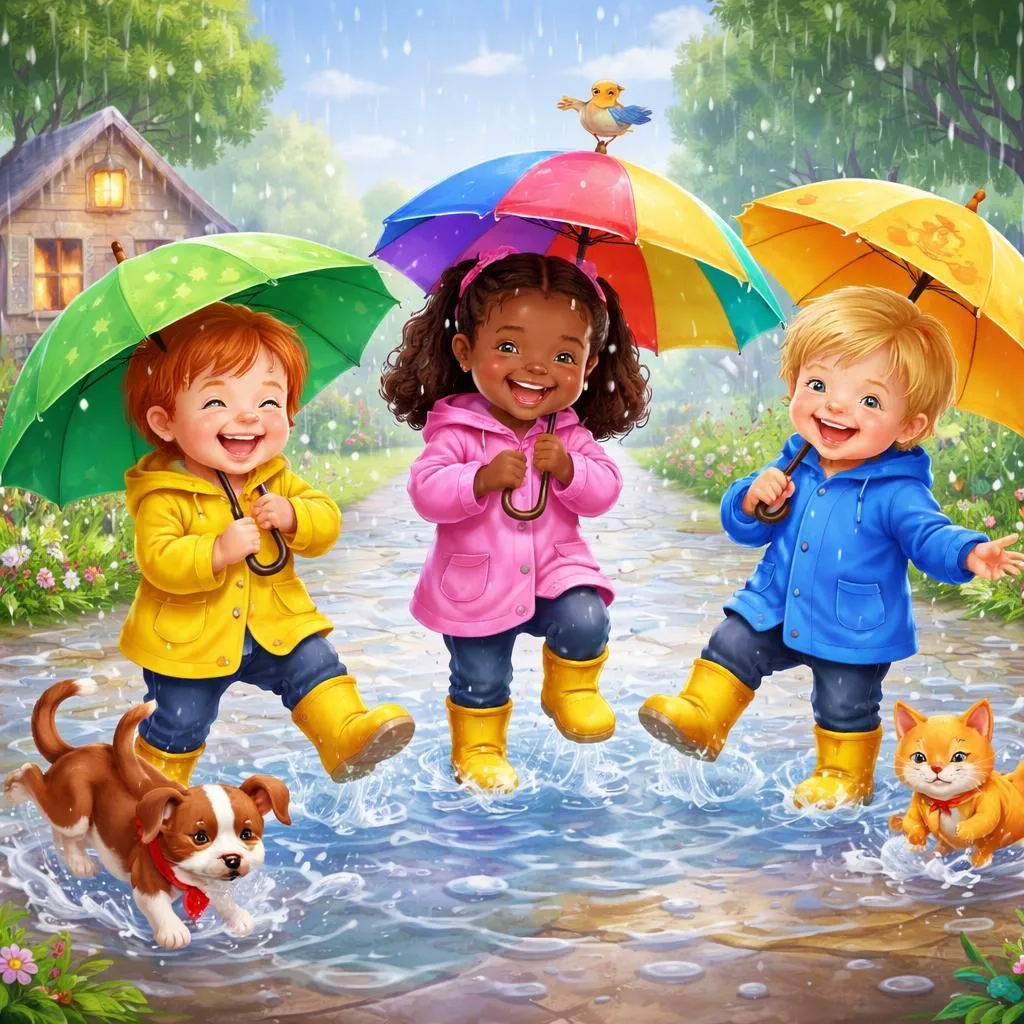

Hello, everyone! Today we explore a very old song. It is about weather. It is about an old man. It is about sleeping. The song is called "Raining and Pouring".
This rhyme has been around for a long time. Grandparents sang it. Parents sang it. Now children sing it. The words are simple. The tune is easy. The story is a little funny.
As a teacher, I love using weather songs. Weather is part of every day. Children experience rain. They see puddles. They hear thunder. Songs about weather connect to their world. Let us discover the raining and pouring song together.
What Is the "Raining and Pouring" Rhyme? This is a traditional nursery rhyme. It describes a rainy day. It tells about an old man who snored. He bumped his head. He could not get up in the morning.
The rhyme has a gentle rhythm. It feels like rain falling. It feels like a lullaby. Children enjoy the sounds. They enjoy the silly story about the old man.
Some people call it "It's Raining, It's Pouring". The words are almost the same. Both versions talk about rain and an old man. Both are popular with young children.
The rhyme is short. Children can learn it quickly. They can sing it on rainy days. They can sing it anytime. It brings weather words into their vocabulary in a natural way.
The Lyrics of the Nursery Rhyme Let us look at the complete lyrics. I will write them clearly. Then we can talk about each part.
It's raining, it's pouring. The old man is snoring. He went to bed and bumped his head And couldn't get up in the morning.
These are the traditional words. Some versions have more verses. But this is the main one. This is what most children know.
The rhyme has four lines. The first two lines rhyme. Pouring and snoring sound alike. The last two lines rhyme too. Head and morning? They do not rhyme perfectly. But in some accents, they sound close. Morning sounds like "mornin'" and that rhymes with head? Not really. This is an imperfect rhyme. Children still love it.
The words tell a little story. Rain is falling hard. An old man is sleeping loudly. He went to bed somehow and hit his head. Then he could not wake up. It is a bit mysterious. Where did he bump his head? Why can't he get up? Children wonder about these things.
Vocabulary Learning from the Song This rhyme teaches many useful words. Let us learn them.
Raining means water falling from the sky. Rain comes from clouds. Rain makes things wet. Rain helps plants grow. Children know rain from their own experience. They see it out the window. They feel it on their skin.
Pouring means raining very hard. Not just a little rain. A lot of rain. Fast rain. Heavy rain. When it pours, you get wet quickly. You need an umbrella. You might stay inside. Pouring is stronger than raining.
Old describes something with many years. An old person has lived a long time. An old toy has been played with for years. An old house was built long ago. The man in the song is old. This tells us something about him.
Man means a grown male person. A boy grows into a man. Men can be fathers, grandfathers, teachers. This song has an old man. Children can picture him.
Snoring means making noise while sleeping. Some people snore loudly. Some people snore softly. Air moves through the nose and mouth. It makes a sound. The old man in the song is snoring. He is sleeping deeply.
Went is the past tense of go. He went to bed means he moved to his bed. This happened before. It is finished now.
Bed is where people sleep. Beds have mattresses and pillows. Children have beds. They go to bed every night. This word is very familiar.
Bumped means hit something by accident. You bump your elbow on a door. You bump your knee on a table. The old man bumped his head. It was an accident. It probably hurt.
Head is the top part of the body. The head has the face, the brain, the hair. We wear hats on our heads. We think with our heads. The old man bumped his head.
Couldn't means could not. It shows something was impossible. He could not get up. He tried but he could not. Something stopped him.
Get up means to leave the bed. To stand up. To start the day. In the morning, we get up. But the old man could not.
Morning is the early part of the day. After night comes morning. The sun rises. People wake up. Birds sing. But the old man stayed in bed.
These words are all useful. Children can use them in daily talk. They can talk about rain. They can talk about sleeping. They can talk about accidents. The song gives them language for real situations.
Phonics Points in the Song Now let us look at the sounds. Phonics helps children read. It helps them hear sounds in words.
The "AIN" Sound in Raining Raining has the "ain" sound. This is the same sound in train and pain. Say it with me: ain. Raining. The letters "ai" together make this sound. Children learn this pattern. They can read rain, train, main.
The "OR" Sound in Pouring Pouring has the "or" sound. This is the same sound in door and more. Say it: or. Pouring. The letters "ou" here make the "or" sound. This is a little tricky. English has many spellings for the same sound.
The "O" Sound in Old Old has the long "o" sound. This is the same sound in gold and cold. Say it: o. Old. The letters "ol" together make this long o sound. Children learn that o can be long or short.
The "ORE" Sound in Snoring Snoring has the "ore" sound. This is the same sound in store and more. Say it: ore. Snoring. This is very similar to the "or" sound. They are almost the same.
The "ED" Sound in Bumped Bumped ends with "ed". But it sounds like "t". Say bumped. The e is silent. The ed says "t". This happens with many past tense verbs. Walked sounds like walkt. Jumped sounds like jumpt. Children learn that ed can sound different.
The "OU" Sound in Couldn't Couldn't has the "ou" sound. This is the same sound in would and should. Say it: ou. Could. The letters "ou" here make a special sound. It is different from the "ou" in pouring. English is full of these differences.
Grammar Patterns in the Song This rhyme teaches grammar too. Let us look at the patterns.
Present Continuous Tense The song starts with "It's raining, it's pouring". This is present continuous tense. It means the action is happening now. Right at this moment. Rain is falling. We use this tense for things in progress.
Children learn to describe current weather. "It is raining." "It is snowing." "The sun is shining." This is a very useful pattern. They can talk about what they see outside the window.
Descriptive Adjectives The song uses "old" to describe the man. Adjectives describe nouns. Old man. Red apple. Big house. Children learn to add describing words to their sentences. This makes their language richer.
Past Tense Verbs The song uses "went" and "bumped". These are past tense. They tell about things that already happened. He went to bed. He bumped his head. This happened before now. Children learn to talk about yesterday, last week, last year.
Negative Contractions The song uses "couldn't". This is a contraction. It combines could and not. English uses many contractions. Don't, won't, can't, isn't. Children learn these short forms. They sound more natural in conversation.
Prepositional Phrases The song uses "in the morning". This is a prepositional phrase. It tells us when. In the morning, in the afternoon, at night. Children learn to add time words to their sentences. This makes their meaning clearer.
Learning Activities for the Song Here are activities to use with this rhyme.
Activity 1: Rainy Day Window Watch On a rainy day, stand by the window. Watch the rain together. Is it raining? Is it pouring? Use the words from the song. Talk about what you see. Puddles forming. People with umbrellas. Cars with wipers moving.
Activity 2: Make Rain Sounds Use hands and feet to make rain sounds. Rub hands together for light rain. Pat legs for medium rain. Stomp feet for heavy rain. Clap for thunder. Say the rhyme while making sounds. This connects words to physical experience.
Activity 3: Draw the Story Give children paper and crayons. Ask them to draw the old man. Where is he? In bed? Is it raining outside the window? Is he snoring? Show his bumped head. Drawing helps children imagine the story. It makes it their own.
Activity 4: Act It Out Children pretend to be the old man. They go to bed. They snore loudly. They bump their head. They try to get up but cannot. Other children can be the rain, making soft sounds. This brings the rhyme to life.
Activity 5: Weather Chart Make a weekly weather chart. Each day, look outside. Draw the weather. Sunny, cloudy, rainy, pouring. Use the words from the song. At the end of the week, count how many rainy days. This combines weather words with counting.
Activity 6: Safety Talk Talk about bumping heads. What happens when someone falls? What should we do? How can we be safe? This connects the song to health and safety lessons. Children learn to be careful.
Printable Materials for the Song Here are materials teachers can make.
Flashcards Make picture cards for each key word. Rain, pour, old man, snore, bed, head, morning. Show the card. Say the word. Have children repeat. Use them to retell the story in order.
Mini Book Fold paper to make a small book. Each page has one line from the rhyme. Children draw the pictures. Page one: It's raining, it's pouring. Page two: The old man is snoring. They now have their own book to read.
Word Search Make a simple word search with words from the song. Rain, pour, old, man, bed, head, morning. Children find and circle the words. This builds word recognition.
Coloring Page Draw a simple picture of the old man in bed. Rain outside the window. Children color it. While coloring, talk about the rhyme. Ask questions. What is the weather? What is the old man doing?
Sentence Strips Write each line on a long strip of paper. Mix them up. Children put them in order. They can read them aloud in the correct sequence. This builds reading and sequencing skills.
Educational Games for the Song Games make learning fun. Here are some games.
Game 1: Rainy Day Freeze Play music or sing the rhyme. Children move around like rain falling. When the music stops, they freeze. The teacher asks a question. "What is the weather?" Children answer "Raining!" Then music starts again.
Game 2: Old Man Says This is like Simon Says. The leader says "Old man says go to bed." Children pretend to go to bed. If the leader just says "Go to bed" without "Old man says", children should not move. This teaches listening.
Game 3: Rhyme Match Make cards with words from the song. Find words that rhyme. Rain and pain. Pour and door. Old and cold. Head and bed. Morning and warning. Children match the rhyming pairs. This builds phonemic awareness.
Game 4: Story Sequence Cards Make picture cards of the story. Rain falling. Old man in bed snoring. Old man bumping head. Old man cannot get up. Mix them up. Children put them in story order. This builds comprehension.
Game 5: Weather Charades Act out different weather. Rain falling. Wind blowing. Sun shining. Snow falling. Children guess the weather. Then they say the rhyme if the weather is rain. This connects actions to words.
Game 6: What's Missing? Put several picture cards on a tray. Let children look. Cover the tray. Remove one card. Uncover. Ask "What's missing?" Children guess. This builds observation and vocabulary.
The raining and pouring song is simple but rich. It teaches weather words. It teaches body parts. It teaches daily routines. It teaches past tense. All in just four lines.
Children love this song because it is easy. They love it because it is funny. An old man snoring. Bumping his head. Not getting up. It makes them smile. Laughter helps learning.
Teachers can use this song on rainy days. It matches the weather outside. It gives words to what children see and feel. The song becomes part of their experience.
Parents can sing it at bedtime. The gentle rhythm calms children. The words about sleeping fit the moment. The old man snoring might even make them giggle before sleep.
Every time it rains, children can remember this song. They can look out the window and say "It's raining, it's pouring." They connect English to real weather. This is how language becomes natural.
So let us sing about the rain. Let us sing about the old man. Let us learn and laugh together. The raining and pouring song will keep teaching children for many years to come. Happy singing, everyone