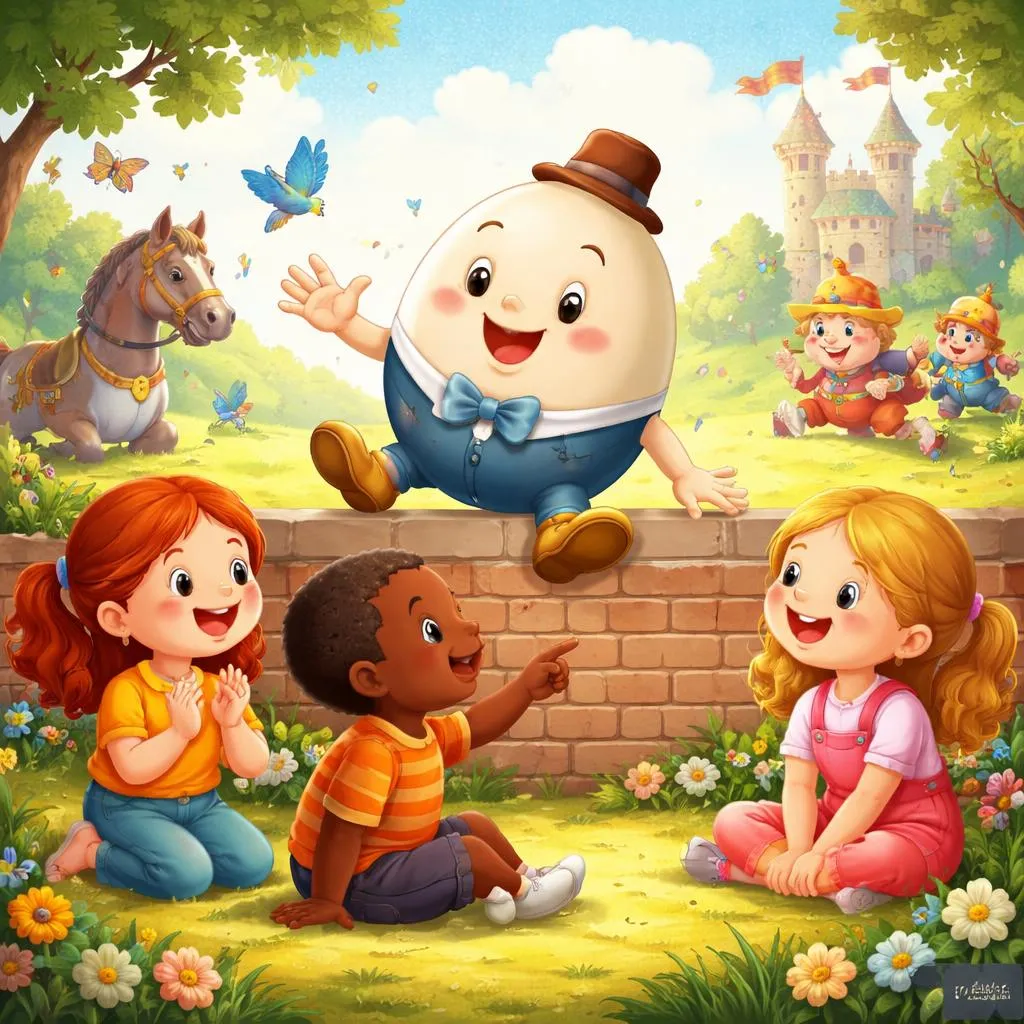

Hello, wonderful learners and teachers! Today, we are going to explore a famous and mysterious tale. We will look at the "humpty dumpty song". This short rhyme tells a complete story with a beginning, middle, and end. It is a perfect tool for learning about the past tense, story sequence, and expressive vocabulary. Let's climb up on the wall and see what lessons we can find.
What is the story? The "humpty dumpty song" is one of the most famous English nursery rhymes. While its exact origins are a mystery, it has been told for centuries. The story presents a simple but dramatic narrative about a character named Humpty Dumpty. He is often pictured as an egg, though the rhyme never says this. He has a terrible accident and cannot be repaired, despite the best efforts of many. The rhyme is brief, rhythmic, and memorable. It teaches children about consequences and the idea that some things cannot be fixed, all within a safe, fictional context. It's a first lesson in storytelling.
The lyrics of nursery rhymes The traditional lyrics of the humpty dumpty song are short and powerful. Here is how they go:
Humpty Dumpty sat on a wall, Humpty Dumpty had a great fall. All the king's horses, And all the king's men, Couldn't put Humpty together again.
The story is told in just five lines. The repetition of "Humpty Dumpty" makes it catchy, and the sad ending makes it unforgettable. This simplicity is what makes it such an effective teaching tool.
Vocabulary learning This short song introduces strong, descriptive words and royal vocabulary.
The name Humpty Dumpty itself is a fun example of a rhyming nickname or character name.
We learn key past tense verbs: sat (past of 'sit') and had a fall (past of 'have a fall'). The adjective great here means "big" or "serious."
The rhyme introduces royal and collective nouns: king, horses, men. "All the king's horses" means his cavalry, and "all the king's men" means his soldiers or servants.
The final line teaches a very useful phrase for inability in the past: "Couldn't put... together again." The phrasal verb put together means to fix or assemble.
Phonics points This rhyme is excellent for practicing specific vowel sounds and clear consonant pronunciation.
The short /ʌ/ sound is featured in "Humpty," "Dumpty," and "together."
The /ɔː/ sound appears in "wall," "all," and "horses."
We can hear consonant blends like the /st/ in the context of the story and the /k/ sound in "couldn't," "king," and "come."
Most importantly, it uses perfect rhyming pairs: wall/fall, and the near-rhyme men/again. Listening for and repeating these rhymes builds phonological awareness.
Grammar patterns This little story is a masterclass in using the simple past tense to narrate an event.
Every main action verb is in the past tense: sat, had, couldn't put. This shows how we talk about completed stories.
It uses the modal verb "could" in the negative past: "couldn't + base verb." This structure expresses inability ("was not able to").
The phrase "All the king's horses and all the king's men" uses "all" for emphasis, teaching a way to say "every single one."
The story has a clear sequence: 1. He sat. 2. He fell. 3. They tried. 4. They failed. This teaches basic story structure and cause-and-effect.
Learning activities We can bring Humpty Dumpty's story to life with fun and educational activities.
-
Story Sequencing Cards: Create four picture cards: 1) Humpty on the wall, 2) Humpty falling, 3) Horses and men arriving, 4) Broken Humpty. Children put them in order and tell the story for each picture.
-
"What If?" Creative Discussion: The ending is sad. What could have happened differently? Brainstorm new endings. "What if he fell on a pillow?" "What if a magic doctor came?" Encourage children to use past or future tense. "The queen came and used magic glue." This builds creative language use.
-
"Safe Seat" Science & Language Activity: Discuss why Humpty fell. Explore the concept of balance and safe places to sit. Build a small wall with blocks and test which objects (a ball, a flat book, an egg-shaped toy) are stable. Use words like high, wall, fall, balance, safe, wobbly.
-
Rhyming Word Expansion: After learning "wall/fall," find other words in the "-all" family (ball, call, tall, small). For "men/again," find the "-en" family (pen, ten, hen, when). Create new silly lines: "Humpty Dumpty played with a ball, then he took a fall."
Printable materials Printable resources can make this a hands-on learning experience.
Create a "My Humpty Dumpty Book" with a page for each line of the rhyme. Children trace the words and draw the illustrations.
Design vocabulary cards with pictures and words: wall, fall, king, horse, man, together. Use them for matching games or to physically build the sentence "Humpty Dumpty sat on a wall."
A "Cut and Paste Story Order" sheet is very effective. Provide the four story images in a jumbled order at the bottom. Children cut them out and glue them in the correct sequence on numbered boxes above.
Provide a "Fix Humpty!" puzzle. Print a picture of Humpty Dumpty cracked into 4-6 large puzzle pieces. Children can color, cut, and glue him back together on another sheet, literally "putting him together again."
Educational games Structured games can deepen understanding of the rhyme's language and themes.
-
"Build the Wall" Syllable Game: Use blocks. Say a word from the rhyme. For each syllable, the child adds a block to a wall. "Humpty" (2 blocks). "Together" (3 blocks). This teaches syllable counting in a tactile way.
-
"The King's Command" Listening Game: One child is the "king" or "queen." They give polite commands starting with "Please" to the "horses and men" (other children). "Please hop twice." The group only follows if the command is polite. This reinforces "please" and connects to the theme.
-
"Could or Couldn't?" Sorting Game: Prepare cards with activities from long ago and now (e.g., "ride a horse," "use a video call"). Children sort them into two piles: "Long ago, people could do this" and "Long ago, people couldn't do this." This solidifies the "could/couldn't" grammar from the rhyme's finale.
The "humpty dumpty song" is a small package filled with big language lessons. It teaches narrative, past tense, rich vocabulary, and the concept of consequences. By exploring this rhyme through song, art, and play, children gain a deeper, more intuitive understanding of how English works to tell a complete story. So, even from a great fall, we can learn great things about words and how to use them.