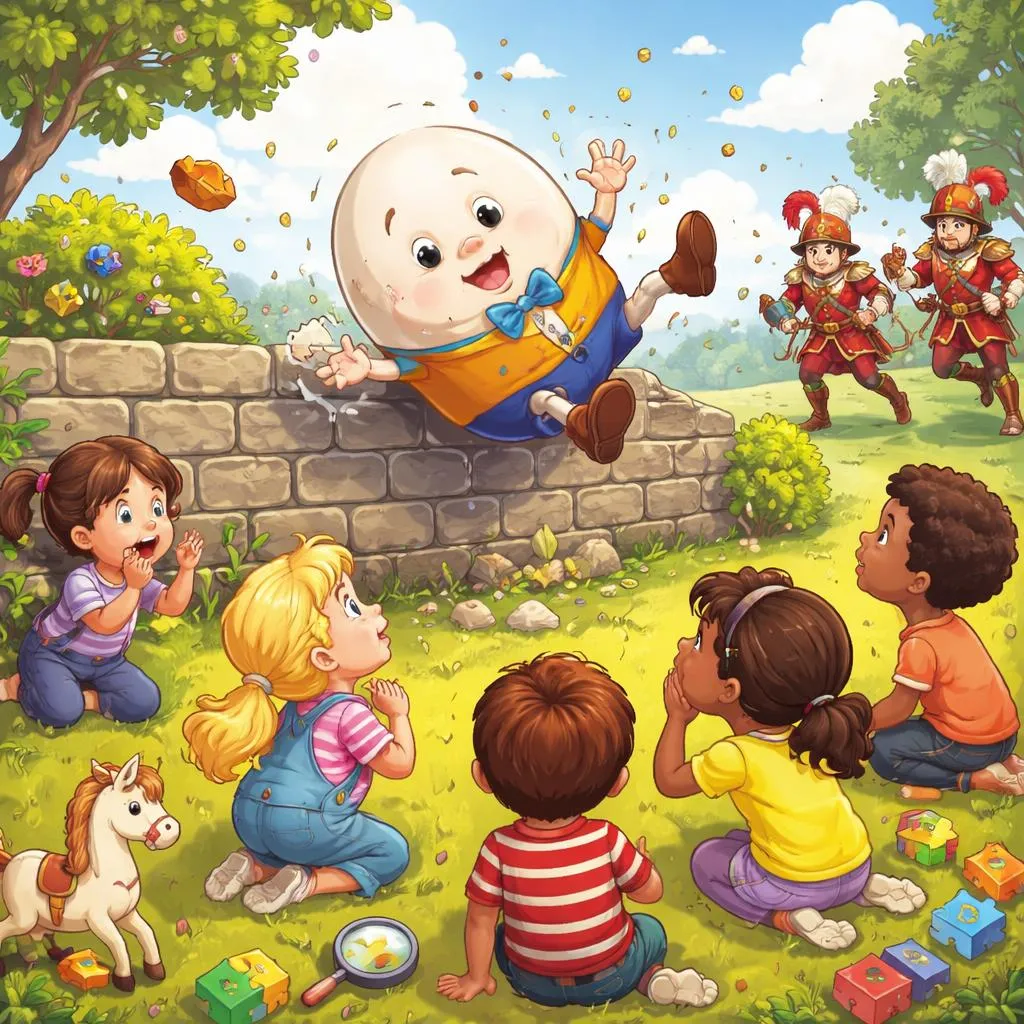

What Is The Story? “Humpty Dumpty” is one of the most famous nursery rhymes in the English language. It tells a very short but dramatic story. The core event of the story is that Humpty Dumpty fell. He sat on a wall, had a great fall, and could not be put back together. This simple sequence makes it an excellent teaching tool. The rhyme is not just a silly poem. It is a mini-narrative with a clear beginning, middle, and end. It introduces cause and effect in a memorable way. The phrase “Humpty Dumpty fell” captures the central action that drives the entire story.
The Lyrics of Nursery Rhymes The traditional lyrics of nursery rhymes for “Humpty Dumpty” are concise and rhythmic. They go: “Humpty Dumpty sat on a wall, Humpty Dumpty had a great fall. All the king’s horses and all the king’s men, couldn’t put Humpty together again.” The lyrics are almost entirely in the simple past tense. This tells us the story is about a completed event. The rhyme uses repetition (“Humpty Dumpty”) and vivid imagery (“all the king’s horses”). The line “Humpty Dumpty fell” is captured in the lyric “had a great fall.” This is a more descriptive way of saying he fell down.
Vocabulary Learning The rhyme introduces specific and useful vocabulary. Key nouns include: wall, fall, king, horses, men. We learn the name Humpty Dumpty. The phrase “Humpty Dumpty fell” gives us the core verb fell (past tense of fall). We can expand this list. We talk about eggs (as Humpty is often depicted), pieces, ground, help. We learn descriptive words: great (big), all. We also learn the negative contraction couldn’t (could not). This builds a small but powerful set of words for talking about accidents, help, and problems.
Phonics Points This rhyme is rich with phonics opportunities. The name “Humpty Dumpty” itself practices the /h/, /m/, /p/, /t/, and /d/ sounds. The short ‘u’ sound in Humpty and Dumpty. The /aw/ sound in wall and fall. The /k/ sound in king and couldn’t. We can highlight the blend /gr/ in great. The rhyme also features alliteration: “horses” and “men” both follow “king’s.” Finding rhyming pairs is key: wall/fall, men/again. Clapping the strong beats (HUMP-ty DUMP-ty) helps children feel the rhythm and syllables of English words.
Grammar Patterns The story of “Humpty Dumpty fell” is a perfect lesson in the simple past tense. Almost every verb is in the past: sat, had (a fall), couldn’t put. This shows how we tell completed stories. It introduces the structure “could not” or “couldn’t” to express inability in the past. The phrase “all the king’s horses” uses the possessive ‘s. We can also practice sequencing words: First, Humpty sat on the wall. Then, he had a great fall. Finally, they couldn’t fix him. This teaches narrative flow and time order.
Learning Activities Interactive activities bring the story to life. Try “Story Re-enactment.” Use a plastic egg as Humpty. Children can act out the sequence: placing him on a block (wall), letting him fall, and trying to tape him together. This makes the past tense verbs physical. Another is “What Happened Next?” Show pictures of the story out of order. Children sequence them and describe each picture in the past tense. “Here, Humpty sat on the wall. Here, he fell.” Also, a “Problem-Solving” discussion: “What could keep Humpty safe? A helmet? A cushion?”
Printable Materials Printable resources support the lesson. Create a “Humpty Dumpty” storyboard. It has three boxes: 1. Humpty on the wall. 2. Humpty falling/broken. 3. The horses and men. Children can draw and write a caption. Design “Vocabulary Cards” with pictures: wall, fall, king, horse, men. A “Past Tense Match” worksheet can have present tense verbs on one side (sit, fall, can) and their past tense matches (sat, fell, could) on the other. Also, provide a broken eggshell outline for children to decorate and “put together” with tape, discussing the word “together.”
Educational Games Games make the vocabulary and grammar fun. Play “Wall or Fall?” Call out words from the rhyme. If it’s something you can sit on (wall, chair, bench), children pretend to sit. If it’s an action word (fall, jump, drop), they pretend to fall safely. “Sequencing Relay” is active. Place three large pictures from the story across the room. Teams race to put them in order and say the line. “Humpty Dumpty Bingo” uses pictures from the story. The caller says a past tense sentence: “He sat on a wall.” Players mark the correct picture.
The story of “Humpty Dumpty fell” is more than a cautionary tale. It is a compact, engaging package for language learning. Its clear past tense narrative teaches children how to structure a story in English. The limited vocabulary is repeated in a meaningful context, helping it stick. By acting it out, sequencing it, and discussing it, children move beyond memorization. They learn to use past tense verbs to explain what happened. They learn words for describing problems and help. This turns a simple, centuries-old rhyme into a powerful tool for building narrative skills, grammatical understanding, and creative thinking in English.