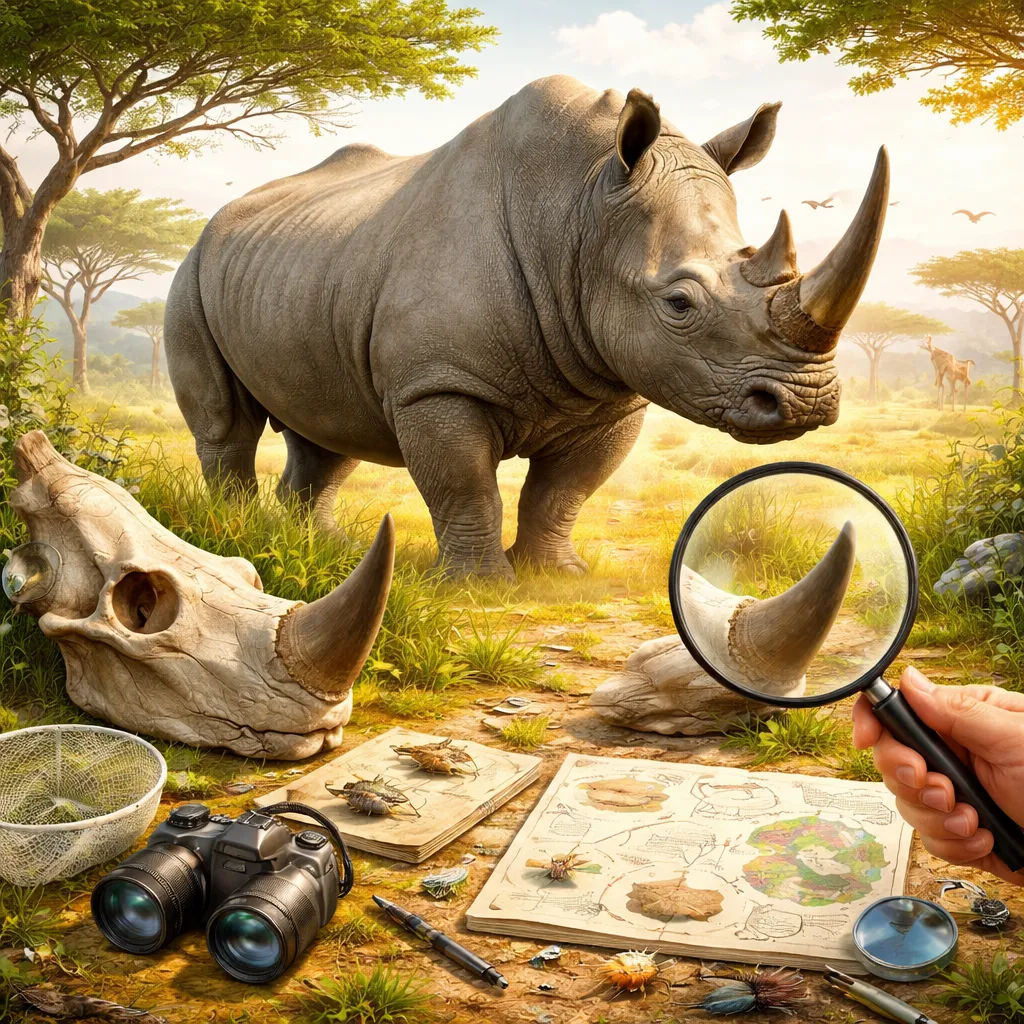

Have you ever seen a rhinoceros at the zoo or in a picture? It looks like a living tank, with its huge body, thick skin, and a big horn on its nose. Rhinos are powerful, ancient animals that have roamed the Earth for millions of years. Learning about the rhinoceros is an adventure that takes us to the grasslands and forests of Africa and Asia. Let’s get ready to start learning about this incredible creature.
English Language Learning
Vocabulary and Spelling
Our armored friend is called a rhinoceros, but we usually say rhino for short.
The word "rhinoceros" is a noun. A noun names a person, place, or thing. So, a rhinoceros is a thing—a very large, living animal.
Spelling the full name is a challenge: R-H-I-N-O-C-E-R-O-S. The 'R' and 'H' start the word together. The 'I', 'N', 'O' are in the middle, and it ends with 'C-E-R-O-S'. R-H-I-N-O-C-E-R-O-S spells rhinoceros. The short name is easier: R-H-I-N-O.
Sound and Pronunciation
Let’s say the short name correctly. It sounds like this: /ˈraɪ.noʊ/.
We can say it in two clear parts. First, say "rye". It rhymes with "eye" or the word for a type of bread, "rye". Next, say "no". It sounds just like the word "no".
Now, put it together! "Rye" "no". Rhino! Great!
The word "rhino" has two beats, or two syllables. Clap your hands twice: Rhi-no. It’s a strong, sturdy word.
Related Words
Learning about rhinos is more fun with new words! Here are some important ones.
Body Part: The hard, pointy growth on a rhino’s nose is called a horn. It is made of keratin, like your hair and fingernails!
Baby: A baby rhino is called a calf.
Group: A group of rhinos is called a crash. Isn’t that a powerful name?
A Famous Saying
There is a common phrase: "Thick-skinned as a rhinoceros."
This means someone is not easily upset by criticism or unkind words. It comes from the rhino’s very thick skin. It reminds us that sometimes it’s good to be strong and not let every little thing bother us.
Say the phrase with me: "Thick-skinned as a rhinoceros." It’s a way to talk about being strong on the inside.
Now you know the word "rhinoceros"! Are you ready to learn about these powerful giants? Let’s charge from words to wonderful knowledge!
Animal Knowledge
Who Are They? – Family and Group
What kind of animal is a rhinoceros? Rhinos are mammals. They have skin (very thick skin!), are warm-blooded, and mother rhinos feed their babies milk.
They are part of a family called Rhinocerotidae. There are five different species: White, Black, Indian, Javan, and Sumatran. Their closest living relatives are horses, zebras, and tapirs.
What Do They Look Like? – Amazing Bodies
Rhinos are enormous, the second-largest land mammal after the elephant. They have a massive body, short, sturdy legs, and one or two horns on their head. Their skin is thick and forms folds, like plates of armor.
Their most famous feature is their horn. The horn is not attached to the skull; it is made of compacted hair! They use it for defense, digging for water, and breaking branches. Rhinos have poor eyesight but excellent hearing and smell.
Rhinos have special adaptations. Their thick skin protects them, but it can get sunburned and bothered by bugs. They take mud baths to cool off, protect their skin, and get rid of pests. The mud acts like sunscreen and bug spray!
Where Do They Live and How? – Home and Habits
Rhinos live in Africa and Asia. Their homes are grasslands, savannas, and tropical forests. They need lots of space, water for drinking and wallowing, and plenty of plants to eat.
Rhinos are herbivores. This means they only eat plants. They are browsers (like the Black Rhino, eating leaves and branches) or grazers (like the White Rhino, eating grass). They spend much of their day eating.
Most rhinos are solitary, but some species are more social. A group is called a crash. They are most active in the early morning and evening. They spend their time eating, resting in the shade, and wallowing in muddy pools.
A Rhino’s Life Story – Growing Up
A baby rhino is called a calf. Rhinos are mammals, so calves are born live from their mother. A mother rhino usually has one calf at a time.
The mother rhino is very protective and caring. The calf can walk within an hour of birth. The mother feeds it milk for about a year and teaches it what to eat. The calf stays with its mother for two to four years.
Calves are born without a horn—just a little bump. The horn grows as they get older. They are playful and curious. A rhino becomes an adult at about five to seven years old.
How Do They "Talk"? – Communication
Rhinos talk with many sounds. They grunt, growl, trumpet, and squeak. A calf will make a high-pitched squeal to call its mother.
They also use scent and poop! They leave smelly droppings in shared dung piles to send messages to other rhinos. They also use urine to mark their paths.
Their best senses are their amazing hearing and sense of smell. Their large ears can turn to catch sounds. Their superb sense of smell helps them find food, water, and other rhinos, even from far away.
Are They Okay? – Taking Care of Them
Most rhino species are critically endangered. This means they are in great danger of disappearing forever. The Northern White Rhino, for example, has only two females left on Earth.
The main threat is poaching. Bad people hunt rhinos for their horns to sell. They also lose their homes when forests and grasslands are cleared for farms and cities.
You can be a rhino hero! You can learn and tell everyone about the rhino’s trouble. You can support groups that protect rhinos in the wild and work to stop poaching. You can choose to never buy anything made from rhino horn. Remember, the horn is just hair—it is not medicine and has no magic power.
Life Connections and Inspiration
How to Be With Them – Safety and Love
Rhinos are massive, powerful, and wild animals. We must always show them the utmost respect and keep a very safe distance.
The rule is: Admire from an extreme distance. We watch them in well-protected zoos that care for them. In the wild, we observe from a safe vehicle on a safari, with a guide. We never, ever try to approach a wild rhino. They can charge if they feel threatened, and they are very fast.
We show our love by being a voice for their protection and supporting the brave rangers who guard them day and night. Protecting rhinos means protecting whole ecosystems.
Super Qualities We Learn from Them
Rhinos teach us incredible lessons. One super quality is quiet strength and resilience. Rhinos are not bullies. They are peaceful plant-eaters who use their great strength only when necessary. They teach us to be strong, to stand our ground for what is right, and to be resilient in the face of big challenges.
Another quality is the importance of being unique. Rhinos are one-of-a-kind. There is no other animal like them. Their very uniqueness makes them precious. This reminds us that our own unique qualities are what make us special and worth protecting.
Think about it: How can you use your inner strength in a peaceful way? What makes you uniquely wonderful, and how can you protect the unique qualities in others?
Take Action! – Your "Rhino Ranger" Project
Let’s do a powerful activity! Your project is to create a "Save the Rhino" awareness poster.
On a large piece of paper, draw a magnificent rhino. Around it, write down key facts you learned: "Herbivore," "Horn made of hair," "Endangered." Draw a big red "X" over a picture of a poacher’s weapon. Write a positive message like "Protect the Horn, Save the Rhino!" or "Let Rhinos Roam Free!" You can hang your poster in your room or classroom to teach others. Your voice and art can help spread the word.
Closing
Learning about the rhinoceros is a powerful and important adventure! We learned the word "rhinoceros" and its shorter name "rhino." We discovered amazing facts about their horns of hair, their mud baths, and their peaceful strength. We know that rhinos are ancient, unique giants who are in grave danger and need our help to survive. You can use your new words to become a champion for these animals. You can use your knowledge to make choices that help protect all wildlife. The animal kingdom is full of resilient and unique treasures. Always remember to stand strong for what is right, celebrate uniqueness, and be a voice for those who cannot speak. Keep exploring with a brave heart, protect our planet’s wonders, and be a ranger for kindness. Your caring actions and strong voice can help ensure the mighty rhinoceros continues to thunder across the Earth for generations to come.