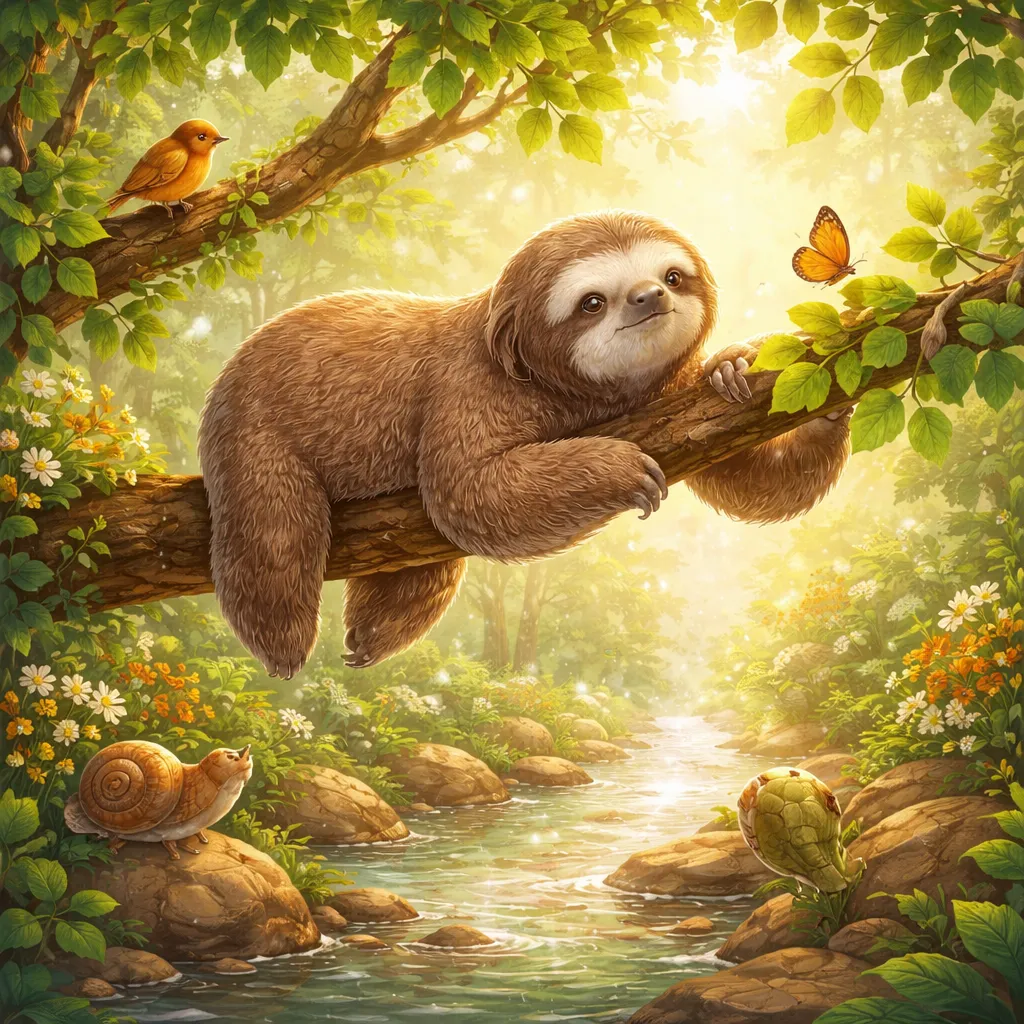

Imagine you are in a rainforest, looking up at the trees. You see a furry animal hanging upside down, moving so slowly that it seems to be in slow motion. That’s a sloth! With their calm smiles and gentle movements, sloths teach us a different way to live. Learning about sloths is a relaxing adventure that takes us to the treetops of Central and South America. Let’s slow down and begin our journey of learning about sloth calm and wisdom.
English Language Learning
Vocabulary and Spelling
Our slow-moving friend is called a sloth.
The word "sloth" is a noun. A noun names a person, place, or thing. So, a sloth is a thing—a calm, living animal.
Spelling "sloth" is short: S-L-O-T-H. The 'S' starts the word, the 'L' and 'O' are in the middle, and it ends with 'T-H'. S-L-O-T-H spells sloth.
Sound and Pronunciation
Let’s say the word correctly. It sounds like this: /sloʊθ/.
We can say it in one clear part. First, say "slow". It rhymes with "go" or "flow". Now, just add a soft "th" sound at the end, like in "bath".
Now, blend it together! "Slow" "th". Sloth! Great!
The word "sloth" has just one beat, or one syllable. Clap your hands once: Sloth! It’s a soft, slow word.
Related Words
Learning about sloths is more fun with new words! Here are some important ones.
Home: The high, leafy world where a sloth lives is called the canopy of the rainforest.
Action: Sloths spend most of their time hanging from branches.
Body Part: A sloth’s long, curved nails are called claws. They are like hooks for hanging.
A Famous Saying
People often say: "As slow as a sloth."
This is the perfect way to describe something that moves very, very slowly. It’s not an insult for the sloth—it’s just how they are built! This saying reminds us that everyone has their own natural speed, and that’s okay.
Say the saying with me: "As slow as a sloth." What is something you like to do slowly and carefully?
Now you know the word "sloth"! Are you ready to relax into some amazing facts? Let’s climb from words to wonderful knowledge!
Animal Knowledge
Who Are They? – Family and Group
What kind of animal is a sloth? Sloths are mammals. They have fur, are warm-blooded, and mother sloths feed their babies milk.
They are part of the order Pilosa. Their closest living relatives are anteaters and armadillos. There are two main types: two-toed sloths and three-toed sloths. The number of toes is on their front feet!
What Do They Look Like? – Amazing Bodies
Sloths are about the size of a small dog. They have shaggy, grayish-brown fur. Their most famous features are their long arms, curved claws, and their seemingly permanent smile.
Their bodies are built for life upside down! Their claws are like strong hooks that lock onto branches. Their fur grows in the opposite direction of other mammals, from their belly to their back, so rain runs off easily when they are hanging.
Sloths have special adaptations for a slow life. They have a very slow metabolism, which means they use energy slowly. They only come down from the tree about once a week to go to the bathroom! Tiny algae grow in their fur, giving it a green tint that helps them hide in the leaves.
Where Do They Live and How? – Home and Habits
Sloths live in the rainforests of Central and South America. Their home is the tropical rainforest canopy, high up in the trees. They almost never touch the ground.
Sloths are herbivores. This means they only eat plants. They are folivores, which means they mostly eat leaves. Leaves are not very nutritious, so they don’t give much energy. That’s one reason sloths move so slowly—to save energy!
Sloths are solitary and move very slowly. They are most active at night but can be active during the day too. They sleep for up to 15-20 hours a day! They spend their waking hours slowly munching on leaves, grooming, and moving from branch to branch.
A Sloth’s Life Story – Growing Up
A baby sloth is called a cub. Sloths are mammals, so cubs are born live from their mother. A mother sloth usually has one tiny cub at a time.
The mother sloth is a patient and caring parent. The cub clings to its mother’s belly for the first few months, drinking milk. The mother carries it everywhere and teaches it which leaves are safe to eat.
Cubs are born with their eyes open and a full coat of fur. They start tasting leaves when they are just a few days old. They stay with their mother for about six months to a year, learning all about the treetop world, before going off on their own.
How Do They "Talk"? – Communication
Sloths are very quiet animals. They can make a soft hissing sound or a high-pitched "aww" sound if they are distressed. A baby sloth may cry if it falls from its mother.
They use scent and touch to communicate. They have a special gland that leaves a scent on trees. They also groom each other sometimes, which is a friendly act.
Their best sense is their sense of touch and smell. They have a good sense of smell to find the right leaves to eat. Their eyesight is not very strong, and they rely on their slow, deliberate movements to stay safe.
Are They Okay? – Taking Care of Them
Many sloth species are facing big problems. Some, like the maned three-toed sloth, are vulnerable. The pygmy three-toed sloth is critically endangered.
The main threats are people cutting down the rainforests where they live. Sloths also get hurt by cars and power lines when they try to move between trees. Sometimes people take them from the wild to keep as pets, which is very bad for the sloth.
You can be a sloth hero! You can learn and tell others about the importance of rainforests. You can support groups that plant trees and protect sloth habitats. You can choose to recycle and use less paper to help save trees. Every little bit helps the rainforest and its gentle inhabitants.
Life Connections and Inspiration
How to Be With Them – Safety and Love
Sloths are wild animals. They may look cuddly, but they are not pets. We must always respect their wild nature and keep a safe distance.
The rule is: Admire from a distance and never touch. We watch them in nature documentaries or at wildlife rescue centers that care for injured sloths. In the wild, we use binoculars to look for them high in the trees. Never try to touch or hold a wild sloth. It is very stressful for them and they can bite if scared.
We show our love by protecting the tall, green, leafy rainforests that are their only home. We can be voices for the trees and all the creatures that live in them.
Super Qualities We Learn from Them
Sloths teach us wonderful things. One super quality is calm patience and mindfulness. Sloths are not in a hurry. They move with intention and focus on the moment. In our busy world, they remind us to slow down, be patient, and pay attention to what we are doing right now.
Another quality is energy conservation and efficiency. Sloths use their energy in the smartest way possible. They don’t waste a single movement. This reminds us to think about how we use our own energy—our time and effort—and to use it wisely on the things that are most important.
Think about it: When is a good time to be patient and move slowly, like when you are learning something new? How can you use your own energy wisely today, instead of rushing or wasting it?
Take Action! – Your "Sloth Sanctuary" Project
Let’s do a calm and creative activity! Your project is to design a perfect sloth sanctuary in a rainforest.
On a large piece of paper, draw the tall trees of the rainforest canopy. Draw leaves and vines. Now, draw a sloth hanging from a branch. What does it need to be happy? Draw a water source (like a rainy cloud), lots of leafy branches to eat, and safe branches for moving. You can even draw other rainforest animals nearby. Write a few sentences about why each part of your drawing is important for the sloth. This shows you understand what a sloth needs to live a calm, safe life.
Closing
Learning about sloth calm is a peaceful and wonderful adventure! We learned the word "sloth" and how to say its soft, one-syllable name. We discovered amazing facts about their algae-covered fur, their hooked claws, and their life in the slow lane. We know that sloths are patient, energy-saving animals who are in danger because their rainforest home is disappearing. You can use your new words to teach others about these gentle tree-dwellers. You can use your knowledge to appreciate the importance of every creature and every tree. The animal world is full of calm and mindful teachers. Always remember to respect wildlife from a safe distance, practice patience in your own life, and use your energy wisely. Keep exploring with a calm heart, move through your day with intention, and be a friend to the rainforest. Your thoughtful actions and peaceful spirit make you a true friend to the amazing sloth.