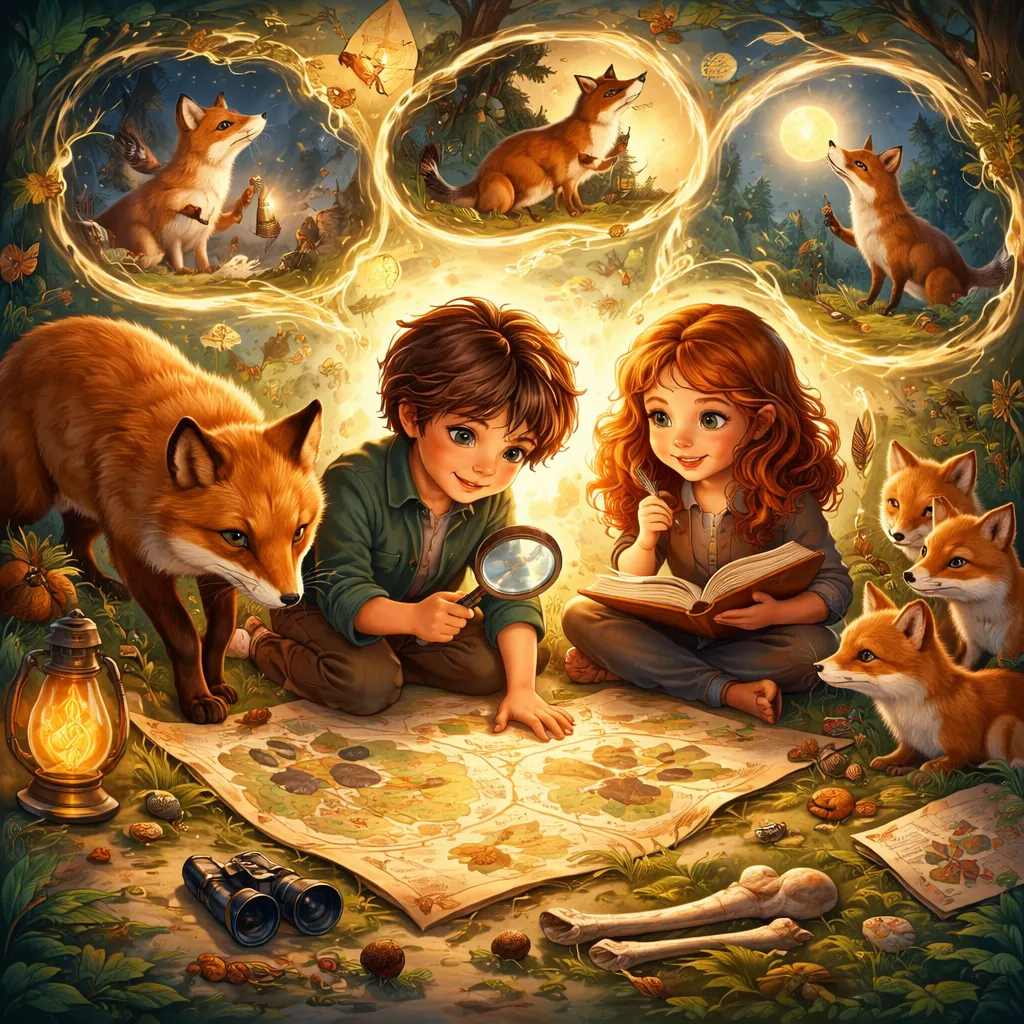

Have you ever seen a flash of red in the woods or a field? It might have been a fox! With its pointy ears, bushy tail, and clever eyes, the fox is a star of many storybooks and legends. Learning about foxes takes us on a journey to the edges of forests and towns, where these smart animals live. Let’s tiptoe quietly and start learning about the fascinating world of the fox.
English Language Learning
Vocabulary and Spelling
The word for this clever animal is fox.
The word "fox" is a noun. A noun names a person, place, or thing. So, a fox is a thing—a wild, intelligent animal.
Spelling "fox" is quick and neat: F-O-X. The 'F' is at the front, like a fox’s pointed face. The 'O' is in the middle, and the 'X' is at the end, marking the spot like a treasure! F-O-X spells fox. More than one fox are foxes.
Sound and Pronunciation
Let’s say the word just right. It sounds like this: /fɑːks/.
We can say it in one smooth part. First, say the sound "f". It’s the sound at the start of "fun" or "fish". Next, say "ah". Open your mouth like at the dentist. Last, say "ks". It’s the sound at the end of "socks".
Now, blend it together! "F" "ah" "ks". Fox! Perfect!
The word "fox" has just one beat, or one syllable. Clap your hands once: Fox! It’s a sharp, smart-sounding word.
Related Words
Learning about foxes is more fun with new words! Here are some interesting ones.
Body Parts: A fox’s big, fluffy tail is called a brush. It helps with balance and keeps the fox warm! Those big, pointy ears on top of its head are great for hearing.
Sound: The high, sharp sound a fox makes is often a bark or a yelp. Sometimes it sounds like a scream!
Home: A fox’s underground home is called a den. It is a safe, cozy place for raising kits.
A Famous Saying
There is a very old and fun saying: "As cunning as a fox."
This means someone is very clever, tricky, or smart at solving problems. It comes from stories where foxes are always outwitting others. It reminds us that being clever and thinking quickly can be a great skill!
Say the saying with me: "As cunning as a fox." Can you think of a time you had to be clever to solve a problem?
Now you know the word "fox"! Are you ready to learn about their clever lives in the wild? Let’s sneak from words to wonderful facts!
Animal Knowledge
Who Are They? – Family and Group
What kind of animal is a fox? Foxes are mammals. They have fur, are warm-blooded, and mother foxes feed their babies milk.
They are part of the canine family. This is the dog family! Their cousins are wolves, coyotes, and domestic dogs. But foxes are usually much smaller and like to live alone.
What Do They Look Like? – Amazing Bodies
The most common fox is the red fox. It is about the size of a medium dog, with beautiful red-orange fur, a white belly, and black legs and ear tips.
Their most famous feature is their big, bushy tail, also called a brush. They use it for balance and to wrap around themselves like a blanket in the cold. Their large, pointy ears help them hear the tiniest sounds, like a mouse under the snow!
Foxes have special adaptations. They are nocturnal or crepuscular, which means they are most active at night or at dusk and dawn. Their eyes have a special layer to help them see well in the dark.
Where Do They Live and How? – Home and Habits
Foxes are amazing adapters! They can live in many places: forests, grasslands, mountains, and even near cities and farms. They are very good at living near people without being seen.
Foxes are omnivores. This means they eat both plants and animals. They eat small animals like mice and rabbits, birds, insects, fruits, and even vegetables from gardens. They are not picky eaters!
Foxes are mostly solitary hunters. They are very quiet and stealthy, moving like shadows. A group of foxes is called a skulk or a leash, but you often see just one.
A Fox’s Life Story – Growing Up
Baby foxes are called kits. Foxes are mammals, so kits are born live from their mother in the den. A mother fox usually has four to six kits at a time.
Both the mother (vixen) and father (dog fox) take care of the kits! The mother feeds them milk, and the father brings food. The parents play with the kits and teach them how to hunt.
Kits are born blind and deaf. After a few weeks, they open their eyes and start to explore outside the den. They are very playful! They stay with their parents for about six months before going off to find their own territory.
How Do They "Talk"? – Communication
Foxes have a variety of sounds. They can bark, yelp, and make a strange, high-pitched scream. They use these sounds to talk to each other, especially during mating season.
They also use their tails and body posture to communicate. A wagging tail can mean excitement. They use scent marking to tell other foxes, "This is my area."
Their best senses are their incredible hearing and sense of smell. They can hear a small animal digging underground. Their nose can sniff out food from far away.
Are They Okay? – Taking Care of Them
Many fox species, like the red fox, are doing okay and are not endangered. They are very good at surviving. But some species, like the Sierra Nevada red fox, are very rare.
The main threats are losing their wild homes to buildings and roads. Sometimes, foxes are hunted or hit by cars. In some places, people see them as pests.
We can be good neighbors to foxes! We can admire them from a distance. We can keep our trash cans closed so they don’t get into human food, which is bad for them. We can protect wild spaces so they have natural homes.
Life Connections and Inspiration
How to Be With Them – Safety and Love
Foxes are wild animals. We must respect their space and watch them from afar.
The rule is: Observe, don’t disturb. If you see a fox in your yard or on a walk, stay calm, be quiet, and watch from a window or a distance. Never try to touch, feed, or chase a fox. They are not pets, and feeding them makes them less afraid of people, which is dangerous for them.
We show our love by letting them be wild. We can make our yards friendly by not using poisons and by having places for wild animals to live safely. The best gift is a healthy, natural habitat.
Super Qualities We Learn from Them
Foxes teach us wonderful things. One super quality is adaptability and cleverness. Foxes can live in many different places and figure out how to find food. They teach us to be smart, to adapt to new situations, and to think creatively to solve problems.
Another quality is quiet independence. Foxes often work and live alone successfully. They remind us that it’s okay to be independent, to rely on your own skills, and to move through the world with quiet confidence.
Think about it: How can you be clever and adaptable when faced with a new challenge? How can you be confidently independent while also being a good friend or family member?
Take Action! – Your "Fox Detective" Project
Let’s do a fun activity! Your project is to become a wildlife detective and look for fox signs.
With an adult, take a walk in a park, forest, or even look carefully in your neighborhood. You are looking for clues, not the fox itself. Look for small paw prints in mud or snow. Look for holes in the ground that could be a den entrance (but don’t go near!). Listen for sharp barks at dusk. Draw or write down the clues you find in a notebook. Remember, you are a silent observer, just like a fox is a silent hunter. What did your detective work discover?
Closing
Learning about fox mysteries is a clever adventure! We learned the word "fox" and how to say its sharp, one-syllable name. We discovered amazing facts about their bushy tails, their super hearing, and their adaptable lives. We know that foxes are smart, independent animals who are our wild neighbors. You can use your new words to tell stories about these cunning creatures. You can use your knowledge to watch wildlife safely and respectfully. The animal world is full of clever survivors that teach us about adaptability. Always remember to observe wildlife with quiet wonder and protect the spaces they call home. Keep exploring with clever questions, be adaptable in your learning, and walk with quiet confidence. Your respectful curiosity helps ensure that these beautiful animals continue to thrive in the wild places, and the not-so-wild places, all around us.