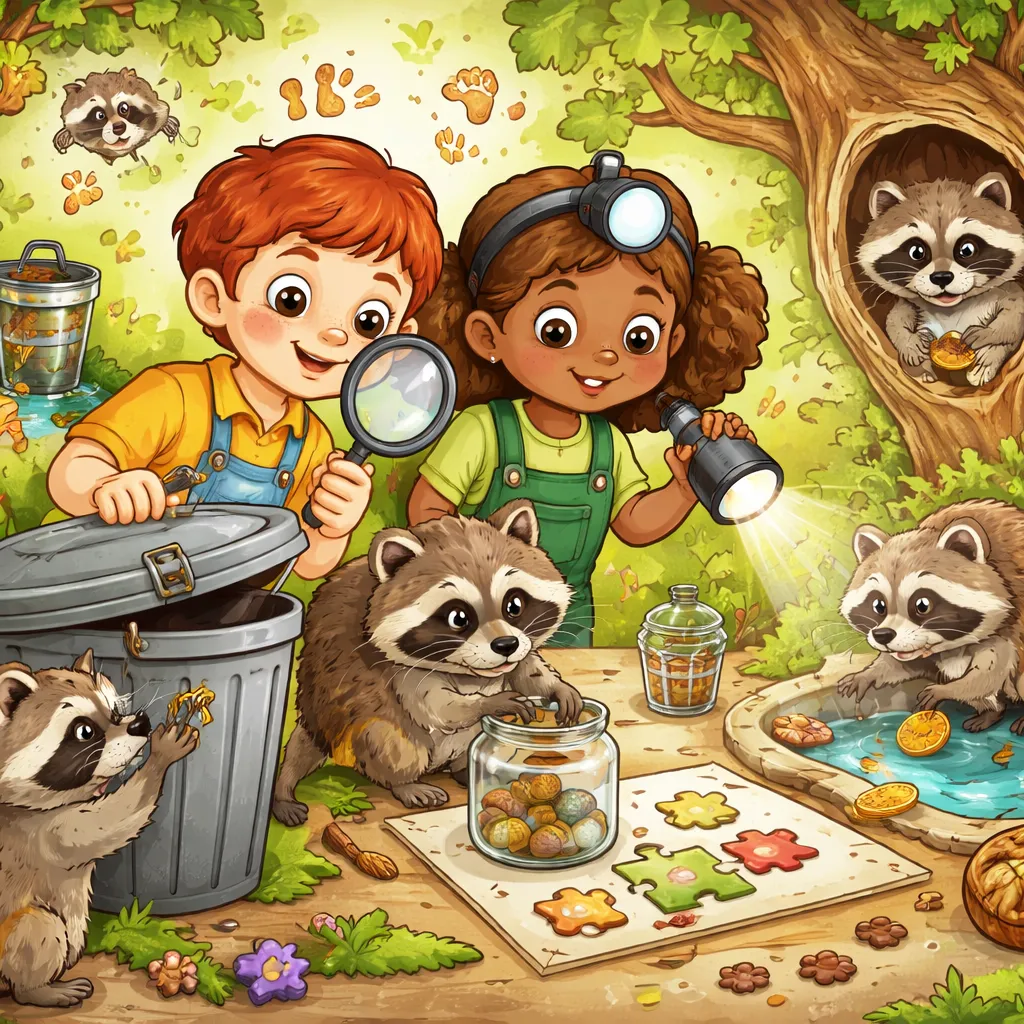

Have you ever seen a raccoon in your backyard, a park, or in a cartoon? With their black "mask" over the eyes and a fluffy, ringed tail, they look like little bandits! Raccoons are curious, smart, and very good with their hands. Learning about raccoons is a fun adventure that takes us from deep forests to city streets. Let’s start our journey of learning about raccoon antics and smarts!
English Language Learning
Vocabulary and Spelling
Our clever, masked friend is called a raccoon.
The word "raccoon" is a noun. A noun names a person, place, or thing. So, a raccoon is a thing—a clever, living animal.
Spelling "raccoon" is a bit tricky: R-A-C-C-O-O-N. The 'R' starts the word. Then there are two 'C's and two 'O's in the middle. It ends with 'N'. R-A-C-C-O-O-N spells raccoon.
Sound and Pronunciation
Let’s say the word correctly. It sounds like this: /ræˈkuːn/.
We can say it in two clear parts. First, say "ra". It sounds like the beginning of "rat". Next, say "coon". It rhymes with "moon" or "spoon".
Now, put it together! "Ra" "coon". Raccoon! Great job!
The word "raccoon" has two beats, or two syllables. Clap your hands twice: Rac-coon. It’s a fun, bouncy word.
Related Words
Learning about raccoons is more fun with new words! Here are some important ones.
Body Parts: The black fur around a raccoon’s eyes is called its mask. Its very skillful front feet that look like little hands are called paws.
Sound: Raccoons make chattering and chittering sounds, like a high-pitched chitter.
Home: A raccoon’s cozy home, often in a hollow tree or an attic, is called a den.
A Famous Saying
People often say raccoons look like "Nature’s little bandits."
This is because their black mask makes them look like the thieves in old stories! But raccoons aren’t really thieves; they are just very curious and clever foragers. It’s a playful nickname that reminds us of their smart and mischievous look.
Say the nickname with me: "Nature’s little bandits." Isn’t that a fun way to describe them?
Now you know the word "raccoon"! Are you ready to uncover their clever secrets? Let’s tiptoe from words to wonderful knowledge!
Animal Knowledge
Who Are They? – Family and Group
What kind of animal is a raccoon? Raccoons are mammals. They have fur, are warm-blooded, and mother raccoons feed their babies milk.
They are part of the Procyonidae family. Their cousins are coatis, kinkajous, and olingos. The most common type is the Northern Raccoon.
What Do They Look Like? – Amazing Bodies
Raccoons are about the size of a small dog. They have grayish-brown fur, a black mask, and a bushy tail with black rings. Their most famous features are their black mask and their super-sensitive front paws.
Their front paws are amazing tools. They have five long fingers that can open jars, untie knots, and even turn doorknobs! Raccoons often look like they are "washing" their food in water, but they are actually using the water to feel it better with their paws.
Raccoons have special adaptations. They are excellent climbers with sharp claws. They are also very good swimmers. Their mask might help reduce glare and improve their night vision.
Where Do They Live and How? – Home and Habits
Raccoons live in North and Central America. They are incredibly adaptable. Their homes are forests, marshes, and, very commonly, cities and suburbs. They can live almost anywhere!
Raccoons are omnivores. This means they eat both plants and animals. They eat fruits, nuts, insects, frogs, fish, eggs, and, sometimes, food from our garbage cans! They are not picky eaters.
Raccoons are mostly nocturnal, meaning they are most active at night. They are solitary but sometimes live in small groups. A group of raccoons is called a nursery or a gaze. They spend their nights exploring, looking for food, and climbing.
A Raccoon’s Life Story – Growing Up
A baby raccoon is called a kit. Raccoons are mammals, so kits are born live from their mother. A mother raccoon usually has two to five tiny, blind kits at a time.
The mother raccoon is a very caring parent. She raises her kits alone in a safe den. She feeds them milk and later teaches them how to find food and climb. The kits are very playful.
Kits are born without their mask or rings on the tail. These markings develop as they grow. They open their eyes after about three weeks. They stay with their mother for about a year, learning all the skills they need to survive on their own.
How Do They "Talk"? – Communication
Raccoons talk with many sounds. They chitter, purr, growl, hiss, and whimper. Each sound can mean something different, like a warning or a call to their kits.
They also use their bodies. They might stand on their back legs to get a better view. They use scent marking to tell other raccoons about their territory.
Their best sense is their incredible sense of touch, especially in their front paws. Their paws are so sensitive that they can feel and identify objects without seeing them! Their hearing is also very sharp.
Are They Okay? – Taking Care of Them
Raccoons are very common and are not endangered. In fact, they are doing very well in many places because they can adapt to living near people.
The main threats are cars, diseases like rabies, and conflicts with people who see them as pests. Sometimes they get into trouble by trying to live in attics or garages.
We can be good neighbors to raccoons! We can make sure our trash cans have tight lids so they don’t get into human food, which is not healthy for them. We should never try to touch or feed a raccoon. We can also keep our pets indoors at night.
Life Connections and Inspiration
How to Be With Them – Safety and Love
Raccoons are wild animals. They can be curious and clever, but we must remember they are not pets.
The most important rule is: Watch, but don’t touch or feed. If you see a raccoon in your yard, watch it from a window. Never try to pet or chase a raccoon. If a raccoon is out during the day, it might be sick, so tell an adult and stay far away. Secure pet food and trash so they aren’t tempted to come too close.
We show our love by letting them be wild. We can appreciate their cleverness from a distance and make sure our homes and neighborhoods are safe for both people and wildlife.
Super Qualities We Learn from Them
Raccoons teach us wonderful things. One super quality is curiosity and problem-solving. Raccoons are naturally curious and love to figure things out. They teach us to be curious about the world, to ask questions, and to think of clever ways to solve problems.
Another quality is adaptability. Raccoons can live in the deep forest or a big city. They adapt to new situations and find what they need. This reminds us to be flexible and adaptable when our own environment or plans change.
Think about it: How can you use your curiosity to learn something new today? How can you be more adaptable when something doesn’t go the way you expected?
Take Action! – Your "Raccoon Puzzle" Project
Let’s do a fun and clever activity! Your project is to build a simple "puzzle box" for a stuffed animal raccoon.
Find a small cardboard box with a lid. Put a small toy or a ball inside. Now, without using tape, can you close the box so a clever raccoon (your stuffed animal) would have to figure out how to open it? You could tie the lid with a loose string, use a paper clip hook, or just tuck the flaps in. See if you can open it using only your "paws" (but it’s okay to use your hands!). This shows how raccoons use their cleverness and sensitive fingers to solve problems.
Closing
Learning about raccoon cleverness is a fantastic adventure! We learned the word "raccoon" and how to say its two-part name. We discovered amazing facts about their sensitive paws, their black masks, and their life as nocturnal explorers. We know that raccoons are curious, adaptable animals who are our wild neighbors. You can use your new words to tell stories about these masked bandits. You can use your knowledge to be a responsible and kind neighbor to all wildlife. The animal world is full of clever and adaptable teachers. Always remember to observe wildlife from a safe distance, be curious in your learning, and adapt to new challenges with a smile. Keep exploring with wonder, solve problems with creativity, and be a friend to the creatures in your own backyard. Your thoughtful actions and clever mind make you a true friend to the amazing raccoon.