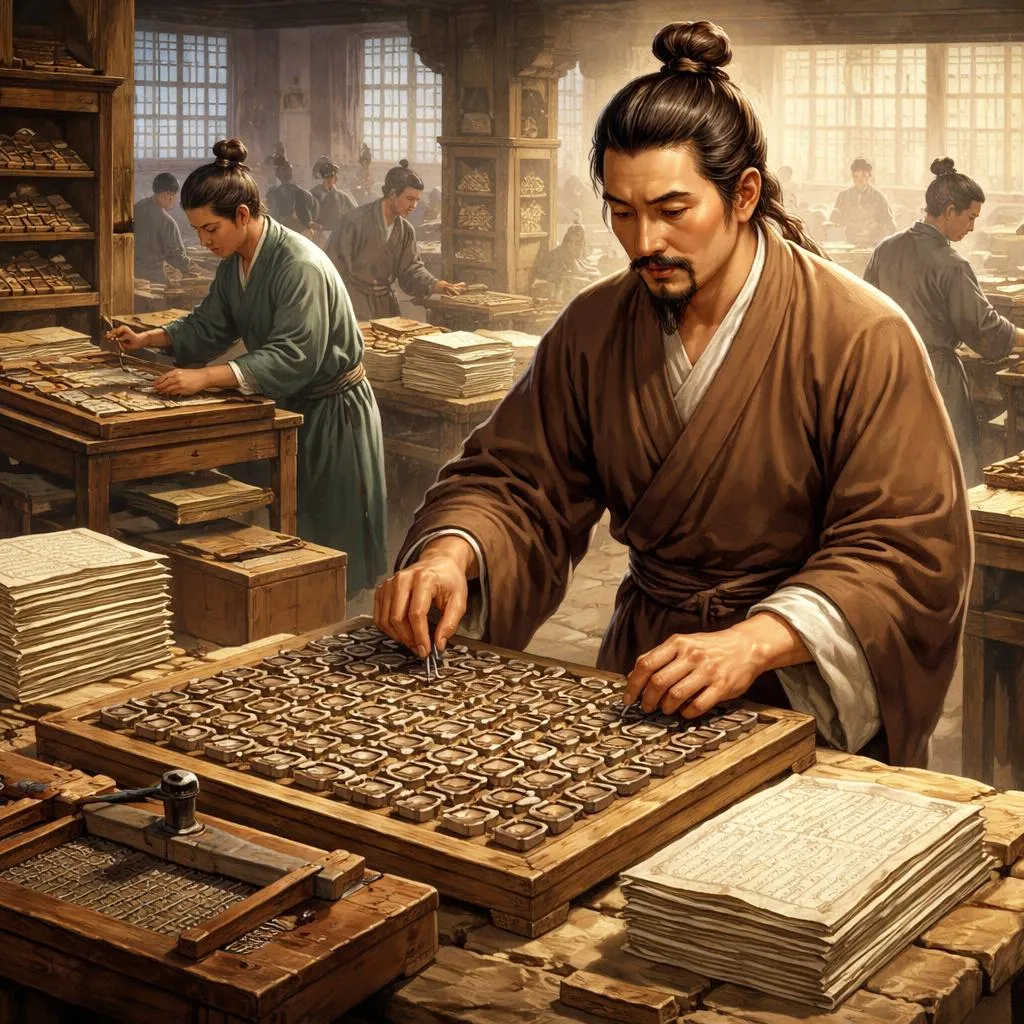

Who Is This Celebrity?
Bi Sheng invented the world's first movable type printing press. He lived about 1,000 years ago during the Song Dynasty in China. He was not a scholar or a rich man. He worked as a common printer making books by hand. Before his invention, printers carved each page onto a single wood block. That took months for one book. Bi Sheng created reusable clay letters that could be rearranged. His idea made printing faster and cheaper. His story shows that ordinary workers can change the world.
Early Life and Childhood
Bi Sheng was born around 990 CE in Yingzhou, Hubei Province, China. Historians know very little about his childhood. He came from a poor family of artisans and farmers. Young Bi loved watching craftsmen work with clay and wood. He also enjoyed carving small figures from soft stone. He learned to read from a local scholar who taught poor children for free. He dreamed of becoming a printer when he grew up. He noticed how slowly books were made. He wondered if there was a faster way. His friends called him a dreamer. They did not know he would change history.
Education and Learning Journey
Bi Sheng did not attend any fancy school or university. He learned basic reading and writing from a village teacher. He learned arithmetic from his father. He learned printing skills by working as an apprentice in a print shop. His master taught him how to carve wood blocks for each page. Bi Sheng practiced carving every day for years. He became very skilled at creating beautiful characters. But he still thought the process was too slow. He experimented with different materials in his free time. He tried wood, stone, and metal. He failed many times. But he kept learning from each failure.
How Did They Become Successful?
Bi Sheng became successful by never giving up on his idea. He spent over ten years experimenting with movable type. First, he tried carving letters on wood blocks. Wood absorbed ink and swelled. The letters became uneven. He tried metal letters next. Metal was expensive and hard to carve. Then he tried clay. He mixed clay with water and pressed it into molds. He carved each character into the soft clay. Then he baked the clay letters in a small kiln. The result was hard, durable, and cheap. He arranged the clay letters on an iron plate. He spread a sticky mixture over them. The letters stayed in place while he printed. After printing, he heated the plate and removed the letters. He could reuse them for the next page.
Big Ideas and Achievements
Bi Sheng's biggest achievement was creating reusable movable type. Before him, printers carved an entire wood block for each page. That block could only print that one page. If you made a mistake, you ruined the whole block. Bi Sheng's system let printers reuse letters thousands of times. They could store letters in cases and pull them out as needed. They could print one page, rearrange the letters, and print the next page. This cut printing time from months to days. Books became cheaper and more available. More people learned to read. Knowledge spread faster than ever before. Bi Sheng's idea eventually spread to Korea, Japan, and Europe. Johannes Gutenberg later adapted it for the Western alphabet.
Challenges and Difficult Times
Bi Sheng faced many challenges throughout his life. He had almost no money for experiments. He used leftover clay from local potters. His family went hungry while he spent time on his invention. Neighbors thought he was wasting his life. Fellow printers mocked his strange clay letters. They said clay would never work as well as wood. Bi Sheng also faced the challenge of imperial exams. The government only promoted scholars who passed difficult tests. Bi Sheng never took those exams. He remained a common worker his whole life. His invention did not make him rich or famous. He died in relative obscurity around 1051 CE. A scholar named Shen Kuo recorded Bi Sheng's invention in a book. Without that record, we might have forgotten him forever.
Fun Facts About the Celebrity
Bi Sheng loved eating sticky rice cakes while working. He used the leftover sticky rice to test new adhesives. He also enjoyed fishing in the river near his home. He said fishing taught him patience. He never drank alcohol, unlike many other workers. He said alcohol made his hands shake. He kept a pet songbird in a small cage. The bird sang while he carved letters. He also loved playing a game called pitch-pot. Players threw arrows into a pot. He was very good at it. He never wore shoes inside his workshop. He said feeling the floor helped him balance. He also kept a small kiln in his backyard just for baking clay letters. His children helped him fire the kiln.
Why Is This Celebrity Important Today?
Bi Sheng's movable type changed the world. Every printed book you see today comes from his basic idea. Modern printing presses use metal or plastic letters instead of clay. But the principle is the same: reusable characters that can be rearranged. Without Bi Sheng, books might still cost a fortune. Libraries might hold only a few hundred volumes. Most people might never learn to read. His invention helped spark the Renaissance in Europe. It helped spread scientific ideas during the Scientific Revolution. It helped fuel the Industrial Revolution. All of these world-changing events trace back to a common printer in China. Bi Sheng's name deserves to stand beside Gutenberg. He came first, 400 years earlier.
What Can Kids Learn from This Story?
You can learn that you do not need a degree to invent something. Bi Sheng had no formal education. He was a common worker. You can also learn to keep experimenting after failures. He tried wood and metal before finding clay. You can learn that small improvements matter. He did not invent printing. He made it faster and cheaper. You can learn to ignore people who mock your ideas. Other printers laughed at him. He kept working. You can also learn that your invention might become famous even if you do not. He died unknown. Now every history book mentions him.
Quick Quiz or Practice Time
Let's see what you remember about Bi Sheng.
Question 1: What material did Bi Sheng use to make his movable type?
Answer: Clay (baked in a kiln).
Question 2: How did Bi Sheng keep the clay letters in place on the printing plate?
Answer: He used a sticky mixture, then heated the plate to remove the letters.
Question 3: What food did Bi Sheng love eating while working?
Answer: Sticky rice cakes.
Question 4: Who recorded Bi Sheng's invention in a book so we remember him today?
Answer: A scholar named Shen Kuo.
Question 5: What game did Bi Sheng play that involved throwing arrows into a pot?
Answer: Pitch-pot.
Activity: Try your own version of movable type. Write the alphabet on small pieces of paper. Cut them out. Arrange the letters to spell your name. Then rearrange them to spell a different word. This is exactly what Bi Sheng did with his clay letters. Now draw a picture of Bi Sheng baking his clay letters in a small kiln.
Bi Sheng lived a simple life. He worked with his hands. He ate sticky rice cakes. He fished in the river. He raised children and kept a pet bird. No one called him great. No one built statues of him. He died and was buried in an unmarked grave. But his idea did not die. That idea spread across mountains and oceans. It reached Europe and started a revolution. It made books cheap enough for schoolchildren. It made knowledge available to everyone. Bi Sheng never saw any of this. He never knew how famous he would become. But he made the world better anyway. That is the definition of a hero. Not someone who seeks fame. Someone who solves a problem. Someone who keeps trying after failure. Someone who shares their idea with others. Bi Sheng was that kind of hero. You can be too. You do not need a laboratory. You do not need a degree. You need a problem and a willingness to fail. Start today. Notice something that takes too long. Think of a faster way. Test your idea. Fail. Try again. That is how clay becomes printing. That is how a common person changes history. That is how you become like Bi Sheng.