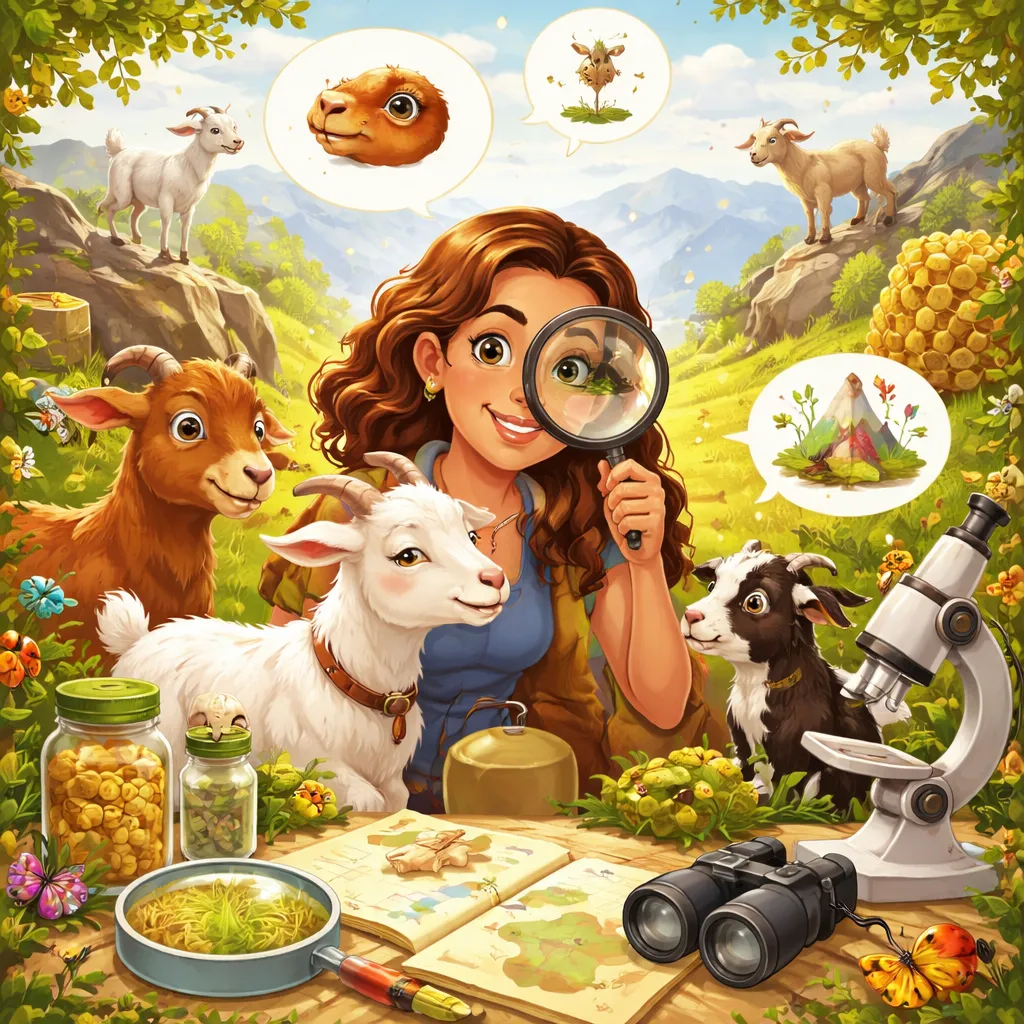

Have you ever watched a goat at a petting zoo or on a farm? Maybe it was standing on a wobbly fence or trying to nibble on someone’s shirt! Goats are curious, smart, and full of energy. Learning about goats takes us on an adventure to rocky hills and sunny farms. Let’s start our journey of learning about these playful and clever animals.
English Language Learning
Vocabulary and Spelling
Our curious friend is called a goat.
The word "goat" is a noun. A noun names a person, place, or thing. So, a goat is a thing—a lively, living animal.
Spelling "goat" is simple: G-O-A-T. The 'G' starts the word, the 'O' and 'A' are in the middle, and the 'T' is at the end. G-O-A-T spells goat.
Sound and Pronunciation
Let’s say the word correctly. It sounds like this: /ɡoʊt/.
We can say it in one clear part. First, say the hard "g" sound, like in "game". Next, say "oht". It rhymes with "boat" or "coat".
Now, blend it together! "G" "oht". Goat! Great!
The word "goat" has just one beat, or one syllable. Clap your hands once: Goat! It’s a short, strong word.
Related Words
Learning about goats is more fun with new words! Here are some important ones.
Baby: A baby goat is called a kid. A young female goat is a doeling.
Sound: The sound a goat makes is a bleat.
Action: Goats love to climb and jump. They are excellent at balancing on rocks and ledges.
A Famous Saying
There is a common saying: "Get someone's goat."
This means to annoy or irritate someone. It’s a fun phrase, but it doesn’t mean you actually take a goat! It’s just a way to say someone is bothered. Remember, we should never actually bother a goat!
Say the saying with me: "Get someone's goat." It’s a playful piece of language.
Now you know the word "goat"! Are you ready to climb into some amazing facts? Let’s jump from words to wonderful knowledge!
Animal Knowledge
Who Are They? – Family and Group
What kind of animal is a goat? Goats are mammals. They have hair, are warm-blooded, and mother goats feed their babies milk.
They are part of the bovine family, in a group called Capra. Their close cousins are sheep. But goats are more independent and love to explore.
What Do They Look Like? – Amazing Bodies
Goats can be as small as a big dog or as large as a child. They have short hair that can be white, black, brown, or spotted. Many goats have two horns on their head and a beard under their chin.
Their hooves are their super tools! A goat’s hoof is split into two toes. The bottom is rubbery for grip, and the edges are hard. This lets them climb steep, rocky places that other animals cannot.
Goats have special adaptations. They have rectangular pupils in their eyes, which help them see almost all the way around to watch for predators. They are ruminants, which means they have a four-chambered stomach to digest tough plants.
Where Do They Live and How? – Home and Habits
Goats live all over the world. Domestic goats live on farms and in villages. Wild goats live in mountains and hilly areas. They are very adaptable.
Goats are herbivores. This means they only eat plants. But they are not picky! They eat grass, leaves, shrubs, and even bark. They are famous for eating almost anything, which is called being browsers.
Goats are very social and live in groups called herds or tribes. They are most active during the day. They spend their time grazing, climbing, playing, and exploring their surroundings.
A Goat’s Life Story – Growing Up
A baby goat is called a kid. Goats are mammals, so kids are born live from their mother. A mother goat, called a doe, usually has one to three kids at a time.
The mother goat is a great caregiver. The kids can stand and walk within minutes of being born! The mother feeds them milk and keeps them close. The kids are very playful and love to jump and run.
Kids grow up quickly. They drink milk for a few months, then start eating plants. They stay with their mother for several months. A goat becomes an adult at about one year old.
How Do They "Talk"? – Communication
Goats talk with sounds and body language. They bleat to talk to their kids and to the herd. Each goat has a unique voice, so friends can recognize each other.
They use their bodies a lot. They might butt heads with each other to play or to figure out who is stronger. They nuzzle and groom each other to show friendship.
Their best senses are their excellent eyesight and sense of smell. Their special rectangular pupils give them a wide view. Their nose helps them find food and recognize their herd mates.
Are They Okay? – Taking Care of Them
Most domestic goats are well cared for. Some wild goat species are threatened because they lose their mountain homes or are hunted.
Problems for goats can include predators, diseases, and not having enough space or the right food. Good farmers make sure their goats are healthy, have clean water, and safe shelter.
You can be a goat friend! You can learn about where goat milk and cheese come from. You can thank farmers for their hard work. If you visit a farm, be gentle and calm. Remember, goats are living beings that deserve kindness.
Life Connections and Inspiration
How to Be With Them – Safety and Love
Goats are usually friendly, but they are also strong and curious. Being around them requires calmness and respect.
If you visit a farm: Always have an adult with you. Move slowly and let the goat come to you. Hold out your hand for it to sniff. Pet it gently on its back or neck. Goats might nibble, so watch your clothes! Never pull their horns or ears.
Owning goats is a big, long-term responsibility. They need a strong fence, a sturdy shelter, fresh water, hay, and a vet. They are herd animals, so they need at least one other goat friend.
We show our love by understanding their playful nature and treating them with gentleness. A happy goat is a healthy, curious goat.
Super Qualities We Learn from Them
Goats teach us wonderful things. One super quality is curious exploration and agility. Goats are natural explorers. They climb to high places to see what’s around. They teach us to be curious, to explore our world, and to be agile in solving problems.
Another quality is resilient adaptability. Goats can live in many different environments, from hot deserts to cold mountains. They eat a variety of plants. This reminds us to be adaptable, to try new things, and to be resilient when faced with challenges.
Think about it: How can you safely explore and learn about the world around you? How can you be more adaptable when your plans change?
Take Action! – Your "Goat Explorer" Project
Let’s do a fun and curious activity! Your project is to build a mini climbing obstacle course for a toy goat.
Find a small toy goat or draw and cut one out of cardboard. Then, use safe household items like cardboard tubes, small boxes, and books. Build a little course with ramps, bridges, and a tall "mountain" (a pile of books). Guide your toy goat through the course. Can it balance on a bridge? Can it climb the mountain? This shows how agile and adventurous goats are. Draw a map of your goat’s exploration!
Closing
Learning about goat adventures is a fantastic journey! We learned the word "goat" and how to say its strong, one-syllable name. We discovered amazing facts about their climbing hooves, their rectangular eyes, and their life in the herd. We know that goats are curious, adaptable animals who provide us with milk and cheese. You can use your new words to tell stories about these playful climbers. You can use your knowledge to appreciate farmers and the food we eat. The animal world is full of curious and resilient teachers. Always remember to treat all animals with kindness, be a curious explorer, and adapt to new situations with a positive attitude. Keep exploring with wonder, climb towards new knowledge, and be a friend to all creatures. Your adventurous spirit and caring heart make you a true friend to the wonderful goat.