
What Is This Animal?
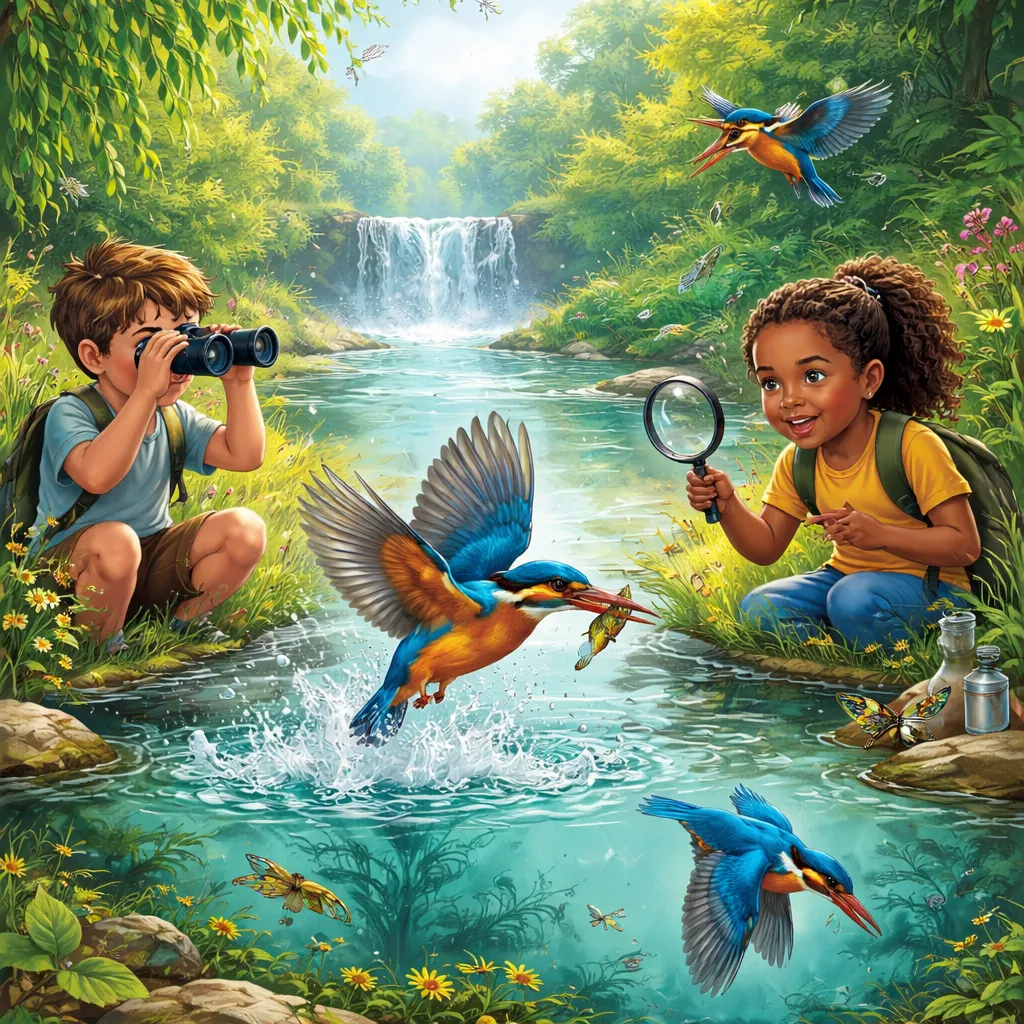
A kingfisher is a small, brightly colored bird with a long, sharp beak. Its feathers are often brilliant blue, green, or orange. It has a large head and short legs. Kingfishers are built for diving. They sit on branches over water and watch for fish.
Kingfishers live near rivers, lakes, and streams. They are found on every continent except Antarctica. They are expert fishers. They dive into the water to catch fish. They hit the water with great speed. Their eyes are adapted to see clearly underwater.
These birds are often heard before they are seen. They make loud, rattling calls as they fly. They fly low over the water. Their wings beat fast. They are solitary birds. They defend their fishing territories.
For children, kingfishers are dazzling. Their bright colors and diving skills make them exciting to watch. Learning about kingfishers teaches children about river habitats, bird adaptations, and the importance of clean waterways.
English Learning About This Animal
Let us learn the English word kingfisher. We say it like this: /ˈkɪŋfɪʃər/. The word has two parts. King sounds like “king.” Fisher sounds like “fish-er.” Put them together: kingfisher. Say it three times. Kingfisher. Kingfisher. Kingfisher.
Now let us learn words about a kingfisher’s body. The beak is long, sharp, and pointed. The feathers are bright blue, green, or orange. The head is large with a crest. The eyes are adapted to see underwater. The chicks are baby kingfishers.
There is a beautiful saying about kingfishers. People say, “The kingfisher is a flash of blue lightning over the water.” This describes their speed and color. Another saying is, “Where the kingfisher dives, the water is clean.” This connects them to healthy rivers.
These English words help children understand kingfisher anatomy. When they say beak, they learn about the fishing tool. When they say chicks, they know the babies. Parents can practice these words while looking at pictures. Point to the parts. Say the words together.
Animal Facts and Science Knowledge
Kingfishers belong to the family Alcedinidae. There are about ninety kingfisher species. The common kingfisher is found in Europe and Asia. The belted kingfisher lives in North America. The kookaburra is a large kingfisher from Australia. It does not eat fish. It eats insects and small animals.
Kingfishers live near water. They need clear water to see fish. They perch on branches, reeds, or rocks. They watch for movement. When they see a fish, they dive. They enter the water headfirst. They catch the fish in their beak. They return to the perch to eat.
Kingfishers are carnivores. They eat fish, insects, crayfish, and frogs. They beat their prey against a branch before swallowing. They swallow fish headfirst to avoid scales catching in their throat. They spit out pellets of bones and scales.
Kingfishers have special abilities. They can see underwater. Their eyes have special lenses that adjust when they enter the water. They can dive from heights. They hit the water with great force without hurting themselves. They can hover briefly before diving.
Kingfishers dig burrows. They nest in tunnels in riverbanks. Both parents dig the tunnel. The tunnel can be three to six feet long. The nest chamber is at the end. They raise one or two broods each year. Both parents feed the chicks.
How to Interact With This Animal Safely
Kingfishers are wild birds. They are not pets. The best way to interact is to watch them from a distance. If you are near a river or lake, sit quietly. Watch for a flash of blue. Listen for their rattling call. Do not try to approach them.
Teach children to respect kingfishers. They are shy birds. They will fly away if people come too close. Using binoculars is a great way to see them. Sit still and wait. Patience is rewarded with a sighting.
If you want to attract kingfishers, keep rivers and lakes clean. Kingfishers need clear water to hunt. They need healthy fish populations. They need riverbanks for nesting. Protecting waterways protects kingfishers.
Never try to catch or touch a kingfisher. They have sharp beaks. They can bite if they feel threatened. They are protected in many countries. Watching them in nature is the best way to enjoy them.
Kingfishers are indicators of healthy water. If you see kingfishers, the water is likely clean. Learning about them helps us understand why we need to protect rivers and streams.
What Can We Learn From This Animal
Kingfishers teach us about patience. They sit and wait for fish. They do not rush. Children learn that waiting can be rewarding. Sitting still, watching, and being patient help us see wonderful things.
Kingfishers teach us about precision. They dive straight and true. Children learn that doing things carefully leads to success. Practicing, focusing, and being accurate are good skills.
Kingfishers teach us about adaptation. Their eyes see underwater. Their beaks are perfect for fishing. Children learn that we all have tools that help us. Using our strengths, learning new skills, and adapting to situations help us thrive.
Kingfishers teach us about clean water. They need healthy rivers. Children learn that taking care of water helps animals. Not littering, saving water, and protecting streams make a difference.
Fun Learning Activities
Let us make learning about kingfisher fun. One activity is the kingfisher dive game. Ask your child to perch on a stool or rock. Watch for a pretend fish. Dive down with hands together like a beak. Catch the fish. Return to the perch. Say “kingfisher dives” and “kingfisher catches fish.”
Another activity is drawing a kingfisher. Look at pictures of kingfishers. Notice the bright blue feathers, long beak, and crested head. Draw a kingfisher on a branch over water. Add a fish below. Label the parts. Say the words aloud.
Create a story about a kingfisher family. Ask your child what the kingfisher does. Does it sit on a branch? Does it dive for fish? Does it feed its chicks? Write a few sentences together. Let your child draw pictures. Read the story aloud.
Make a kingfisher craft. Use blue and orange paper for the feathers. Add a long, sharp beak. Add a crested head. Add large eyes. Move the craft kingfisher. Practice saying “kingfisher dives” and “kingfisher calls.”
Learn about river habitats. Talk about why kingfishers live near water. Name other animals that live in rivers. Use words like “stream,” “perch,” and “ecosystem.”
Learn about bird adaptations. Talk about why kingfishers can dive without hurting themselves. Compare to other birds that hunt in water like herons or ospreys. Use words like “adaptation,” “dive,” and “predator.”
These simple activities bring learning to life. Children build English vocabulary while playing. They learn science through understanding river ecosystems. They develop patience through learning to watch quietly. Learning about kingfisher becomes a journey to rivers and streams. Each moment spent together strengthens language, curiosity, and a growing appreciation for the blue flashes of lightning that teach us that patience, precision, and clean water make the world a brighter place.