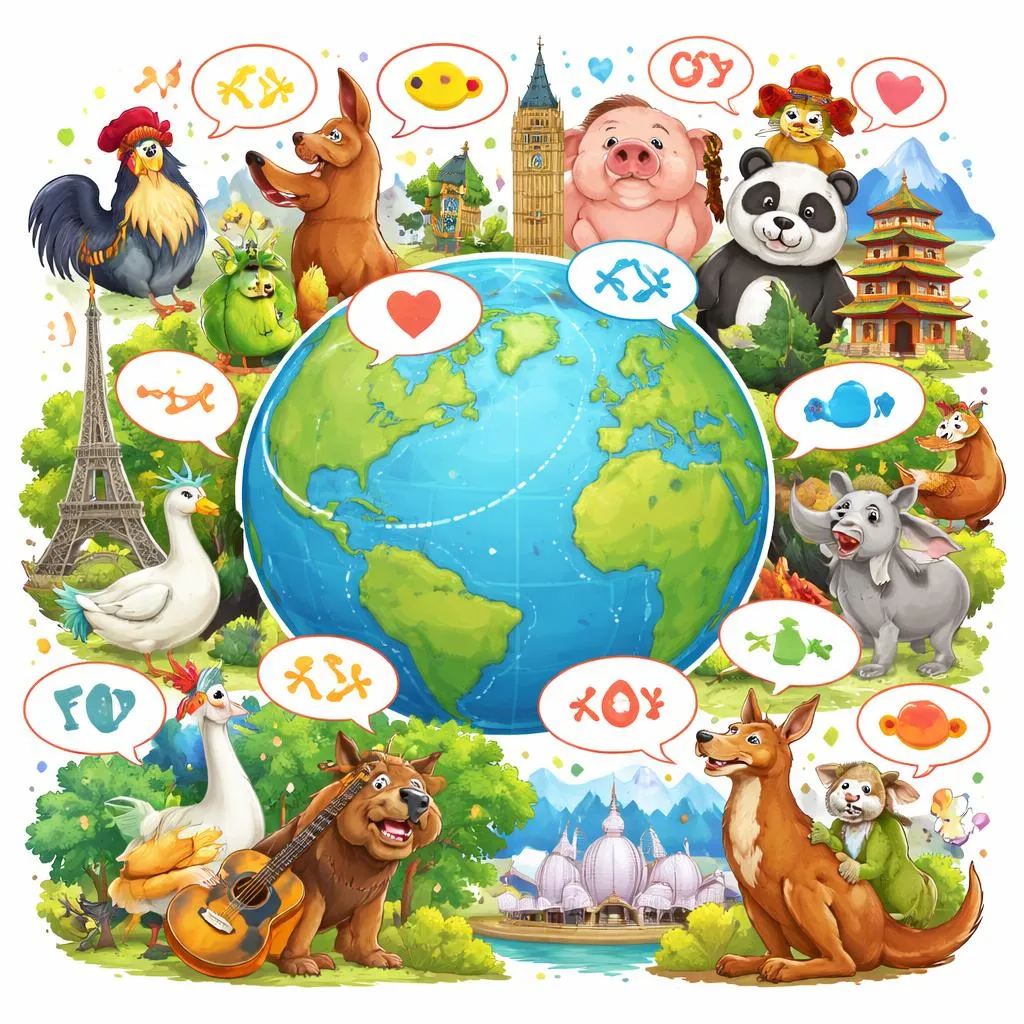

What is animal noises in different languages?
Hello, sound explorers. Today, we are going on a noisy and fun adventure. We are going to learn about animal noises in different languages. Did you know that a dog in England says "woof woof," but a dog in Spain says "guau guau." The animal is the same, but the sound people hear and write is different.
This is because languages have their own special ways of writing sounds. These words are called onomatopoeia. That is a big word for "sound words." Learning about animal noises in different languages shows us how people listen and talk in their own special way. It is not that one is right and one is wrong. They are all just different, and that is what makes it so interesting. Let's listen to the world's animal choir.
Meaning and explanation
So, why do animal noises sound different in different languages? It is not that the animals have accents. A rooster sounds like a rooster everywhere. But the human language tries to copy that sound using its own set of sounds and letters.
Think of your language as a box of building blocks. You can only use the blocks (sounds) in your box to build the animal noise. The English box has the sounds for "moo." The Spanish box might use the sounds for "muu." The Japanese box uses completely different blocks to make "mō mō." People hear the animal and then write down the closest sound their language allows. This is why exploring animal noises in different languages teaches us about the sounds of languages themselves.
Categories or lists
Let's listen to how some common animals "speak" around the world. Remember, these are the words people use to describe the sounds.
Farm Animals: Dog: English: Woof woof / Bow wow. Spanish: Guau guau. French: Ouah ouah. German: Wau wau. Japanese: Wan wan.
Cat: English: Meow. Spanish: Miau. French: Miaou. German: Miau. Japanese: Nyaa nyaa.
Rooster: English: Cock-a-doodle-doo. Spanish: Quiquiriquí. French: Cocorico. German: Kikeriki. Japanese: Kokekokko.
Cow: English: Moo. Spanish: Muu. French: Meuh. German: Muh. Japanese: Mō mō.
Pig: English: Oink oink. Spanish: Oink oink. French: Groin groin. German: Grunz grunz. Japanese: Buu buu.
Wild and Common Animals: Duck: English: Quack quack. Spanish: Cua cua. French: Coin coin. German: Quak quak. Japanese: Ga ga.
Frog: English: Ribbit ribbit. Spanish: Croac croac. French: Coa coa. German: Quak quak. Japanese: Kero kero.
Bee: English: Buzz buzz. Spanish: Bzzz bzzz. French: Bzzz bzzz. German: Summ summ. Japanese: Bun bun.
Lion: English: Roar. Spanish: Grrr. French: Roar. German: Grrr. Japanese: Gao.
Daily life examples
You can listen for these sounds in your own world, even at home. Here are two fun ways.
When You Read a Storybook from Another Country: Many libraries have books from around the world. Find a simple picture book about animals from France or Japan. Read it with a grown-up. When you see the animal, look at the word for its sound. A French book might say the cow goes "Meuh." Try saying it. It is like the book is teaching you a secret code for animal noises in different languages. It makes reading a global adventure.
Playing with Toy Animals or Stuffed Animals: Gather your toy farm. Pick up your toy cow. Make it say "Moo." Then, pretend your cow is on a vacation in Spain. Make it say "Muu." Now your cow is in Japan. Make it say "Mō mō." You can do this with all your toy animals. This imaginative play is a perfect, no-pressure way to practice and remember the different sounds. You are the director of a global animal symphony.
Printable flashcards
Printable flashcards are a super way to see and hear the differences. Create "Global Animal Sound" matching cards.
Make cards in sets of three. One card has a picture of a dog. The second card says "WOOF" with a British flag. The third card says "GUAU" with a Spanish flag. Do this for several animals. Kids can match the animal to its sounds from two different countries. This builds visual and auditory connections.
Another fun idea is a "Passport of Animal Noises." Print a small booklet. Each page is for a different country. The page has the country's flag, and space to write or draw an animal and its local sound. "In Japan, a cat says: Nyaa." Kids can collect "stamps" or stickers as they learn the sounds from each place, turning it into a learning journey.
Learning activities or games
Let's play "Global Animal Charades." Write the names of animals on one set of cards. Write names of countries on another set (USA, Spain, France, Japan). A player picks one animal card and one country card. They must act out the animal AND make the sound it makes in that country. Can they be a French rooster going "Cocorico." Can they be a Japanese frog going "Kero kero." The other players guess both the animal and the country. This game is hilarious and unforgettable.
Try the "Sound Bingo" game. Create bingo cards with pictures of animals in the squares. The caller doesn't say the animal's name. Instead, they make the animal noise in a specific language. "The animal in Spain says 'Guau'." Players must find the dog on their card and mark it. The first to get a line shouts "Bingo" and must name the animal in English. This sharpens listening skills and memory for animal noises in different languages.
Create a "World Animal Choir" performance. Divide the class into groups. Assign each group a country and an animal. Their task is to learn that animal's sound in their assigned language. Then, as a conductor points to each group, they make their sound. A "Japanese cat" group says "Nyaa." A "Spanish dog" group says "Guau." Create a simple rhythm or song. This collaborative, musical activity celebrates the wonderful diversity of animal noises in different languages in a joyful, shared experience. It shows that our world is full of many beautiful and funny ways to hear the same creatures.