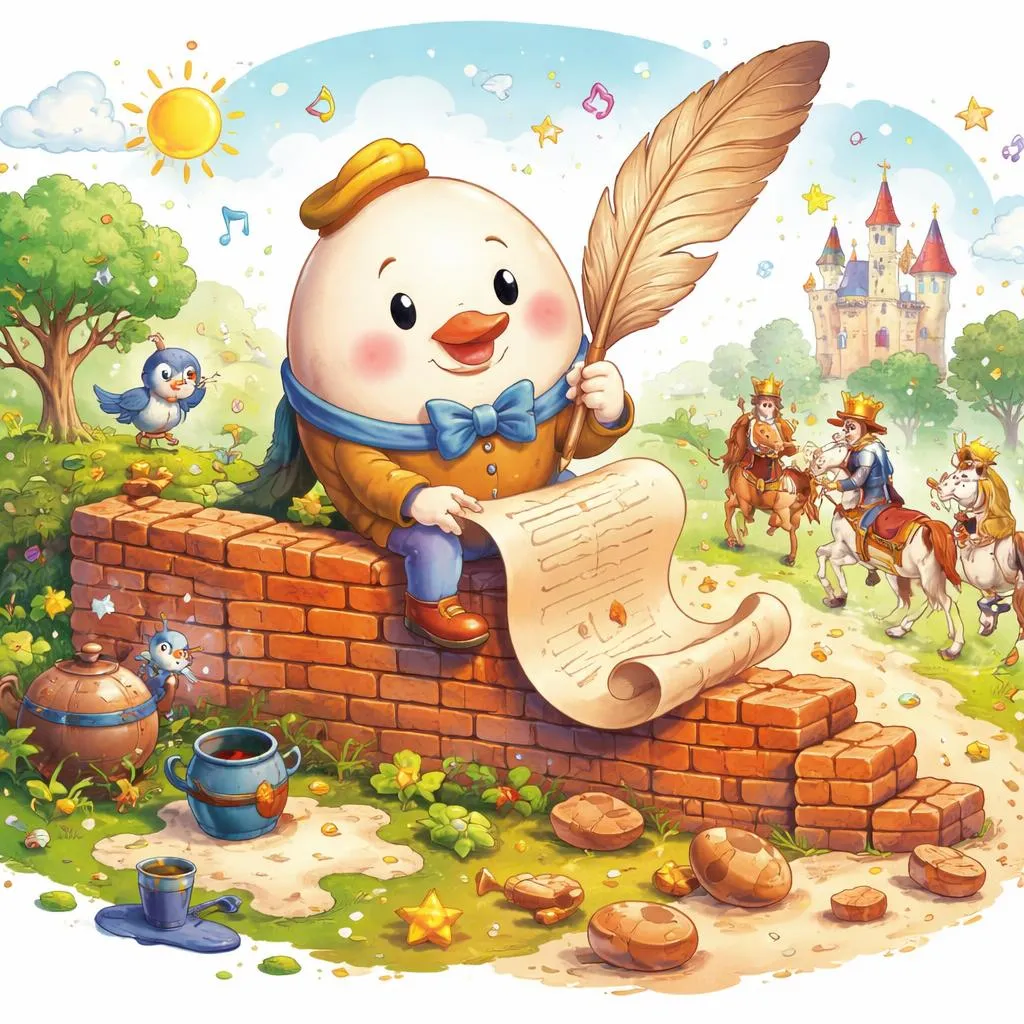

There is something about Humpty Dumpty that captures children's imaginations. He is an egg-shaped character sitting on a wall. He has a great fall. And no one can put him together again. The famous "humpty dumpy lyrics" have been recited for centuries. Children love the rhythm. They love the sad but funny story. As teachers, we can use this classic rhyme to teach sequencing, rhyming words, and even lessons about problem-solving. Let's explore how to bring this egg-shaped character into our classroom.
What Is the Humpty Dumpty Rhyme? This is one of the most famous English nursery rhymes. It dates back to the late 18th century. The rhyme tells a short, simple story. Humpty Dumpty sits on a wall. He falls off. All the king's horses and all the king's men cannot put him together again.
The character is usually depicted as an egg. Interestingly, the original rhyme never says Humpty is an egg. That became part of the tradition later. The phrase "humpty dumpy lyrics" brings to mind this unfortunate character and his famous fall. The rhyme is short but powerful. It creates a complete story in just four lines.
The Lyrics of the Nursery Rhyme Let's look at the most common version of the lyrics.
Humpty Dumpty sat on a wall, Humpty Dumpty had a great fall. All the king's horses and all the king's men Couldn't put Humpty together again.
That is the entire rhyme. It is short and simple. But within these four lines, we have a complete story with a beginning, middle, and end. The "humpty dumpy lyrics" are perfect for young learners because they are easy to memorize and recite.
Some versions add a second verse, but the first verse is the most famous and widely used.
Vocabulary Learning: Words from the Rhyme This short rhyme introduces several useful words.
Humpty Dumpty: The name of the character. It is a fun, bouncy name to say.
Sat: Past tense of sit. He was sitting on the wall.
Wall: A structure that divides or encloses an area. Walls can be high or low.
Great: Very big or important. A great fall means a big fall.
Fall: The act of dropping down from a higher place.
King's: Belonging to the king. The ruler of a country.
Horses: Animals that people ride. In this rhyme, they represent the king's soldiers on horseback.
Men: People, specifically the king's soldiers.
Couldn't: Could not. They were not able to do something.
Together: In one piece. Joined as a whole.
Again: Once more. Back to the original state.
These words create a complete story picture. The "humpty dumpy lyrics" give us a rich vocabulary lesson in just four lines.
Phonics Points: Sounds in the Rhyme The rhyme is excellent for phonics practice, especially rhyming.
Rhyming Words: The rhyme uses a simple AABB pattern.
Wall and fall rhyme.
Men and again rhyme.
We can point out these rhymes. We can ask students to listen for words that sound the same at the end. This builds phonemic awareness.
The "H" Sound: "Humpty" and "had" start with the /h/ sound. We practice this sound. We feel the air from our lungs.
The "S" Sound: "Sat" starts with the /s/ sound. We feel the air hiss out between our teeth.
The "G" Sound: "Great" starts with the /g/ sound. We feel the back of our tongue.
The "F" Sound: "Fall" starts with the /f/ sound. We feel our top teeth on our bottom lip.
The "K" Sound: "King's" starts with the /k/ sound. We feel the back of our tongue.
The repetition in the "humpty dumpy lyrics" gives us many chances to hear and practice these sounds.
Grammar Patterns: Language in the Rhyme The short rhyme contains several useful grammar patterns.
Past Tense: The rhyme uses past tense throughout. "Sat" and "had" are past tense verbs. We are telling a story about something that already happened. We can contrast with present tense. "Now Humpty sits on the wall." "Yesterday he sat on the wall."
Proper Nouns: "Humpty Dumpty" is a proper noun. It is the character's name. We always capitalize names.
Possession: "King's" shows possession. The horses and men belong to the king. We can practice this pattern. "Teacher's book." "Student's pencil."
Contractions: "Couldn't" is a contraction of "could not." We explain that we put words together to speak faster.
Negatives: "Couldn't" also shows the negative. They were not able to fix Humpty. We can practice other negatives. "I can't fly." "She doesn't have a pet."
The simple structure of the "humpty dumpy lyrics" makes it perfect for introducing these grammar concepts.
Learning Activities: Bringing the Rhyme to Life Here are some activities to deepen the learning experience.
Activity 1: Build a Wall We provide blocks or small boxes. Students work together to build a wall. We place a toy egg (Humpty) on top. Then we act out the rhyme. The egg falls. We try to put it together again. This makes the story physical and real.
Activity 2: Humpty Art Students draw or paint their own Humpty Dumpty. They can give him a face, clothes, and maybe even a little wall to sit on. They can practice writing the first line of the "humpty dumpy lyrics" under their picture.
Activity 3: Egg Experiment We bring in a real egg. We talk about how fragile it is. We carefully drop it (into a container to contain the mess). We see that we cannot put it back together. This science connection makes the rhyme even more meaningful.
Activity 4: Problem-Solving Discussion We ask the class an important question. "How could we help Humpty?" Students brainstorm ideas. A pillow to catch him? A safer wall? A helmet? This extends the rhyme into creative thinking and problem-solving.
Activity 5: Acting Out the Rhyme Students take turns being Humpty. One student sits on a low, safe "wall" (a cushion or low step). They act out sitting and falling. Other students are the king's horses and men who try to help. This dramatic play builds comprehension and empathy.
Printable Materials: Visuals for the Classroom Printables support the lesson and provide independent practice.
Vocabulary Flashcards: We create cards for key words. Wall, egg, king, horse, men. Pictures help children remember the meanings.
Sequencing Cards: We create cards showing the events of the rhyme. Humpty sitting on the wall. Humpty falling. The king's horses and men trying to fix him. Humpty still broken. Students put the cards in order.
Coloring Page: We provide a coloring page showing Humpty Dumpty sitting on a wall. Students can color the scene. They can practice writing the "humpty dumpy lyrics" at the bottom.
Puppet Templates: We provide simple templates for making Humpty puppets with craft sticks. Students can use their puppets to act out the rhyme.
Educational Games: Making Learning Playful Games turn the rhyme into an interactive experience.
Game 1: Humpty Says This is a variation of Simon Says using the rhyme. "Humpty says touch your nose." "Humpty says pat your head." "Fall down!" (without Humpty says) means students should not move. This gets them moving while connecting to the character.
Game 2: What Comes Next? We recite the rhyme but pause before key words. "Humpty Dumpty sat on a..." The class shouts "WALL!" "Humpty Dumpty had a great..." The class shouts "FALL!" This builds memory and anticipation.
Game 3: Rhyming Match We take words from the rhyme and other simple words. Wall, fall, ball, tall. Men, again, ten, pen. Students match the rhyming pairs. This reinforces the rhyming pattern.
Game 4: Humpty's Wall Relay We set up two piles of blocks at one end of the room. Teams race to build a wall for Humpty, one block at a time. When the wall is built, they place a toy egg on top. This combines teamwork with the theme.
Game 5: Create a New Ending We challenge students to create a new ending for Humpty's story. What if the king's men had glue? What if a friendly bird caught him? What if he landed on a soft pillow? This extends creativity and language skills. It builds on the pattern of the "humpty dumpy lyrics" .
By using these strategies, we transform a simple four-line rhyme into a rich learning experience. We explore vocabulary, phonics, grammar, and creative thinking. Humpty Dumpty becomes a beloved classroom friend. His story teaches us about rhyming, problem-solving, and the importance of being careful. And we never get tired of wondering what might have happened if those king's men had brought some glue.