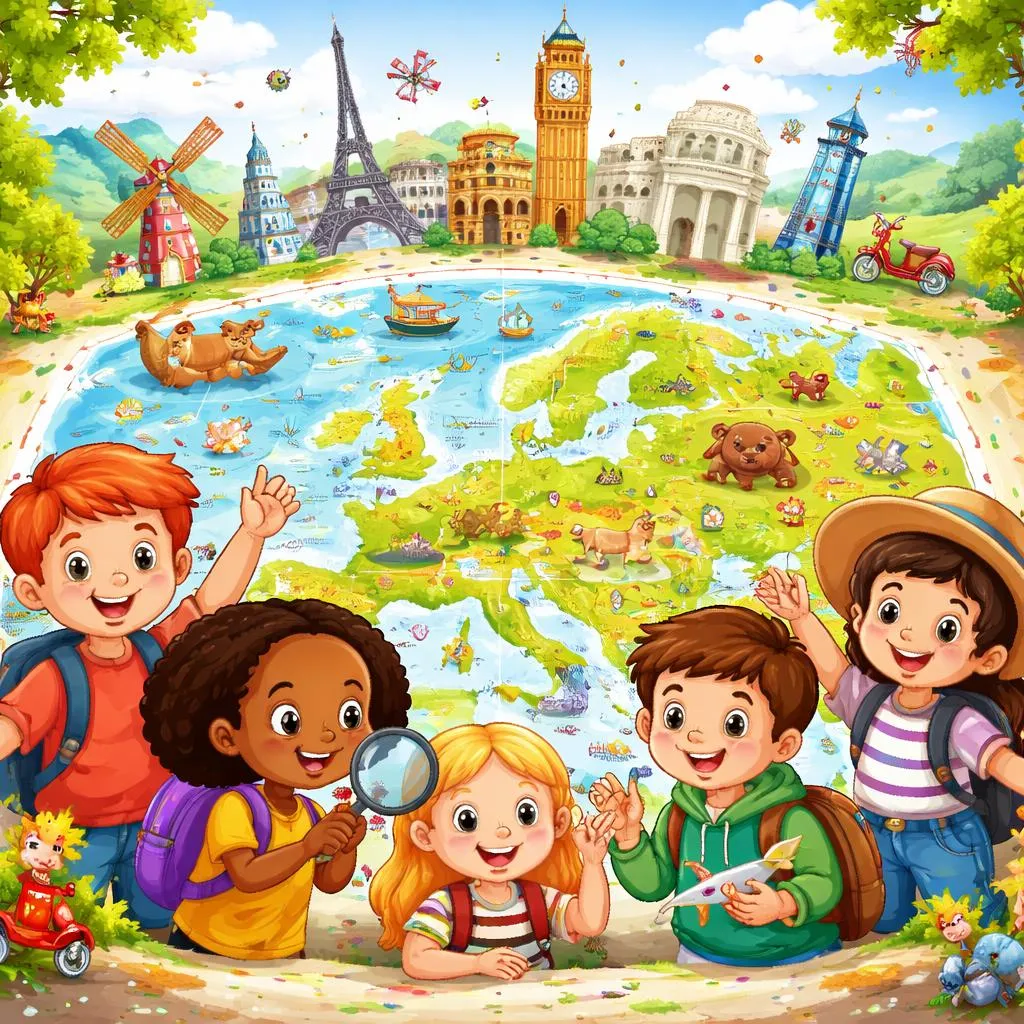

Hello, young explorers and world citizens. Are you ready for a special trip. We are not going to travel in a car or a plane. We are going to travel with our minds. Our destination is a big idea. The idea is the word "european." This is a word you might hear. What does it mean. Let us put on our explorer hats. Let us discover the meaning of european together. It is a word that opens a door to a whole part of our world.
What is european?
The word "european" is an adjective. It is a describing word. It describes something that comes from Europe. What is Europe. Europe is one of the world's seven continents. A continent is a very large area of land. So, if something is european, it belongs to or comes from Europe. A person from France is a european person. A car made in Germany is a european car. Food from Italy is european food. The word helps us group things. It tells us about their origin. Their origin is where they started.
Think of the word "european" as a label. It is a friendly label. It does not mean better or worse. It just tells us a connection. Just like "american" means from America, "european" means from Europe. It is a simple but powerful word. Learning it helps you understand maps, stories, and people. It makes the big world feel a little smaller and friendlier. Now, let us look closer at what this word really means.
Meaning and explanation
The meaning of european is all about connection to a place. Let us explain. The word describes many things. It can describe people. A european person is someone who was born in Europe or lives in Europe. It can describe objects. A european painting is a painting made by an artist in Europe. It can describe languages. English, French, Spanish, and Italian are all european languages. They started in Europe.
The explanation is in the details. Europe is not a country. It is a continent with many countries inside it. Countries like the United Kingdom, France, Spain, Italy, and Germany are all in Europe. So, something can be from a specific country and also be european. A french croissant is from France. France is in Europe. So, the croissant is also a european food. The word european is the bigger group. The country name is the smaller, specific group. Understanding this helps you when you read books or watch shows about different places. You can say, "This story is set in a european castle." It gives everyone a general idea of the location.
Categories or lists
We can think about european things in different categories. This makes the idea clear and fun. One category is European Countries. This is a list of places. Some well-known countries are: France, Germany, Italy, Spain, the United Kingdom, Greece, Sweden, and the Netherlands. Another category is European Languages. People in Europe speak many languages. English, French, German, Spanish, Italian, Greek, Polish, Dutch.
We also have a European Foods category. This is a yummy list. Pizza and pasta from Italy. Croissants from France. Fish and chips from the United Kingdom. Paella from Spain. Chocolate from Belgium. Another fun category is European Landmarks. These are famous buildings or places. The Eiffel Tower in France. Big Ben in London. The Colosseum in Italy. The Parthenon in Greece.
We can also list European Animals. Animals that are common in Europe. The red fox, the brown bear, the wolf, the red squirrel, the hedgehog. Thinking in these categories answers the question "what is european?" with examples. It shows that "european" is not one thing. It is a big family of countries, languages, foods, and animals that share a home continent. Learning these lists is like collecting stamps from different european places.
Daily life examples
You can find european things in your daily life. Here are some scenes. First, a trip to the supermarket. Go to the cheese section. You might see "cheddar" from England. You might see "brie" from France. These are european cheeses. In the cookie aisle, you might see "biscuits" from Scotland. In the international foods aisle, you might see pasta from Italy. You can point and say, "This is a european food." This connects the word to things you can touch and eat.
Second, in your school or home library. Look for books about knights, castles, or ancient Greece. These stories often have european settings. You can say, "I am reading a book about european history." You might learn about artists like Vincent van Gogh from the Netherlands. You can say, "Van Gogh was a european painter." When you watch cartoons, some might be made in Europe. Like "Peppa Pig" is from the United Kingdom. You can say, "I like this european cartoon."
Third, think about holidays or festivals. You might celebrate Christmas. Many christmas traditions, like decorating a tree, started in Europe. You can say, "We have some european holiday traditions." You might eat a gingerbread house. That tradition is from Germany. Even in your play, you might have toys or games that started in Europe. Lego bricks are from Denmark. Using the word european in these everyday moments makes it a normal, useful part of your vocabulary. It helps you see the connections between your life and the wider world.
Printable flashcards
Printable flashcards are a great way to learn about european things. How to make them. You can make a set of "European Country Cards." On one side, put the flag of a country, like the flag of Italy. On the other side, write the country name "Italy" and a fun fact. "Capital city: Rome. Famous for pizza." Do this for several countries. You can also make "European Food Cards." One side has a picture of a croissant. The other side says "Croissant. From France."
Another idea is "European Vocabulary Cards." Have cards with words like "castle," "painting," "language," "continent." On the other side, have a simple definition and a note saying these are often linked to Europe. How to use the cards. Play a matching game. Match the country flag to its name. Play "Go Fish" with the food cards. "Do you have a card for pizza?" You can also sort the cards. Sort the country cards by region. Or sort all cards into "Things from Europe" and "Things from other places." Printable flashcards make learning about european topics visual and interactive. You are not just reading. You are playing a matching game that teaches you geography and culture.
Learning activities or games
Learning about european culture should be an adventure. Let us play some games. First, "European Country Bingo." Make bingo cards with pictures of flags or famous landmarks from different european countries. Call out the country names. Players mark the matching picture on their card. First to get a line wins. This is a fun way to learn to recognize flags and names.
Second, play "Passport to Europe." Create a simple paper passport. Each page is for a different european country. Set up stations around the room. Each station represents a country. At the Italy station, you might taste a small piece of bread (like a mini pizza). At the France station, you might try to say "Bonjour." At the UK station, you might color a picture of a red bus. Get a stamp in your passport at each station. This activity is full of movement and small experiences.
Third, the "European Food Tasting Party." This is a yummy activity. With a parent's help, prepare or buy small samples of safe european foods. Small pieces of different breads, slices of apple (like from France), a piece of mild cheese, a small piece of chocolate. Talk about where each food is from. Use the word european. "This is european chocolate from Belgium." This engages the senses and makes learning delicious.
For a craft, make "European Flag Windsocks." Choose a few european flags. Use construction paper to create simple wind sock designs based on the flag colors. Hang them up. As you make each one, talk about the country it represents. For a storytelling game, play "Once Upon a Time in Europe." Start a fairy tale. "Once upon a time, in a european castle..." Each person adds a sentence. The story must include something european, like a knight, a forest, or a special food. This sparks imagination. Play these games and the word european will become a doorway to a fascinating part of our world.