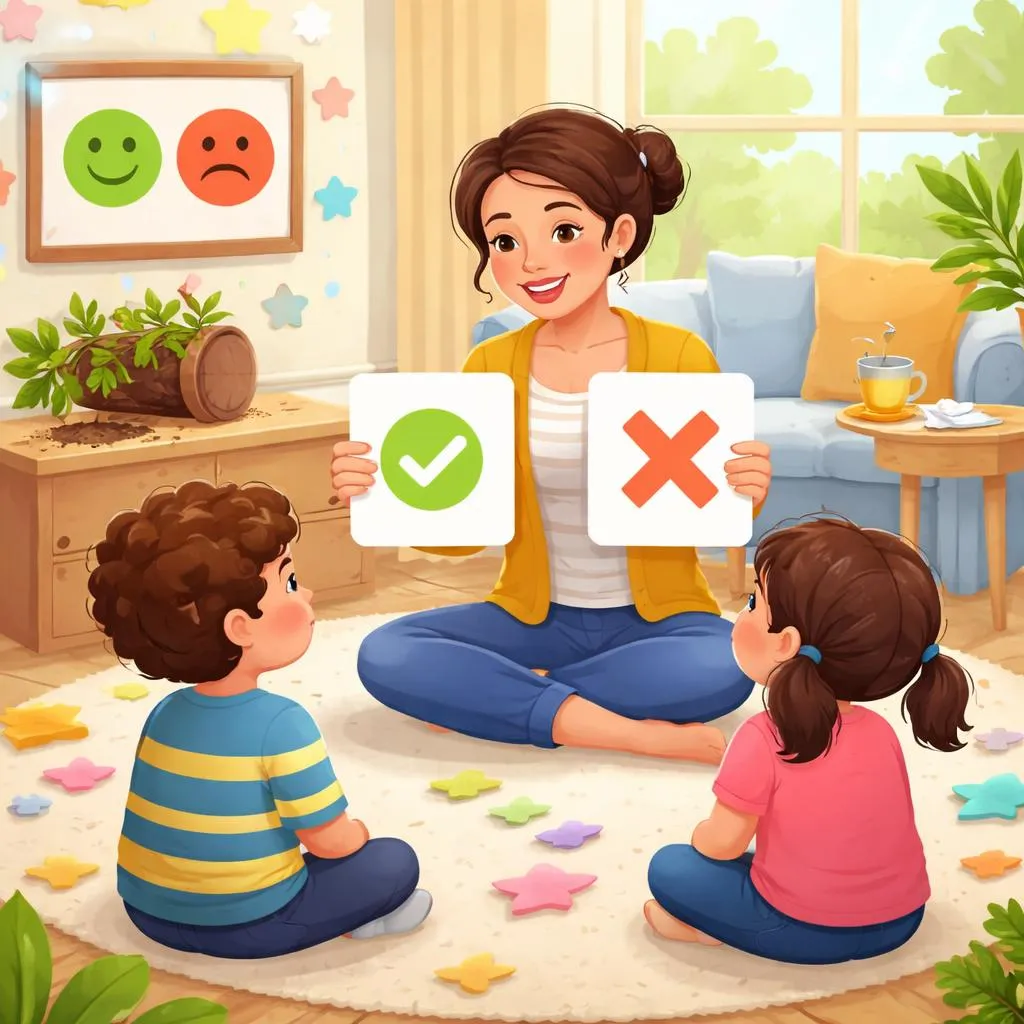

Teaching children about modal verbs helps them express advice, obligation, and right and wrong. The phrase "ought not" is a polite but firm way to tell someone something is not a good idea. Today, we are going to explore the meaning of ought not and discover how to help young learners understand and use this important phrase correctly.
Meaning Let us start with the basic question. What does "ought not" mean? "Ought not" is a phrase used to express that something is not advisable, not morally right, or not the proper thing to do. It is the negative form of "ought to."
"We ought not run in the hallway." This means running in the hallway is not a good idea. It might be dangerous or against the rules.
"You ought not eat too much candy." This means eating too much candy is not healthy. It is not advisable for your body.
"They ought not be late for school." This means being late is not the right thing to do. It is important to be on time.
"Ought not" is similar in meaning to "should not" but is slightly more formal and carries a stronger sense of moral obligation.
Conjugation The phrase "ought not" does not conjugate like regular verbs. "Ought" is a modal auxiliary verb. This means it does not change form based on the subject. It stays the same for everyone.
I ought not You ought not We ought not They ought not He ought not She ought not It ought not
Notice that we do not add an "s" for he, she, or it. "He ought not" is correct. "He oughts not" is wrong.
After "ought not," we use the base form of the main verb. We do not add "to" after "not" in the negative form, though in positive statements we use "ought to."
Positive: "You ought to listen." Negative: "You ought not listen."
Present Tense We use "ought not" in the present tense to talk about things that are not advisable now or in general.
"We ought not make too much noise. The baby is sleeping." This is advice for the present moment.
"She ought not wear sandals in the snow. Her feet will get cold." This is general advice about appropriate clothing.
"They ought not play ball in the house. They might break something." This is a rule about behavior.
"He ought not eat so fast. It is bad for digestion." This is general health advice.
In the present tense, "ought not" expresses that something is not a good idea in general or right now.
Past Tense To talk about past situations where something was not advisable, we use "ought not have" followed by the past participle of the main verb.
"I ought not have eaten so much cake. Now I feel sick." This means eating too much cake was a bad idea, and now there is a consequence.
"She ought not have gone out without a coat. She caught a cold." This means going out without a coat was not advisable, and it led to getting sick.
"They ought not have played so rough. Someone got hurt." This means playing rough was a bad choice, and someone was injured.
Notice the pattern: ought not + have + past participle. This structure talks about past actions that were not advisable.
Future Tense For future situations, we use "ought not" with future time words. The modal verb itself carries the meaning, so we do not add "will."
"We ought not go to the beach tomorrow if it rains." This means going to the beach is not advisable if the weather is bad.
"You ought not stay up too late tonight. You have school tomorrow." This means staying up late is not a good idea for the future.
"They ought not buy that car. It looks broken." This is advice about a future purchase.
The context of future time is shown by words like "tomorrow," "tonight," or "next week," not by changing the verb.
Questions Forming questions with "ought" is less common in modern English, but children may encounter it in stories. Usually, we use "should" for questions instead.
Traditional question form: "Ought we to go now?" This is grammatically correct but sounds very formal.
More common: "Should we go now?" Children will hear "should" much more often in questions.
For negative questions with "ought," the pattern is: "Ought we not to go?" or the contraction "Oughtn't we to go?"
In everyday English, children will rarely need to form questions with "ought." We teach them to recognize it but use "should" for their own questions.
Other Uses of Ought Not Beyond advice and obligation, "ought not" has other uses in English.
Moral Wrongness: "You ought not lie to your parents." This expresses that lying is morally wrong.
Social Expectations: "We ought not wear jeans to the wedding." This expresses what is socially appropriate.
Logical Deduction: "He ought not be home yet. He only left five minutes ago." This expresses a logical conclusion about what is probably not true.
Polite Refusal: "I ought not have another piece of cake, thank you." This is a polite way to decline something offered.
These different uses show how "ought not" expresses various kinds of "not advisable" situations.
Learning Tips for Ought Not Teaching "ought not" requires specific strategies. Here are tips that work well with young learners.
Start with concrete examples from children's lives. "We ought not run in the classroom." "You ought not touch a hot stove." These are rules they already understand.
Contrast with "should not" which is more common. Explain that "ought not" means the same thing but is a little more formal.
Use stories to show situations where characters make bad choices. Discuss what they ought not have done.
Practice the past form separately. "Ought not have" is tricky. Give many examples: "I ought not have eaten that." "She ought not have said that."
Use polite contexts. "Ought not" can sound gentler than "should not" in some situations. "You ought not interrupt" sounds like advice rather than a command.
Common Mistakes with Ought Not Children make predictable mistakes with "ought not." Knowing these helps us address them gently.
One common mistake is adding "to" after "not." "You ought not to run" is actually correct in some contexts, but the simpler "you ought not run" is fine. The pattern can be confusing.
Another mistake is conjugating "ought." "He oughts not" is wrong. Remind children that "ought" stays the same for everyone.
Some children use "ought not" for past without "have." "I ought not eat that yesterday" should be "I ought not have eaten that yesterday." Practice the past pattern.
Word order in questions can be tricky. "Ought we to go?" sounds strange to modern ears. Reassure children that using "should" for questions is fine.
Educational Games for Ought Not Games make grammar practice fun and memorable. Here are some games to practice using "ought not."
Good Choice/Bad Choice Game: Present scenarios. Children decide if it is a good choice or a bad choice. For bad choices, they say what someone ought not do. "He ought not run in the hall." "She ought not eat candy before dinner."
Advice Game: One child describes a problem. Others give advice using "ought not." "I have a tummy ache." "You ought not eat so fast." "You ought not eat too much candy."
Story Finish: Start a story about someone making a bad choice. Children finish with what they ought not have done. "Maria ate ten cookies. She..." Children finish: "ought not have eaten so many."
Role Play: Children act out situations where one person gives advice using "ought not." A parent talking to a child about safety. A friend advising another friend. This makes the language practical.
Picture Cards: Show pictures of situations. A child reaching for a hot stove. A child running with scissors. A child not wearing a coat in the snow. Children say what the person ought not do.
Using Ought Not in Stories Stories are wonderful for practicing "ought not." Many children's books show characters making bad choices.
"Goldilocks and the Three Bears" shows Goldilocks making many bad choices. She ought not have entered the house. She ought not have eaten the porridge. She ought not have broken the chair.
"The Boy Who Cried Wolf" shows a boy who ought not have lied. His lies cause problems later.
While reading, pause and discuss. "What ought the character not have done?" This builds comprehension and moral reasoning.
Ought Not vs. Should Not Children will hear "should not" much more often than "ought not." We can explain the difference.
"Should not" is more common in everyday speech. "You should not touch that."
"Ought not" is slightly more formal and often carries a stronger sense of moral obligation. "You ought not lie" sounds more serious than "you shouldn't lie."
In most situations, both are correct. Children can use whichever feels more comfortable.
Ought Not in Songs and Rhymes Some traditional songs and rhymes use "ought." "Oh, dear, what can the matter be? Johnny's so long at the fair. He promised to buy me a trinket to please me, and then for a kiss, oh, he ought not to tease me."
Hearing "ought" in songs helps children recognize it even if they do not use it often themselves.
As we explore ought not with young learners, we help them express advice and moral judgments in a polite, thoughtful way. They learn to say what is not advisable, not right, or not proper. Through games, stories, and discussions, this phrase becomes part of their language for talking about choices and consequences.