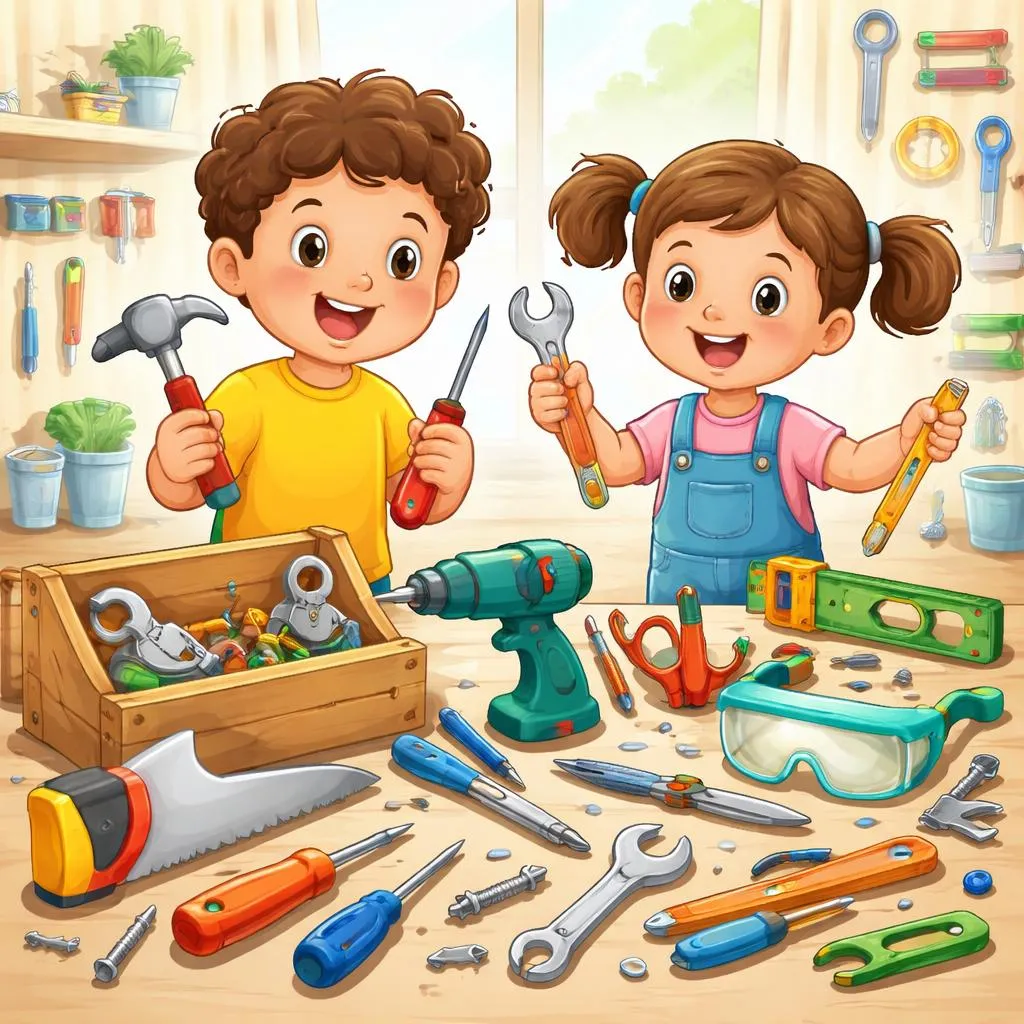

Hello, young builders and wonderful teachers! Today we explore the wonderful world of tools. Tools help us fix things and create things. They help us build and repair. Having a complete names of tools list helps children understand how things work. It builds vocabulary for hands-on activities. It gives them words to ask for what they need. Let us discover hammers, screwdrivers, wrenches, and more. Let us learn what each tool does and how to use it safely.
What Are Tools? Tools are objects that help people do work. They make tasks easier and faster. Some tools are simple, like a hammer. Some are more complex, like a drill. Each tool has a special job.
People have used tools for thousands of years. Early humans used stones as tools. Now we have many different tools for many different jobs. Tools help us build houses, fix cars, make furniture, and create art.
Learning tool names helps children understand the world around them. They see adults using tools and want to help. Knowing the names gives them words to ask questions and learn more.
Meaning and Explanation of Common Tools Each tool has a specific purpose. Understanding what tools do helps children remember their names.
Hammer: A hammer drives nails into wood. It has a heavy head and a handle. The flat part hits the nail. Some hammers have a curved claw for pulling nails out.
Screwdriver: A screwdriver turns screws. It has a tip that fits into the screw head. Different screwdrivers have different tips. Flathead screwdrivers work for screws with one slot. Phillips screwdrivers work for screws with a cross shape.
Wrench: A wrench turns nuts and bolts. It grips the sides of the nut. Some wrenches are adjustable. They can fit different sizes. Some are fixed size for specific nuts.
Pliers: Pliers grip, bend, or cut things. They work like strong fingers. They have two handles and a jaw. Some pliers can cut wire. Some can hold small objects tightly.
Saw: A saw cuts wood or other materials. It has a sharp blade with teeth. The teeth bite into the material as the saw moves back and forth. Different saws cut different materials.
Tape Measure: A tape measure measures length. It has a long, flexible ruler that rolls up inside a case. It helps people measure things accurately before cutting or building.
Level: A level checks if things are straight. It has a small tube of liquid with a bubble. When the bubble is in the center, the surface is level. This helps make things that don't wobble.
Drill: A drill makes holes. It spins a drill bit quickly. The bit cuts into wood, metal, or other materials. Some drills are electric. Some are hand-powered.
Sandpaper: Sandpaper smooths rough surfaces. It has small sharp particles on paper. Rubbing it on wood makes the wood smooth.
Clamp: A clamp holds things together tightly. It works like a strong hand that does not let go. This helps when gluing or cutting.
Categories or Lists of Tool Names Organizing tools into categories helps learning. Here is a complete names of tools list organized by type.
Hand Tools: These tools use human power. No electricity needed. Hammer, screwdriver, wrench, pliers, saw, file, chisel, hand plane, clamp, level, tape measure, utility knife, crowbar, mallet, vise
Measuring Tools: These tools help measure things accurately. Tape measure, ruler, yardstick, level, square, protractor, caliper, measuring tape, carpenter's square
Cutting Tools: These tools cut through materials. Saw, scissors, utility knife, wire cutters, tin snips, hacksaw, bolt cutters, pipe cutter, glass cutter
Fastening Tools: These tools join things together. Hammer and nails, screwdriver and screws, wrench and bolts, stapler, glue gun, rivet gun, nail gun
Shaping Tools: These tools change the shape of materials. File, sandpaper, plane, chisel, rasp, grinder, sander
Garden Tools: These tools work in the yard. Shovel, rake, hoe, trowel, pruning shears, wheelbarrow, garden fork, edger, loppers, hedge trimmers
Painting Tools: These tools help with painting projects. Paintbrush, paint roller, paint tray, scraper, sandpaper, drop cloth, painter's tape, extension pole
Electrical Tools: These tools work with electricity. Wire strippers, voltage tester, multimeter, fish tape, crimping tool
Plumbing Tools: These tools work with pipes. Plunger, pipe wrench, basin wrench, plumber's snake, hacksaw, tubing cutter
Power Tools: These tools use electricity or batteries. Drill, circular saw, jigsaw, sander, grinder, router, planer, impact driver
Daily Life Examples of Tools Tools appear in many places in daily life. Pointing them out helps children learn naturally.
At home, tools are often in the garage or basement. "Daddy uses a hammer to hang pictures." "We need a screwdriver to fix the toy." These comments connect tool names to real uses.
In the kitchen, some tools are familiar. "Use the scissors to open this package." "Hand me the can opener, please." Children learn that tools are everywhere.
At the playground, tools built the equipment. "Workers used wrenches to put together the slide." "They used levels to make sure the swings are straight." This builds appreciation for how things are made.
In stores, tools are on display. Point out tools in hardware stores or home improvement sections. Name them and explain what they do.
Printable Flashcards for Tool Names Flashcards help children learn tool vocabulary visually. They provide clear images with words.
Hand Tool Flashcards: Create cards showing common hand tools. Hammer, screwdriver, wrench, pliers, saw, level. Each card has a clear picture and the word.
Measuring Tool Flashcards: Create cards for measuring tools. Tape measure, ruler, level, square. Children learn to recognize these important tools.
Garden Tool Flashcards: Create cards for garden tools. Shovel, rake, hoe, trowel, pruning shears. These are tools children might see in the yard.
Power Tool Flashcards: Create cards for power tools. Drill, saw, sander. Explain that these need electricity or batteries.
Safety Tool Flashcards: Create cards for safety equipment. Safety goggles, work gloves, ear protection, dust mask. This teaches important safety vocabulary.
Use the cards for games. Hold up a card and name the tool. Ask children what each tool does. Play memory match with two sets.
Learning Activities or Games for Tool Names Games make learning tool names active and fun.
Tool Matching Game: Gather real or toy tools. Have children match each tool to a card with its name. They can also match tools to pictures of what they do. Hammer with a nail. Screwdriver with a screw.
What Does It Do?: Hold up a tool. Ask children to describe what it does. "This is a hammer. It hits nails." "This is a saw. It cuts wood." This builds understanding of tool functions.
Tool Scavenger Hunt: Hide tool pictures around the room. Children find them and bring them to a toolbox. They name each tool as they put it in. This combines movement with learning.
Fix-It Pretend Play: Set up a pretend repair shop. Provide toy tools and items to "fix." Children pretend to be repair people. They use the tools and name what they are doing.
Tool Sort: Gather pictures of different tools. Have children sort them by category. Cutting tools in one group. Measuring tools in another. Fastening tools in another. This builds categorization skills.
Printable Materials for Tool Names Printable resources support tool vocabulary learning. They provide structure for activities.
Tool Coloring Pages: Create coloring pages showing different tools. Children color them and practice saying the names. This reinforces vocabulary quietly.
Tool Matching Worksheets: Create pages where children match the tool picture to its name. Draw a line from the hammer to the word "hammer."
Tool Box Craft: Create a paper toolbox template. Children color and cut it out. They add tool pictures inside. This creates a personal tool vocabulary book.
Tool Function Cards: Create cards showing what tools do. A nail for hammer. A screw for screwdriver. A bolt for wrench. Children match the tool to its function.
Educational Games for Tool Names Games extend tool vocabulary learning in joyful ways.
Tool Bingo: Create bingo cards with tool pictures. Call out tool names. Children cover the matching picture. When someone gets BINGO, they name all the tools in their winning row.
Tool Memory: Place tool picture cards face down. Children flip two trying to find matches. When they find a match, they name the tool and say what it does.
I Spy Tools: Play I Spy with tools. "I spy something you use to hit nails." Children guess "hammer!" "I spy something you use to measure." Children guess "tape measure!"
Tool Charades: Act out using a tool without speaking. Pretend to hammer. Pretend to saw. Others guess which tool is being used. This builds observation and vocabulary.
Tool Questions Game: Ask questions about tools. "Which tool would you use to hang a picture?" Children answer "hammer" or "screwdriver" depending on the picture hanging method. This builds problem-solving.
What's Missing?: Place several tool cards in a row. Children close their eyes. Remove one card. They open their eyes and guess which tool is missing. This builds observation and memory.
Through learning this names of tools list, children gain vocabulary for hands-on activities. They understand how things are built and repaired. They can help with projects around the house. They develop respect for the tools that create our world. Every tool has a name and a job. Knowing them opens up a world of making and fixing.