
What Is This Animal?
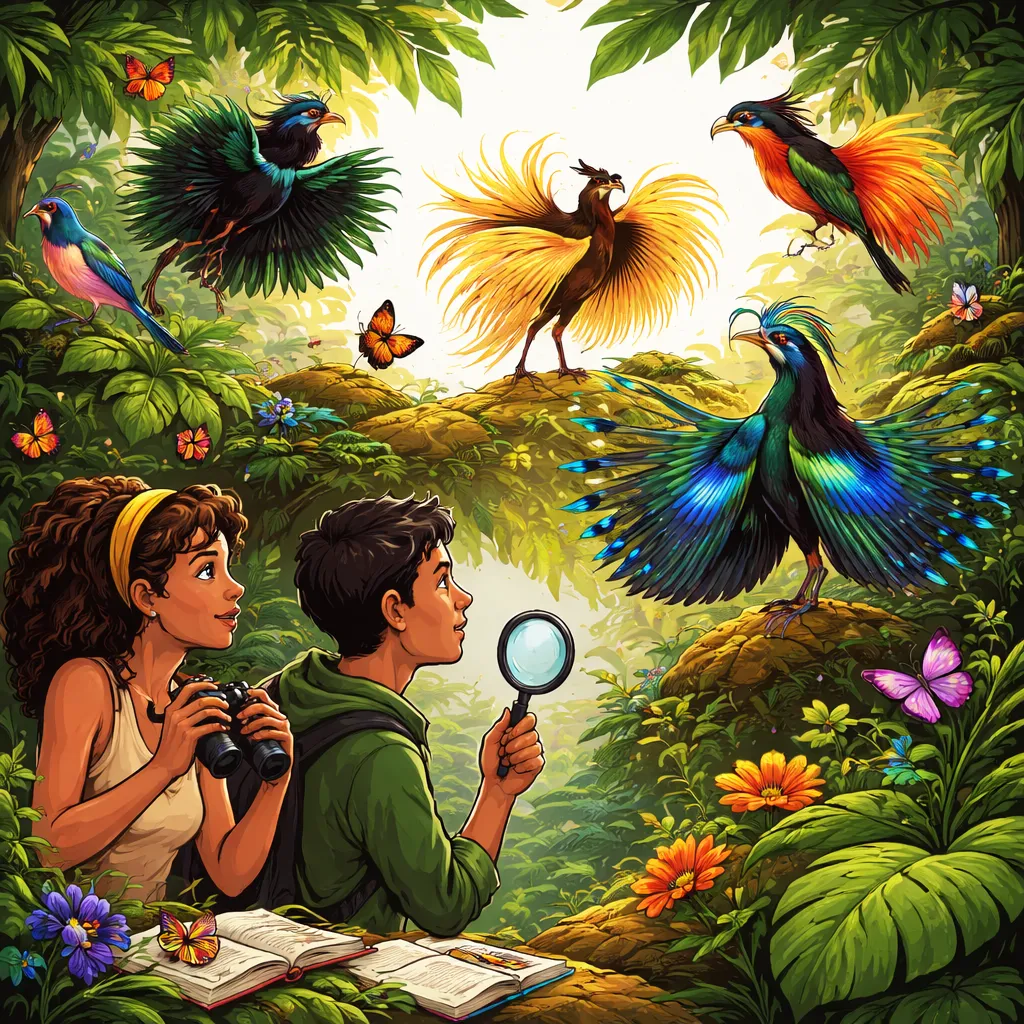
A bird of paradise is a colorful bird with spectacular feathers. Males have long, flowing plumes, bright colors, and unique shapes. They have feathers that look like wires, ribbons, or fans. Their displays are among the most beautiful in the animal kingdom.
Birds of paradise live in the rainforests of New Guinea and nearby islands. They are also found in northeastern Australia. They spend most of their time in the trees. They eat fruit and insects. They are shy and hard to find in the wild.
These birds are famous for their courtship dances. Males perform elaborate displays to attract females. They clear a stage on the forest floor. They show off their feathers. They dance, hop, and call. Each species has its own unique dance.
For children, birds of paradise are like something from a fairy tale. Their feathers and dances are extraordinary. Learning about birds of paradise teaches children about rainforest wildlife, evolution, and the incredible diversity of life on Earth.
English Learning About This Animal
Let us learn the English words bird of paradise. We say it like this: /bɜːrd əv ˈpærədaɪs/. Bird sounds like “bird.” Of sounds like “uv.” Paradise sounds like “pair-uh-dice.” Put them together: bird of paradise. Say it three times. Bird of paradise. Bird of paradise. Bird of paradise.
Now let us learn words about a bird of paradise’s body. The plumes are the long, decorative feathers. The tail can be long or wire-like. The wings have bright colors. The feet are strong for perching. The chicks are baby birds of paradise.
There is a famous saying about birds of paradise. Naturalists say, “The bird of paradise dances for the forest itself.” This describes their spectacular displays. Another saying is, “To see a bird of paradise is to see nature’s finest art.” This celebrates their beauty.
These English words help children understand bird of paradise anatomy. When they say plumes, they learn about the decorative feathers. When they say chicks, they know the babies. Parents can practice these words while looking at pictures. Point to the parts. Say the words together.
Animal Facts and Science Knowledge
Birds of paradise belong to the family Paradisaeidae. There are about forty species. They are found in New Guinea, nearby islands, and northeastern Australia. They are related to crows and jays. Their beautiful feathers evolved through sexual selection.
Birds of paradise live in tropical rainforests. They live in the canopy. They need tall trees for display areas. They eat fruit, insects, and small animals. They are important seed dispersers. They spread seeds throughout the forest.
Birds of paradise have special abilities. Males have the most elaborate feathers of any bird. Some have long tail wires. Some have fans on their backs. Some have bright blue heads. They can change their shape. They can turn into a circle or a crescent.
Courtship displays are incredible. Males clear a display area. They call to attract females. They show their feathers. They dance. Some hang upside down. Some hop from branch to branch. Some make buzzing sounds with their feathers. Females watch and choose the best performer.
Females build nests and raise young alone. They are not as colorful as males. Their brown feathers help them hide from predators. They lay one or two eggs. They feed the chicks until they are ready to leave the nest.
How to Interact With This Animal Safely
Birds of paradise are wild birds. They are not pets. They are endangered in some areas. The best way to interact is to learn about them. Watch videos of their dances. Read books about them. Visit a zoo or wildlife sanctuary that has them.
If you ever visit New Guinea, join a guided tour. Guides know where to find them. They know how to watch without disturbing. Stay on trails. Be quiet. Do not try to approach them.
Teach children to respect birds of paradise. They are rare and special. They need their forest home. Watching them from a distance is the best way to see them.
Do not try to keep a bird of paradise as a pet. They need large spaces. They need special food. They are protected by law. They belong in the wild.
Support rainforest conservation. Birds of paradise need healthy forests. Protecting their habitat protects them. Learning about them helps us understand why rainforests matter.
What Can We Learn From This Animal
Birds of paradise teach us about beauty. Their feathers are the most beautiful in the world. Children learn that beauty is something to celebrate. Looking for beauty, appreciating art, and finding wonder in nature are important.
Birds of paradise teach us about effort. Males practice their dances for years. Children learn that doing our best takes effort. Practicing, working hard, and striving to improve help us succeed.
Birds of paradise teach us about uniqueness. Each species has its own dance and feathers. Children learn that being different is wonderful. Everyone has their own way of being special.
Birds of paradise teach us about the rainforest. They show us that rainforests hold incredible treasures. Children learn that protecting rainforests protects animals found nowhere else on Earth.
Fun Learning Activities
Let us make learning about bird of paradise fun. One activity is the bird of paradise dance game. Ask your child to create a dance. Use scarves or ribbons as feathers. Clear a stage. Show off the dance. Hop and turn. Say “bird of paradise dances” and “bird of paradise shows its feathers.”
Another activity is drawing a bird of paradise. Look at pictures of birds of paradise. Notice the long plumes, bright colors, and unique shapes. Draw a male displaying his feathers. Add a forest background. Label the parts. Say the words aloud.
Create a story about a bird of paradise. Ask your child what the bird does. Does it clear a stage? Does it dance for a female? Does it show its feathers? Write a few sentences together. Let your child draw pictures. Read the story aloud.
Make a bird of paradise craft. Use bright paper for the feathers. Add long plumes from ribbons or strips of paper. Add a fan or wires. Add a small body. Move the craft bird. Practice saying “bird of paradise dances” and “bird of paradise shows off.”
Learn about New Guinea animals. Talk about other animals that live in the same forests. Compare birds of paradise to other colorful birds. Use words like “courtship,” “display,” and “endemic.”
Learn about evolution. Talk about why males are so colorful. Discuss how females choose the best dancers. Use words like “sexual selection,” “adaptation,” and “diversity.”
These simple activities bring learning to life. Children build English vocabulary while playing. They learn science through understanding evolution and rainforest ecosystems. They develop appreciation through learning about the world’s most beautiful birds. Learning about bird of paradise becomes a journey into the rainforests of New Guinea. Each moment spent together strengthens language, curiosity, and a growing appreciation for the feathered dancers that teach us that beauty, effort, and being unique are gifts to be celebrated.