
What Is This Animal?
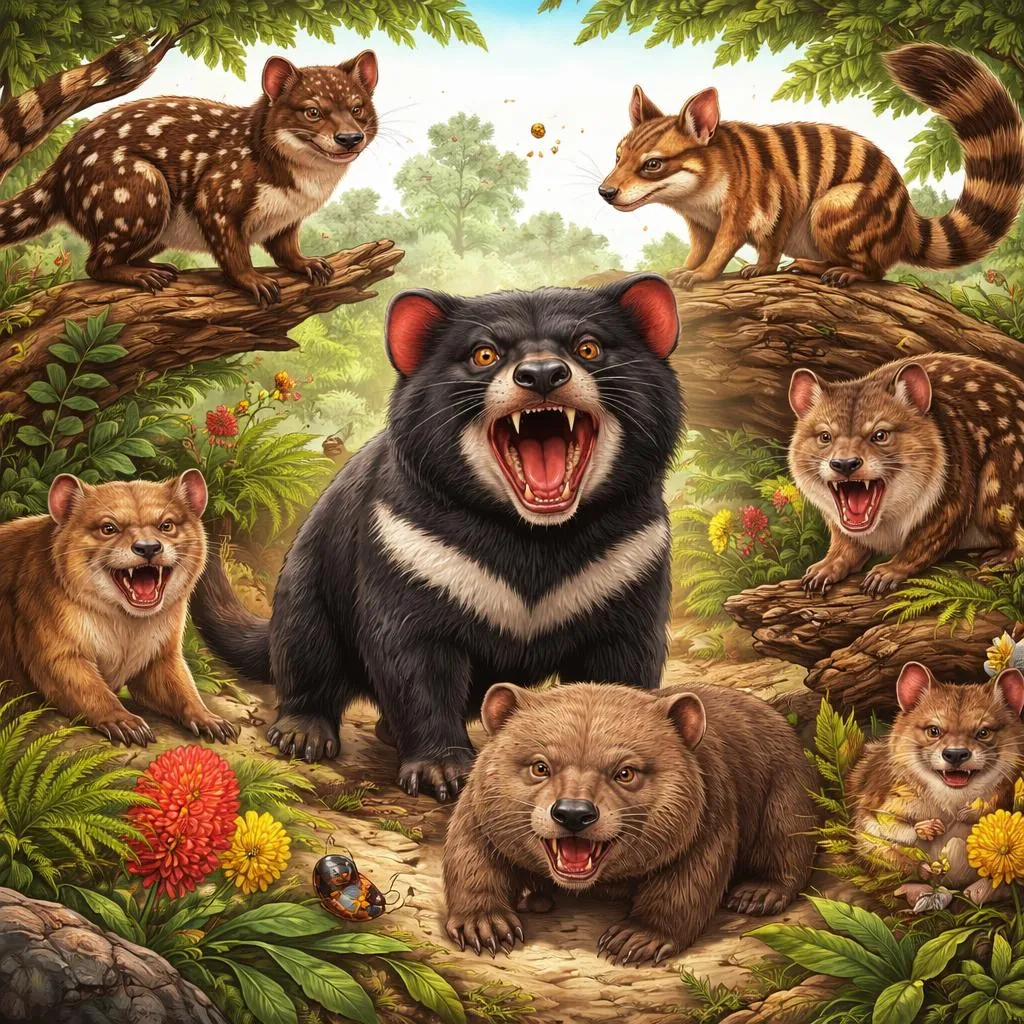
A Tasmanian devil is a stocky, black-furred marsupial with a powerful build and a loud, screeching call. It has a large head, strong jaws, and a thick tail. It is about the size of a small dog. Tasmanian devils are carnivorous marsupials. They are found only in the wild on the island of Tasmania, south of Australia.
Tasmanian devils are famous for their fierce temperament. They make loud growls and screeches. They show their teeth when threatened. They have one of the strongest bites of any mammal for their size. Despite their fierce reputation, they are mostly scavengers. They eat animals that are already dead.
These animals are nocturnal. They sleep during the day in dens. They come out at night to search for food. They travel long distances. They are solitary but gather to eat at large carcasses. They communicate with many sounds.
For children, Tasmanian devils are fascinating. Their loud calls and strong jaws make them memorable. Learning about Tasmanian devils teaches children about Australian wildlife, marsupials, and the importance of protecting endangered species.
English Learning About This Animal
Let us learn the English words Tasmanian devil. We say it like this: /tæzˈmeɪniən ˈdevəl/. Tasmanian sounds like “taz-may-nee-an.” Devil sounds like “dev-il.” Put them together: Tasmanian devil. Say it three times. Tasmanian devil. Tasmanian devil. Tasmanian devil.
Now let us learn words about a Tasmanian devil’s body. The jaws are incredibly strong. The teeth are sharp for crushing bone. The fur is black with white markings. The tail stores fat. The pouch holds the babies. The joeys are baby devils.
There is a famous saying about Tasmanian devils. Naturalists say, “The devil screams loud, but its bite is even louder.” This describes their fierce nature. Another saying is, “Where the devil eats, nothing is left.” This reflects their ability to consume everything, including bones.
These English words help children understand Tasmanian devil anatomy. When they say jaws, they learn about the powerful bite. When they say joeys, they know the babies. Parents can practice these words while looking at pictures. Point to the parts. Say the words together.
Animal Facts and Science Knowledge
Tasmanian devils belong to the marsupial family Dasyuridae. They are related to quolls and other carnivorous marsupials. They are the largest carnivorous marsupial in the world. They once lived on mainland Australia. They disappeared there about three thousand years ago. Now they only live in the wild on Tasmania.
Tasmanian devils live in forests, woodlands, and coastal areas. They make dens in hollow logs, caves, and burrows. They have home territories. They travel up to ten miles in a night searching for food. They are solitary but share feeding areas.
Tasmanian devils are carnivores. They eat wallabies, birds, insects, and reptiles. They are mostly scavengers. They prefer to eat animals already dead. They eat everything—meat, fur, bones. Their strong jaws crush bones completely. They can eat up to forty percent of their body weight in one meal.
Tasmanian devils have special abilities. They have the strongest bite of any mammal relative to body size. Their jaws can crush bones. They make loud, frightening screeches. These sounds help them communicate and intimidate others. They are excellent climbers. They can climb trees to escape danger or find food.
Tasmanian devils are endangered. A contagious cancer called Devil Facial Tumor Disease has killed many devils. The disease spreads when they bite each other. Conservation programs work to save them. Scientists are studying the disease. Zoos have breeding programs to keep the population safe.
How to Interact With This Animal Safely
Tasmanian devils are wild animals. They are not pets. They can be dangerous if threatened. The best way to interact is to learn about them from a distance. If you ever visit Tasmania, follow park rules. Do not approach wild devils.
Teach children that Tasmanian devils are not like cartoon characters. They are real wild animals. They need respect and space. Watching them from a safe distance is the best way to see them.
In zoos and wildlife sanctuaries, Tasmanian devils are in secure enclosures. Follow all rules. Stay behind barriers. Watch them eat and sleep. Learn about them from keepers. Zoos play an important role in saving this species.
If you see a Tasmanian devil in the wild, do not feed it. Feeding wild animals makes them lose their fear of people. It can also spread disease. Keep a safe distance. Observe quietly.
Conservation efforts need support. Learning about Tasmanian devils helps people understand why they need protection. Sharing what you learn helps others care too.
What Can We Learn From This Animal
Tasmanian devils teach us about strength. They have powerful jaws. Children learn that strength comes in many forms. Physical strength, mental strength, and emotional strength help us face challenges.
Tasmanian devils teach us about being resourceful. They eat everything. They waste nothing. Children learn that using what we have and wasting less are good habits.
Tasmanian devils teach us about facing hard times. They are fighting a deadly disease. Conservationists are helping them. Children learn that when things are hard, help makes a difference. Helping others, asking for help, and working together solve problems.
Tasmanian devils teach us about uniqueness. They live only in one place on Earth. Children learn that some animals are special to one part of the world. Protecting their home protects them.
Fun Learning Activities
Let us make learning about Tasmanian devil fun. One activity is the devil growl game. Ask your child to make loud growling and screeching sounds. Show strong jaws. Pretend to eat a meal, eating everything. Say “Tasmanian devil growls” and “Tasmanian devil eats everything.”
Another activity is drawing a Tasmanian devil. Look at pictures of Tasmanian devils. Notice the black fur, strong jaws, and white markings. Draw a Tasmanian devil eating or sleeping in a den. Label the parts. Say the words aloud.
Create a story about a Tasmanian devil mother. Ask your child what the mother does. Does she carry joeys in her pouch? Does she find food at night? Does she scare away other devils? Write a few sentences together. Let your child draw pictures. Read the story aloud.
Make a Tasmanian devil craft. Use black paper for the fur. Add white markings on the chest. Add strong jaws with sharp teeth. Add a pouch with small joeys. Move the craft devil. Practice saying “devil screams” and “devil crushes bones.”
Learn about Australian animals. Talk about other animals that live in Tasmania. Compare the Tasmanian devil to kangaroos, wombats, and quolls. Use words like “marsupial,” “endemic,” and “carnivore.”
Learn about conservation. Talk about Devil Facial Tumor Disease. Learn what scientists are doing to help. Make a poster about Tasmanian devil conservation. Use words like “endangered,” “conservation,” and “protection.”
These simple activities bring learning to life. Children build English vocabulary while playing. They learn science through understanding marsupials and conservation. They develop awareness through learning about endangered species. Learning about Tasmanian devil becomes a journey to the island of Tasmania. Each moment spent together strengthens language, curiosity, and a growing appreciation for the fierce, screeching marsupials that teach us that strength, resourcefulness, and fighting for survival are powerful lessons from the wild.