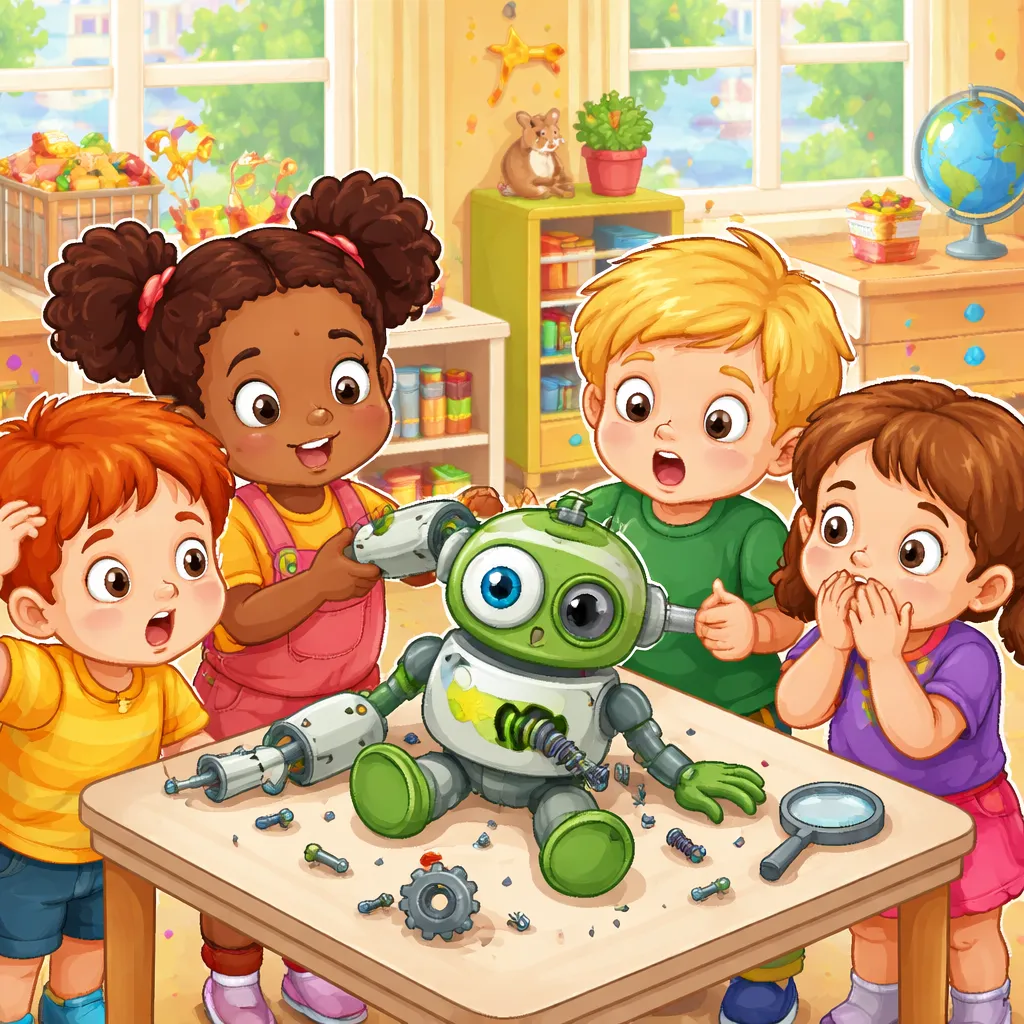

Hello, little word detective! Sometimes, in a story, the hero is not the one doing the action. Sometimes, the hero is the one that the action happens to. This is a special way of talking called the Passive Voice. The Passive Voice is when we talk about something that is being acted upon. Think of it like a magic lens! Your guide is Penny the Picture Taker. Penny has a special camera lens. This lens shows us what happens to things. Let's look through Penny's lens at home, the playground, school, and the world outside!
What is the Passive Voice?
The Passive Voice is a different way to look at an action. In the Passive Voice, the sentence starts with the thing that receives the action. The thing that is getting something done to it is the star! The doer of the action might be hiding, or it might come at the end with the word "by". Look at this: "The ball is thrown." The ball is not throwing. The ball is being thrown. Someone else is doing the throwing. This is the Passive Voice. The formula is: Thing Receiving Action + is/am/are/was/were + Action Word (often with -ed) + (by + Doer). "The cookie is eaten by me." The cookie is the star. It is getting eaten. I am the eater, but I come at the end. This way of talking is very useful.
Why Learn About the Passive Voice?
Using the Passive Voice makes you a smart observer. It helps your ears listen. You can understand stories and instructions. "The toys are put away." It helps your mouth speak. You can describe what you see happening to things. "My picture is hung on the wall!" It helps your eyes read. You will see the Passive Voice in many books and signs. "The door is locked." It helps your hand write. You can write about events and science. "The seed is planted in the soil." The Passive Voice is great for when the action is more important than who did it.
How is the Passive Voice Different?
The Passive Voice has a twin called the Active Voice. They are opposites. In Active Voice, the doer is the star. "I eat the cookie." In Passive Voice, the receiver is the star. "The cookie is eaten by me." Penny's magic lens lets us focus on the cookie, not on me. We use the Passive Voice when we do not know the doer, when the doer is not important, or when we want to surprise the listener. "My bike was moved!" (I don't know who moved it). "The rules are made." (The maker is not the important part). "The window was broken!" (The surprise is the broken window).
How Can You Spot a Passive Voice Sentence?
Penny the Picture Taker has a detective kit. Use these clues to find a Passive Voice sentence.
Look for a "being" verb. The words "is", "am", "are", "was", "were" are big clues. They often start the special verb phrase. "The bed is made. The toys are put away."
Look for the main action word ending in -ed. Many action words in the Passive Voice have an "-ed" at the end. "The ball was kicked. The book was read." (Some are special, like "eaten", "taken").
Look for the word "by". The word "by" often tells us who did the action. "The picture was drawn by my sister." If you see "by", it is a very strong clue for the Passive Voice.
Ask the magic question. Ask: "What is happening to this thing?" If the answer makes sense, it might be passive. Look at "The door is closed." What is happening to the door? It is being closed. Yes, that is passive.
How Do We Build a Passive Voice Sentence?
Building a Passive Voice sentence is like taking a picture of the result. Here is Penny's simple recipe.
The Result Recipe: [Thing Receiving Action] + is/am/are/was/were + [Action Word in special form] + (by + [Doer]).
Step 1: Find the thing that gets the action. This is the star of your picture. "The window", "My hands", "The flowers".
Step 2: Add a "being" helper. Choose "is", "am", "are", "was", or "were". "The window is ", "My hands are ", "The flowers were ".
Step 3: Add the main action word. Use the special form. Often, add "-ed". "The window is cleaned." "My hands are washed." "The flowers were watered."
Step 4: Add the doer (optional). Use "by" if you want to say who did it. "The window is cleaned by Dad." "The flowers were watered by me."
Let's make one! What gets the action? The apple. What is the action? Eat. What is the special form of "eat"? Eaten. Let's build: "The apple is eaten." Do we know who ate it? Not yet. Let's add: "The apple is eaten by me." Great picture!
Let’s Fix Some Blurry Pictures!
Sometimes our passive pictures are not clear. Let's help Penny fix them.
The Missing "Being" Verb.
Wrong: "The ball thrown." This is not a full picture. We need the helper.
Right: "The ball is thrown." or "The ball was thrown."
The Wrong Action Word Form.
Wrong: "The bed is make by me." The word "make" needs its special form for this recipe.
Right: "The bed is made by me." Remember the "-ed" or special form.
Confusing Active and Passive.
Wrong: "I am ate the sandwich." This mixes the recipe. "I am" is from passive, but "ate" is active voice.
Right (Active): "I ate the sandwich." (I am the doer).
Right (Passive): "The sandwich is eaten by me." or "The sandwich was eaten."
The Unclear Star.
Wrong: "It is broken." This is a passive picture, but we do not know what "it" is. Try to be clear.
Better: "My toy is broken." or "The cup is broken."
Can You Be the Picture Taker?
Let's play. I will say a sentence. You tell me if it is Passive Voice. "The cake was baked by Mom." Yes! The cake gets the baking. "Mom baked the cake." No. Mom is the doer. This is Active. "The toys are put away." Yes! The toys are receiving the action. "I put the toys away." No. I am the doer. Great detective work!
Penny's Photo Album: 100 Common Passive Voice Pictures.
Here are one hundred pictures of things that happen. They are all Passive Voice sentences. See the action happen to the star.
At Home:
The bed is made. The floor is swept. The dishes are washed. The table is set. The light is turned on. The door is closed. The window is opened. The trash is taken out. The food is cooked. The clothes are folded. The toys are picked up. The carpet is vacuumed. The story is read. The song is sung. The picture is drawn. The hands are washed. The teeth are brushed. The hair is combed. The shoes are tied. The pajamas are put on. The house is cleaned. The mail is brought inside. The plant is watered. The cookie is eaten. The TV is turned off.
At the Playground:
The ball is thrown. The swing is pushed. The slide is slid down. The game is played. The turn is taken. The line is formed. The sandcastle is built. The hands are clapped. The song is sung. The race is run. The bar is climbed on. The frisbee is caught. The merry-go-round is spun. The seesaw is balanced. The ball is kicked. The jump rope is turned. The bench is sat on. The gate is opened. The rules are explained. The snack is shared. The high five is given. The laugh is heard. The fun is had. The park is loved. The playground is left.
At School:
The name is written. The hand is raised. The question is asked. The book is read. The song is sung. The line is walked in. The desk is cleaned. The paper is colored. The picture is painted. The story is told. The lesson is learned. The work is finished. The bell is rung. The door is held open. The chair is pushed in. The glue is used. The scissors are shared. The board is erased. The mistake is fixed. The job is done. The backpack is packed. The coat is put on. The goodbye is said. The classroom is loved. The teacher is listened to.
In Nature and Animals:
The flower is watered. The seed is planted. The tree is climbed. The nest is built. The web is spun. The honey is made. The grass is cut. The leaf is raked. The path is walked on. The rock is turned over. The bird is fed. The dog is walked. The fish is fed. The pet is petted. The bug is watched. The sun is blocked by a cloud. The rain is collected. The snow is made into a ball. The wind is felt. The sound is heard. The animal is tracked. The fruit is picked. The vegetable is grown. The egg is laid. The world is explored.
You Are a Master Observer!
You did it! You know that the Passive Voice shows us what happens to things. The receiver of the action is the star. Penny the Picture Taker gives you a detective badge. You have learned one hundred common Passive Voice sentences. You can now take word-pictures of actions and their results.
Here is what you learned from our photo album. You know the Passive Voice focuses on what receives the action. You know the recipe: Thing + is/am/are/was/were + action word (often with -ed) + (by + doer). You can spot it by looking for "is/are/was/were" and the word "by". You know it is useful when the action is more important than the doer.
Now, let’s do some life practice! Your mission is today. Be Penny's helper. Use your magic lens. Look at your breakfast table. Say three Passive Voice sentences about what you see. Say: "The milk is poured. The cereal is eaten. The spoon is used." You are a wonderful word detective.