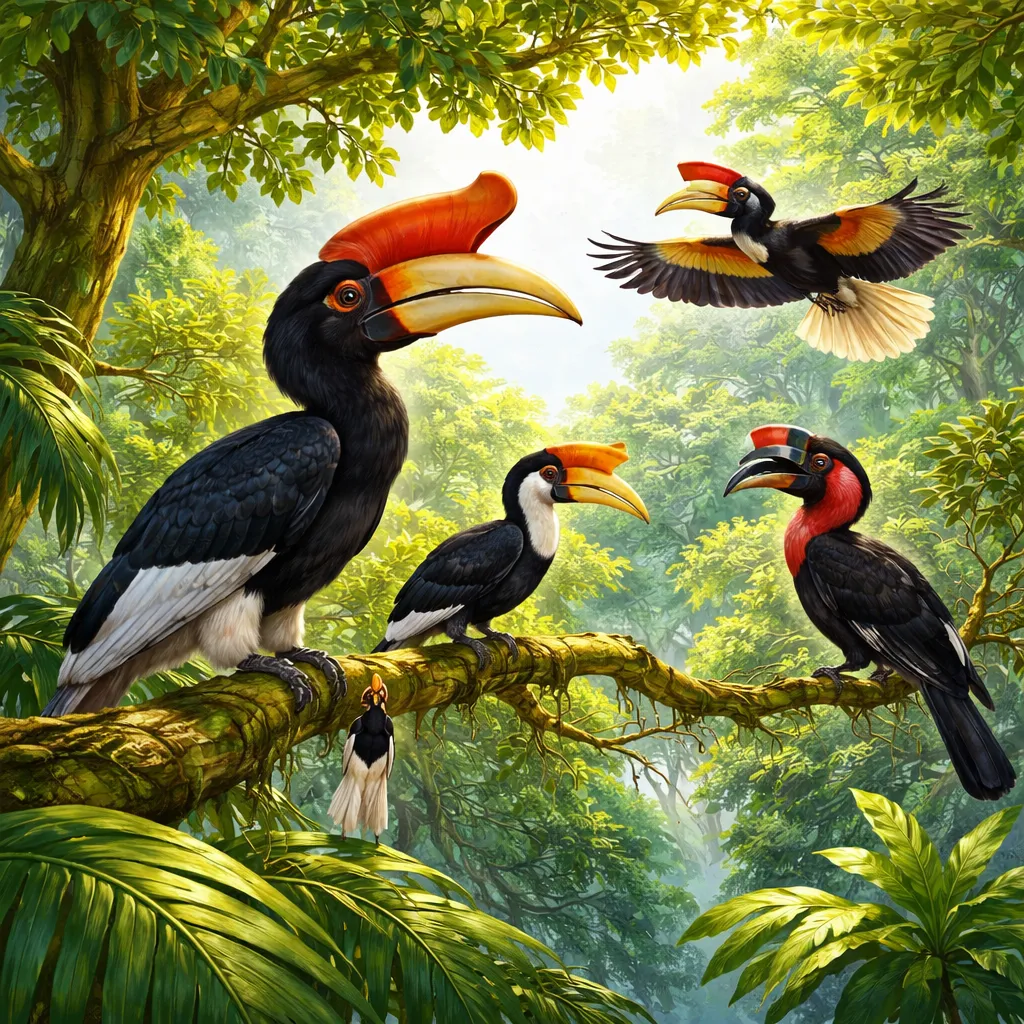

What Is This Animal?
A hornbill is a large bird with a huge, curved beak and a bony growth on top called a casque. The beak is often bright yellow, red, or black. The casque is hollow in some species. Hornbills have long eyelashes. They are one of the most distinctive birds in Africa and Asia.
Hornbills live in tropical forests, woodlands, and savannas. They are found in Africa, India, and Southeast Asia. They spend most of their time in trees. They are excellent fliers. They make loud, honking calls that echo through the forest.
These birds are known for their unique nesting habits. The female seals herself inside a tree cavity. She uses mud and droppings to close the entrance. She leaves a small slit. The male feeds her through the slit. She stays inside until the chicks are ready to leave.
For children, hornbills are fascinating. Their huge beaks and nesting habits make them unforgettable. Learning about hornbills teaches children about African and Asian wildlife, bird adaptations, and the importance of protecting forest habitats.
English Learning About This Animal
Let us learn the English word hornbill. We say it like this: /ˈhɔːrnbɪl/. The word has two parts. Horn sounds like “horn.” Bill sounds like “bill.” Put them together: hornbill. Say it three times. Hornbill. Hornbill. Hornbill.
Now let us learn words about a hornbill’s body. The casque is the helmet-like growth on the beak. The beak is large and curved. The eyelashes are long and feather-like. The feathers are black, white, or gray. The chicks are baby hornbills.
There is a famous saying about hornbills. In Africa, people say, “The hornbill calls when the rain is coming.” This reflects their connection to the seasons. Another saying is, “The hornbill seals its mate inside the tree, trusting only the male to bring food.” This describes their unique nesting.
These English words help children understand hornbill anatomy. When they say casque, they learn about the helmet. When they say chicks, they know the babies. Parents can practice these words while looking at pictures. Point to the parts. Say the words together.
Animal Facts and Science Knowledge
Hornbills belong to the family Bucerotidae. There are about sixty hornbill species. They are found in Africa and Asia. The great hornbill lives in India and Southeast Asia. The southern ground hornbill lives in African savannas. Hornbills are related to hoopoes and wood-hoopoes.
Hornbills live in tropical forests, woodlands, and savannas. They need large trees with cavities for nesting. They live in pairs or small groups. They have large territories. They travel through the forest each day.
Hornbills are omnivores. They eat fruit, insects, small reptiles, and small mammals. They are important seed dispersers. They swallow fruit whole. They spread seeds throughout the forest. Some hornbills eat mostly fruit. Others eat more meat.
Hornbills have special abilities. Their casque is hollow in many species. It amplifies their calls. Their calls can be heard for miles. They have excellent eyesight. Their long eyelashes protect their eyes. They can catch insects in midair.
Hornbills have unique nesting. The female enters a tree cavity. She seals the entrance with mud and droppings. She leaves a small slit. The male brings food to her through the slit. She stays inside for months. She molts her flight feathers inside. She cannot fly during this time. She and the chicks depend entirely on the male.
How to Interact With This Animal Safely
Hornbills are wild birds. They are not pets. They are protected in many countries. If you visit a rainforest or zoo, observe hornbills from a distance. Do not try to touch them. Their beaks are powerful. They can bite if they feel threatened.
Teach children to respect hornbills. They are large and strong. They need space. Watching them in a zoo or aviary is a safe way to see them. Follow the rules. Stay behind barriers.
If you see a hornbill in the wild, stay back. Do not try to feed it. Feeding wild birds makes them lose their fear of people. It can also harm their health.
Hornbills need forests to survive. Many hornbill species are endangered. Their habitat is disappearing. Poachers also hunt them. Conservation programs work to protect them. Learning about them helps us understand why they need protection.
Support rainforest conservation. Hornbills depend on large trees with cavities. Protecting forests protects hornbills. Even from far away, we can help by learning and sharing.
What Can We Learn From This Animal
Hornbills teach us about trust. The female trusts the male to bring food. Children learn that trust is important in families. Trusting parents, trusting siblings, and being trustworthy are good things.
Hornbills teach us about protection. The female seals herself in the nest to protect her chicks. Children learn that protecting those we love is important. Keeping family safe, watching out for others, and being careful show care.
Hornbills teach us about waiting. The female waits inside the nest for months. Children learn that waiting can be hard but sometimes necessary. Waiting for a turn, waiting for a special day, and being patient are good skills.
Hornbills teach us about the forest. They show us that forests are full of amazing creatures. Children learn that protecting forests protects animals. Every forest matters.
Fun Learning Activities
Let us make learning about hornbill fun. One activity is the hornbill nest game. Ask your child to pretend to be a hornbill. Build a nest inside a blanket fort. Close the entrance. Wait for food to come through a slit. Say “hornbill waits” and “male hornbill brings food.”
Another activity is drawing a hornbill. Look at pictures of hornbills. Notice the large beak, casque, and long eyelashes. Draw a hornbill in a tree. Add a nest cavity. Label the parts. Say the words aloud.
Create a story about a hornbill family. Ask your child what the father does. Does he bring fruit to the nest? Does he call to his family? Do the chicks finally leave the nest? Write a few sentences together. Let your child draw pictures. Read the story aloud.
Make a hornbill craft. Use black and white paper for the feathers. Add a large, curved beak. Add a casque on top. Add long eyelashes. Move the craft hornbill. Practice saying “hornbill calls” and “father hornbill brings food.”
Learn about African and Asian animals. Compare hornbills to toucans. Notice the similarities and differences. Use words like “casque,” “rainforest,” and “seed disperser.”
Learn about bird nesting. Talk about why hornbills seal themselves in the nest. Compare to other birds with unique nesting habits. Use words like “cavity,” “incubation,” and “parental care.”
These simple activities bring learning to life. Children build English vocabulary while playing. They learn science through understanding unique bird behaviors. They develop respect through learning about wild animals. Learning about hornbill becomes a journey into the treetops of Africa and Asia. Each moment spent together strengthens language, curiosity, and a growing appreciation for the helmeted birds that teach us that trust, protection, and patience are the foundations of a strong family.