
Teaching grammar to young learners requires breaking down complex concepts into simple, understandable pieces. Determiners are one of those grammar topics that children use naturally but may not understand by name. Today, we are going to explore what is a determiner in grammar and discover how to help children recognize and use these important words correctly.
Meaning Let us start with the basic question. What is a determiner? A determiner is a word that comes before a noun to show which noun we are talking about. It helps to clarify or limit the meaning of the noun.
Determiners answer questions like "Which one?" "Whose?" or "How many?" They give important information about the noun that follows.
In the sentence "I saw a dog," the word "a" is a determiner. It tells us that we are talking about one dog, not a specific dog.
In the sentence "I saw that dog," the word "that" is a determiner. It tells us we are talking about a specific dog, one we can point to.
In the sentence "I saw my dog," the word "my" is a determiner. It tells us the dog belongs to me.
Determiners are small words, but they carry important meaning. Children use them constantly without realizing it.
Categories or Lists of Determiners Determiners come in several different types. Each type does a different job.
Articles: A, an, the. These are the most common determiners. "A" and "an" are indefinite articles. They refer to any member of a group. "The" is the definite article. It refers to a specific member.
Demonstratives: This, that, these, those. These determiners point to things. "This" and "these" point to things nearby. "That" and "those" point to things farther away.
Possessives: My, your, his, her, its, our, their. These determiners show ownership. They tell us who something belongs to.
Quantifiers: Some, any, many, much, few, several, all, both, each, every, no. These determiners tell us how many or how much.
Numbers: One, two, three, first, second, third. Numbers can also be determiners when they come before nouns.
Interrogatives: Which, what, whose. These determiners ask questions about nouns.
Daily Life Examples of Determiners The best way to understand determiners is to see them in everyday language. Here are examples children hear all the time.
Articles: "Can I have a cookie?" (any cookie) "I want the blue cookie." (a specific cookie)
Demonstratives: "I like this book." (the book right here) "Please put away those toys." (the toys over there)
Possessives: "That is my backpack." (belongs to me) "Is this your lunch?" (belongs to you)
Quantifiers: "I want some milk." (an amount, not specified) "Do you have any crayons?" (asking if they exist) "I ate all the grapes." (every single one)
Numbers: "I have two brothers." (exactly two) "This is my first day of school." (the first in order)
Interrogatives: "Which color do you want?" (asking to choose) "Whose shoes are these?" (asking about ownership)
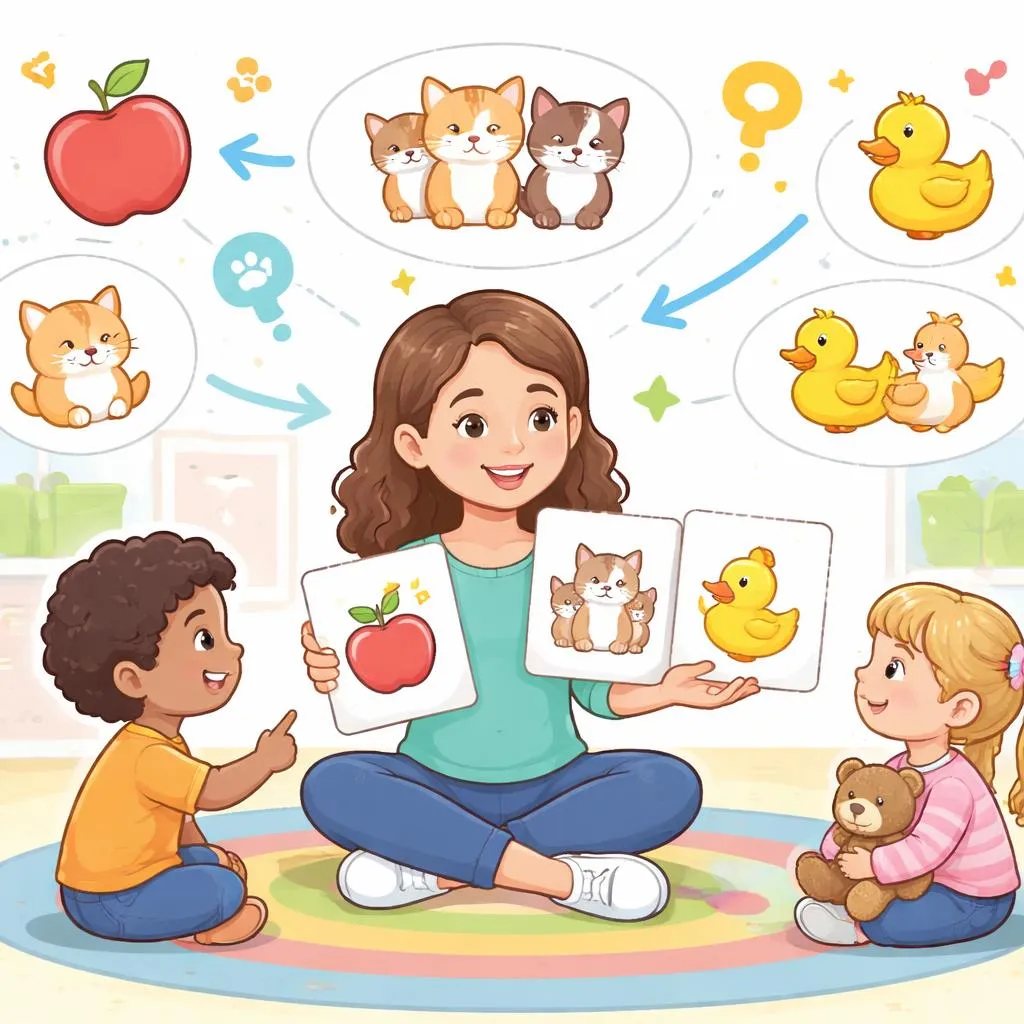
Printable Flashcards for Determiners Flashcards help children recognize different determiners and understand their use. Each card should show the determiner and a simple sentence example.
Create cards for each type:
Articles: a, an, the with example sentences
Demonstratives: this, that, these, those with pictures showing near and far
Possessives: my, your, his, her, its, our, their with pictures showing ownership
Quantifiers: some, any, many, few, all with pictures showing amounts
Numbers: one, two, three, first, second, third with pictures
Interrogatives: which, what, whose with question marks
Children can practice by matching the determiner to the correct type of sentence.
Learning Activities or Games for Determiners Games make learning about determiners active and engaging. Here are activities that work well in the classroom.
Determiner Hunt: Read a storybook aloud. Ask children to listen for determiners. Every time they hear "a," "the," "my," or "that," they raise their hand. This builds listening skills and awareness.
Fill in the Blank: Write sentences with missing determiners. Children choose the correct determiner to complete each sentence. "I want ___ apple." (a/an) "___ is my favorite toy." (This/That)
Determiner Match: Create cards with determiners and separate cards with nouns. Children combine them to make phrases. "a" + "dog" = a dog. "my" + "ball" = my ball. "those" + "cats" = those cats.
Show Me Game: Give each child a set of small cards with determiners. Say a phrase and have them hold up the determiner they hear. "The blue car." Children hold up "the." "My new shoes." Children hold up "my."
Determiner Sort: Provide a collection of determiner cards. Children sort them into categories. Articles go together. Demonstratives go together. Possessives go together. This builds classification skills.
I Spy with Determiners: Play I Spy using determiners. "I spy with my little eye, something that is a color." "I spy my pencil." "I spy that book on the shelf."
Determiner Stories Creating stories that focus on determiners helps children see them in context.
The "A" and "The" Story: "One day, a dog went for a walk. He saw a cat in a tree. The dog barked at the cat. The cat climbed higher in the tree."
The "This" and "That" Story: "This is my left hand. This is my right hand. That is the door. Those are the windows. These are my crayons. Those are Maria's crayons."
The "My," "Your," "His," "Her" Story: "My name is Sam. Your name is Lee. His name is Tom. Her name is Anna. Our teacher is Ms. Jones. Their classroom is next door."
Children can help create these stories, choosing which determiners to use.
Common Determiner Mistakes Children make predictable mistakes with determiners. Knowing these helps us address them gently.
One common mistake is using "a" before words that start with vowel sounds. "A apple" should be "an apple." We explain that "an" comes before vowel sounds.
Another mistake is confusing "this" and "these." "This are my shoes" should be "These are my shoes." Practice with near and far concepts helps.
Some children leave out articles entirely. "I want cookie" should be "I want a cookie" or "I want the cookie." Gentle reminders help.
Possessive determiners can be tricky. "That is her book" not "that is hers book." Practice with examples helps.
Determiner Songs Music helps children remember determiner patterns. Here are some simple songs to sing.
The Determiner Song (to the tune of "Twinkle, Twinkle"):
A, an, the, we use these, Before nouns like trees and bees. This, that, these, those point the way, To things we see every day. My, your, his, her, its, our, their, Show us who owns what and where.
The Article Song (simple chant):
A and an mean any one, The means a specific one. A for words with consonant sounds, An for vowels that are found.
Using Determiners in Daily Conversation The best practice for determiners happens in natural conversation throughout the day.
During morning meeting, use determiners clearly. "Please put your backpack in your cubby." "This is our calendar." "Those are the markers we will use today."
During snack time, emphasize determiners. "Would you like a cracker?" "I want some juice." "This apple is sweet." "That banana is ripe."
During clean-up, use determiners. "Put the blocks in this basket." "Those crayons go on that shelf." "All the toys need to be put away."
These natural repetitions help children internalize determiner use without formal lessons.
Determiner Books Picture books are excellent for highlighting determiners. As you read, pause and notice the determiners.
"The Very Hungry Caterpillar" by Eric Carle uses many determiners. "On Monday, he ate through one apple. On Tuesday, he ate through two pears."
"Brown Bear, Brown Bear, What Do You See?" uses determiners repeatedly. "I see a red bird looking at me." "I see a yellow duck looking at me."
"Goodnight Moon" by Margaret Wise Brown is full of determiners. "Goodnight room. Goodnight moon. Goodnight cow jumping over the moon."
While reading, ask questions about the determiners. "Why did the author use 'a' here? Why use 'the' here?"
Building Determiner Awareness As children become more aware of determiners, they can start to notice them in their own speech and writing.
We can celebrate when children use determiners correctly. "I noticed you said 'I want an apple.' That was perfect!"
We can gently correct errors. Child: "I want apple." Teacher: "You want an apple? Here you go." The correction is natural and not disruptive.
We can play with determiners. "Let's change the story by changing the determiners. Instead of 'a dog,' let's make it 'that dog.' How does the story change?"
As we explore what is a determiner in grammar with young learners, we help them understand words they already use naturally. They learn that small words like "a," "the," "my," and "this" do important work in sentences. Through games, stories, and daily conversations, determiners become not just grammar rules but tools for clear communication. This understanding builds a foundation for all future language learning.