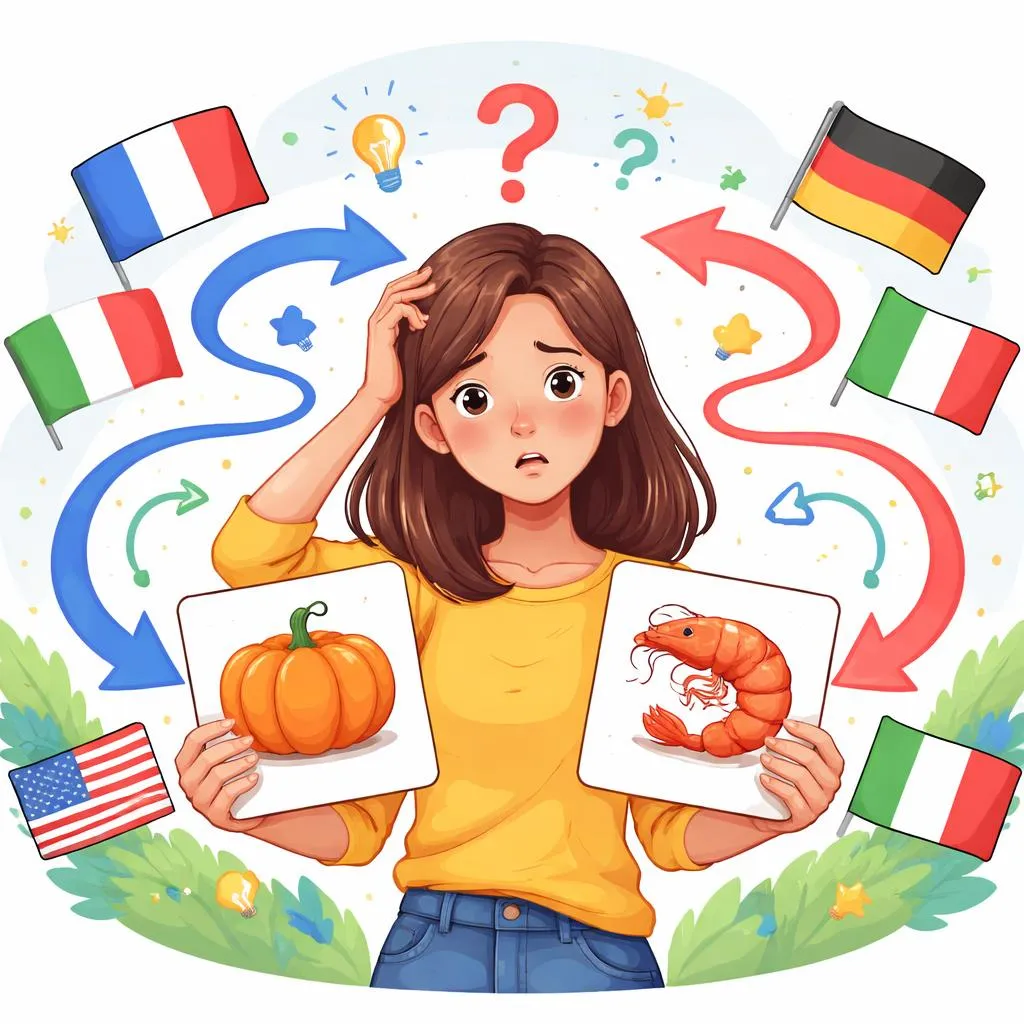

A false cognate is a word that looks similar to a word in another language but has a different meaning. Because the words appear alike, language learners may assume they share the same definition. This assumption often leads to misunderstanding.
The word cognate refers to words in different languages that share a common origin and similar meaning. For example, the English word “information” and the Spanish word “información” are true cognates. They look similar and mean the same thing.
A false cognate, however, only looks similar. The meaning does not match.
One common example appears between English and Spanish:
English: actually
Spanish: actualmente
In English, “actually” means in fact or really.
In Spanish, “actualmente” means currently or at present.
Although the spelling is similar, the meanings are different. Relying only on appearance can cause errors.
Another example:
English: library
Spanish: librería
In English, a library is a place to borrow books.
In Spanish, “librería” means bookstore.
The correct Spanish word for library is “biblioteca.” This difference often surprises learners.
French also includes many false cognates with English.
English: sensible
French: sensible
In English, sensible means practical or reasonable.
In French, “sensible” means sensitive.
The spelling is identical, but the meaning changes significantly.
Another French example:
English: attend
French: attendre
In English, attend means to go to or be present at.
In French, “attendre” means to wait.
Misunderstanding this pair can create confusion in conversation.
German provides additional examples.
English: gift
German: Gift
In English, gift means a present.
In German, “Gift” means poison.
This dramatic difference shows how important careful vocabulary study can be.
Italian also has false cognates.
English: camera
Italian: camera
In English, camera refers to a device for taking pictures.
In Italian, “camera” means room.
The correct Italian word for camera is “macchina fotografica.”
False cognates appear in many language pairs. They are common between languages that share historical roots, especially those influenced by Latin. Because spelling patterns overlap, confusion is understandable.
Why do false cognates exist?
Languages evolve over time. Words may share a common origin but develop different meanings in different regions. Cultural changes, borrowing from other languages, and historical events influence word development.
For language learners, awareness is the best strategy. Memorizing common false cognates reduces mistakes. Comparing definitions carefully rather than relying on spelling improves accuracy.
Reading in context also helps. When encountering a familiar-looking word in another language, checking its definition prevents misunderstanding. Bilingual dictionaries and reliable language resources support correct interpretation.
Teachers often encourage learners to create lists of false cognates. Writing example sentences for each word strengthens memory. Seeing the word used correctly in context reduces confusion.
False cognates may feel challenging at first. However, studying them improves vocabulary precision and cross-linguistic awareness. Recognizing that similar spelling does not always mean similar meaning is an important step in advanced language learning.
Developing this awareness leads to clearer communication, stronger reading comprehension, and fewer translation errors.
False cognates are especially common between English and Romance languages such as Spanish, French, Italian, and Portuguese. Because English borrowed many words from Latin and French, vocabulary often looks familiar across languages. However, over time, meanings shifted in different directions. These shifts created confusion for modern learners.
Another well-known English–Spanish false cognate pair is:
English: embarrassed
Spanish: embarazada
In English, embarrassed describes feeling ashamed or uncomfortable.
In Spanish, embarazada means pregnant.
The similarity in spelling makes this pair particularly memorable. Confusing the two can lead to serious misunderstanding.
Consider another pair:
English: realize
Spanish: realizar
In English, realize means to become aware of something.
In Spanish, realizar means to carry out or complete.
Assuming identical meaning would produce incorrect translation.
French also provides additional examples.
English: location
French: location
In English, location refers to a place.
In French, location means rental.
The French word for location in the English sense is endroit or lieu.
Another French example:
English: college
French: collège
In English, college refers to higher education.
In French, collège refers to middle school.
Such differences show how education systems influence vocabulary development.
Italian contains similar traps.
English: parents
Italian: parenti
In English, parents refers to mother and father.
In Italian, parenti means relatives.
A learner might mistakenly assume the words are identical in meaning.
Portuguese also includes false cognates.
English: pretend
Portuguese: pretender
In English, pretend means to act as if something is true.
In Portuguese, pretender means to intend or plan.
Understanding these distinctions requires careful study rather than guessing.
False cognates do not only appear between English and Romance languages. German and English share historical roots as Germanic languages, yet meaning changes still occur.
English: bald
German: bald
In English, bald means having no hair.
In German, bald means soon.
The identical spelling hides very different meanings.
Another German example:
English: become
German: bekommen
In English, become means to start to be something.
In German, bekommen means to receive.
A learner translating directly may create incorrect sentences.
Why do meanings change so dramatically?
Language evolution plays a major role. Words shift meaning over centuries due to cultural influence, migration, trade, and borrowing. Sometimes a word keeps its spelling but gains a new meaning. In other cases, one language narrows the meaning while another expands it.
Semantic shift explains many false cognates. A word may begin with a general meaning but later specialize. For example, a Latin root may produce two modern words that look similar but function differently.
False cognates also appear in academic vocabulary. Because formal words often share Latin roots, learners may assume meaning based on similarity. However, careful dictionary use prevents mistakes.
For example:
English: argument
French: argument
In English, argument may mean disagreement.
In French, argument more often means reasoning or point.
Context clarifies meaning, but assumption can mislead.
Strategies for managing false cognates are practical and effective. First, build awareness. Recognizing that false cognates exist reduces overconfidence. Second, verify meaning through reliable sources instead of guessing. Third, create comparison charts listing word pairs and their true meanings.
Writing personal example sentences reinforces memory. For example:
She felt embarrassed after the mistake.
Ella está embarazada de seis meses.
Seeing the contrast strengthens understanding.
Reading authentic materials in both languages also builds contextual awareness. When encountering a familiar-looking word, pause and confirm its meaning. Over time, recognition becomes automatic.
False cognates can also be used as learning tools. Teachers sometimes present them as vocabulary challenges. Identifying false cognates during reading exercises sharpens attention to detail.
In translation practice, false cognates demand extra care. Professional translators rely on context rather than surface similarity. Accurate interpretation depends on full sentence meaning, not isolated word resemblance.
Although false cognates may initially cause confusion, they ultimately deepen language awareness. They encourage learners to move beyond visual similarity and develop analytical thinking. Recognizing subtle differences strengthens vocabulary precision.
Language learning involves pattern recognition, but it also requires flexibility. Not every pattern leads to correct meaning. False cognates remind learners to verify, question, and analyze carefully.
With consistent exposure, repeated comparison, and mindful practice, false cognates become less intimidating. Instead of obstacles, they become opportunities to expand linguistic understanding and refine communication skills across languages.