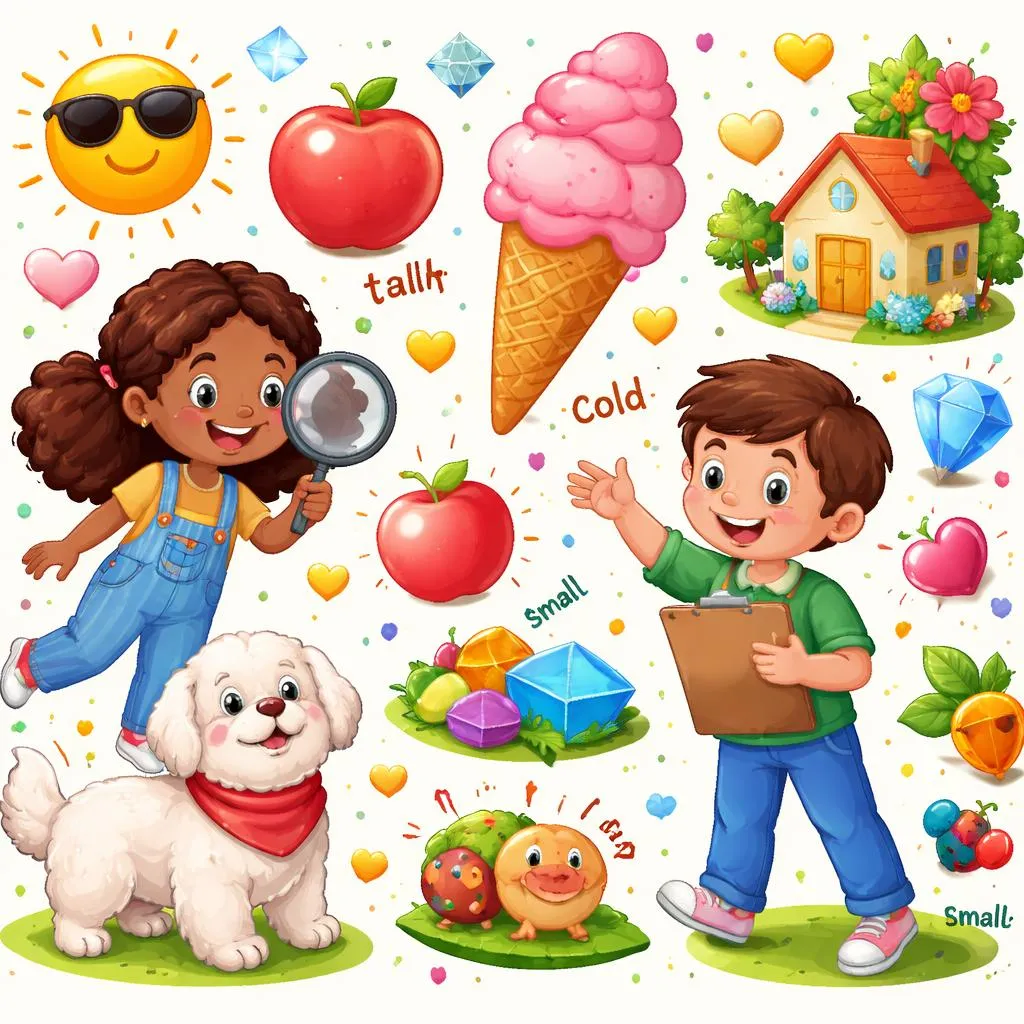

What is an Adjective? An adjective is a word that describes a noun. A noun is a person, place, thing, or idea. An adjective helps give more information about the noun by describing it. For example, adjectives can tell us how something looks, feels, sounds, tastes, or smells. Let’s look at some examples of adjectives:
Big – The elephant is big.
Happy – She feels happy.
Blue – The sky is blue.
Adjectives make our sentences more interesting by giving us more details about the nouns.
Why Are Adjectives Important? Adjectives are important because they help us understand things better. Without adjectives, we would only know about things in a very basic way. For example:
The cat is big.
The cat is small.
See how the adjective "big" helps us understand the cat better? The word "small" also gives us more information about the cat. Adjectives make our sentences more colorful and clear!
Types of Adjectives There are many types of adjectives. Let’s look at the most common ones! Descriptive Adjectives Descriptive adjectives tell us what something is like. They describe the appearance, color, size, or shape of a noun. Examples:
Big – The big dog.
Small – The small mouse.
Happy – The happy child.
Blue – The blue car.
Quantitative Adjectives Quantitative adjectives tell us how many or how much of something there is. Examples:
One – I have one apple.
Many – There are many books.
Few – I have few friends.
Demonstrative Adjectives Demonstrative adjectives tell us which thing or things we are talking about. They usually come before the noun. Examples:
This – This book is interesting.
That – That tree is tall.
These – These shoes are new.
Those – Those dogs are cute.
Possessive Adjectives Possessive adjectives tell us who owns something. They show possession. Examples:
My – My cat is very cute.
Your – Your bag is on the table.
His – His shirt is blue.
Her – Her house is big.
Their – Their car is fast.
Interrogative Adjectives Interrogative adjectives are used in questions. They ask for more information about a noun. Examples:
Which – Which color do you like?
What – What movie are you watching?
Whose – Whose pencil is this?
How Do Adjectives Work in a Sentence? Adjectives usually come before the noun they describe. But sometimes, they can come after a verb, especially when they are linked by the verb "to be". Examples:
The cat is big.
The sky is blue.
She is happy.
In these sentences, big, blue, and happy are all adjectives. They describe the nouns cat, sky, and she.
Using Adjectives to Make Sentences More Interesting Adjectives can make your sentences more exciting and detailed! Instead of saying "The dog is cute," you could say:
The big, fluffy dog is very cute.
The small, brown dog is cute.
By adding adjectives like "big," "fluffy," and "small", you can tell more about the dog and make your sentence more interesting.
Ordering Adjectives When you use more than one adjective in a sentence, there is a special order they should follow. Here is the order for adjectives:
Quantity – How many?
Opinion – What do you think about it?
Size – How big or small?
Age – How old?
Shape – What is the shape?
Color – What color is it?
Proper adjective – Where is it from?
Material – What is it made of?
Example:
Two small old round red wooden chairs. (First quantity, then size, age, shape, color, material)
Examples of Adjectives in Action Here are some sentences using different types of adjectives:
The big blue balloon is flying in the sky. (Descriptive adjectives: big, blue)
I have three favorite toys. (Quantitative adjective: three)
This is her car. (Possessive adjective: her)
Which movie do you like? (Interrogative adjective: which)
The cat is mine. (Possessive adjective: mine)
Fun Activities to Practice Adjectives Here are some fun activities you can do to practice adjectives: Describe Your Favorite Animal Pick your favorite animal and describe it with as many adjectives as you can. For example:
The big, brown dog is friendly and playful.
Look Around and Describe Things Look around the room and describe everything you see using adjectives. For example:
The chair is small.
The book is interesting.
Play an Adjective Game Choose an object and take turns adding adjectives to describe it. For example:
Apple – red, round, juicy, sweet.
Read Books and Identify Adjectives When you read books, pick out the adjectives! Write them down and try to use them in your own sentences.
Adjectives in Different Languages Did you know that adjectives work a little differently in other languages? Let’s look at how adjectives are used in other languages!
In Spanish, adjectives usually come after the noun. Example: La casa grande (The big house)
In French, adjectives can go before or after the noun, but many come before. Example: Une grande maison (A big house)
Different languages have different rules for adjectives, but they all help us describe the world around us!
Common Mistakes with Adjectives Here are a few common mistakes that people sometimes make with adjectives and how to fix them: Using Too Many Adjectives Sometimes it’s easy to add too many adjectives, but remember, less is often more! For example:
Too much: The very big, extremely old, giant red ball.
Better: The big red ball.
Mixing Up Adjective Order In English, we have an order for adjectives. If you mix them up, your sentence might sound strange:
Wrong: The old round red big ball.
Right: The big red round old ball.
Practice Using Adjectives Now that you know all about adjectives, here are some fun ways to practice them:
Pick an object and write 5 adjectives to describe it.
Create a short story and use as many adjectives as possible.
Ask your friends to describe things using adjectives.