
Start! Find a Pair of 'Magic Twin' Words
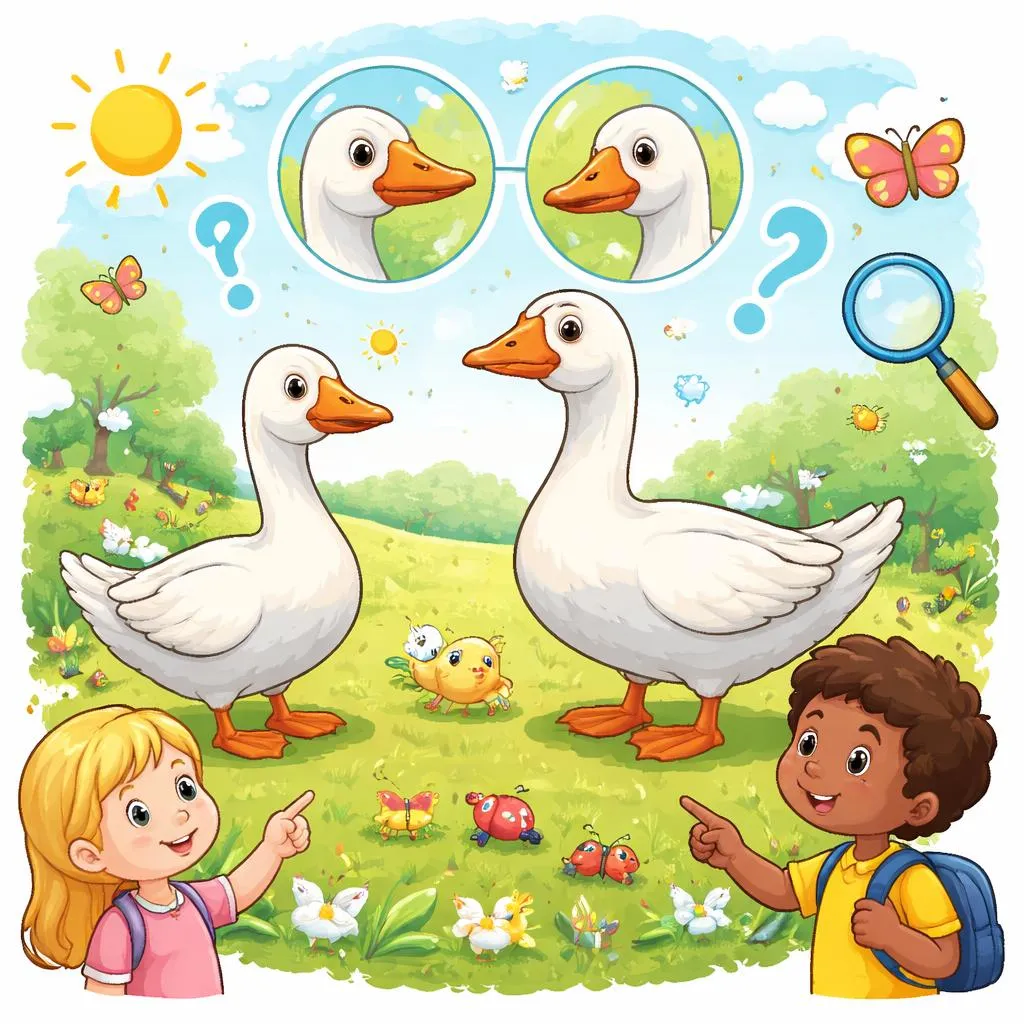
Hello, word explorer! Have you ever visited a farm? You see two large birds. They both have long necks. They both honk loudly. One might be called a "goose." The other might be called a "gander." They look very similar. Are they the same? This is a fun word puzzle. Today we explore a word pair. We explore goose and gander. They are like a married couple. They belong together. But they are different! Knowing the difference is a superpower. Your farmyard stories will be precise. Let us start our word adventure!
Be a Language Observer now. Our first clue is at home. You read a famous nursery rhyme. It says, "Goosey goosey gander, whither shall I wander?" This rhyme uses both words! Then, you see a picture of a bird on a farm. Your parent calls it a "goose." They are clearly related. But are they the same? Let us test with two sentences.
"A goose honked loudly at the fence." This could be either a male or female. "The gander stood guard over the nest." This is likely the male.
They seem to be in the same family. And they are! One is the general word. One is the specific word for the boy. Your observation mission starts. Let us explore their word barnyard.
Adventure! Honk Into the Word World
Feel the Word's Sound!
Feel the word goose. It is a common, familiar word. It feels like the main character. It is the name for the whole species. The word gander is a more specific, traditional word. It feels a bit old-fashioned and precise. It is the term for a male goose. Goose is the big, noisy flock. Gander is one important bird in that flock. One is the everyday word. The other is the special term. Let us see this at school.
In a general story, you read: "The silly goose chased the children." This is a fun tale. In a science book, you might read: "The gander is often larger than the female." This is a specific fact. Saying "The male goose is often larger" is also correct. But using gander is more exact. The sound of the words is different. One is common, the other is technical.
Compare Their General and Specific Use!
Think about a big flock and one leading bird. The word goose is the whole flock. It includes all geese: males, females, and young. The word gander is the leading bird. It is only for the male geese. A gander is always a goose. But a goose is not always a gander. The specificity is the key. The word goose is for everyone. The word gander is for the boys. This is like "duck" and "drake." Let us test this on the playground.
You play a game of tag. You call everyone "goose." That is the name of the game. Now, if you pretend to be a family of geese, you might say, "I am the gander protecting my family." This is a specific role. The word gander gives a clear gender clue. The word goose is the general, safe choice. The playground shows the difference in detail.
Meet Their Best Word Friends!
Words have favorite buddies. The word goose likes common and descriptive words. It teams up with 'silly', 'wild', 'bumps', 'feather', and 'egg'. You get goose bumps. The goose laid a golden egg. The word gander likes specific and traditional words. It teams up with 'old', 'take a gander' (meaning to look), and 'protective'. You take a gander at the view. The gander hissed at the stranger. Their buddies are different. Let us go back to school.
In a language lesson, you learn the idiom "silly goose." This is a common phrase. In a nature study, you might note: "The gander led the family to the pond." This is a specific observation. You would not usually say "The goose led the family" without context. The word friends help set the scene.
Our Little Discovery!
We explored the word barnyard. We made a clear discovery. The words goose and gander are a pair. But they are not the same. The word goose is the general word. It is for the whole species. It can be male or female. The word gander is a specific word. It is only for a male goose. Goose is the big category. Gander is a member of that category. One is for everyday talk. The other is for precise description.
Challenge! Become a Farmyard Word Expert
"Best Choice" Challenge!
Let us look at the farm. Read each scene. Pick the champion word. Scene one: You are at a lake. You see a group of large birds flying in a V shape. You shout, "Look at the migrating ______!" Is it Geese or Ganders? The champion is Geese! You are talking about the whole group, not just the males. Scene two: A farmer points to a large, proud bird. He says, "That gander is the boss of the yard." Is it goose or gander? The champion is gander! He is specifically pointing out the male. Great job!
"My Sentence Show"!
Now, create your own sentences. Here is a fun scene: Imagine a quiet farm pond. Use the word goose in one sentence. Use the word gander in another. Try it! Here is an example. Sentence one: "A goose preened its feathers by the water." Sentence two: "The gander stretched his neck and honked a warning." See the difference? The first sentence is about any goose's action. The second focuses on the male's protective behavior.
"Eagle Eyes" Search!
Can you find the word that needs help? Read this sentence: "The mother gander carefully watched over her goslings near the pond." Hmm. This is a common mistake. A gander is a male. The mother is a goose. A better sentence is: "The mother goose carefully watched over her goslings near the pond." Or, if it's the father: "The gander carefully watched over his goslings." You spotted the family mix-up!
What a wonderful barnyard journey! You started as a curious visitor. Now you are a word farmer. You know the secret of goose and gander. You can feel their different sounds. You see their general and specific uses. You know their best word friends. This is a real language superpower.
You can learn amazing things from this article. You now know that a 'goose' is the general word for the large bird with a long neck. You understand that a 'gander' is the specific word for a male goose. You can explain that all ganders are geese, but not all geese are ganders. You learned that 'gander' is also used in the phrase "take a gander," which means to look at something. Your bird vocabulary is now more accurate.
How can you use this today? It is easy and fun. Next time you see geese, be a detective. Look at the birds. Is one bigger and perhaps more assertive? You might say, "That's the gander." The others are geese. Read a book about farms or animals. See if you can find the word 'gander'. Draw a picture of a goose family. Label the male "gander" and the others "goose". You are using your new skill every day.
Keep your farmer's eyes open. Words help us understand the world in more detail. You are learning to see those details. Great work, word expert. Your English journey is getting more precise and enjoyable with every new word pair you master!