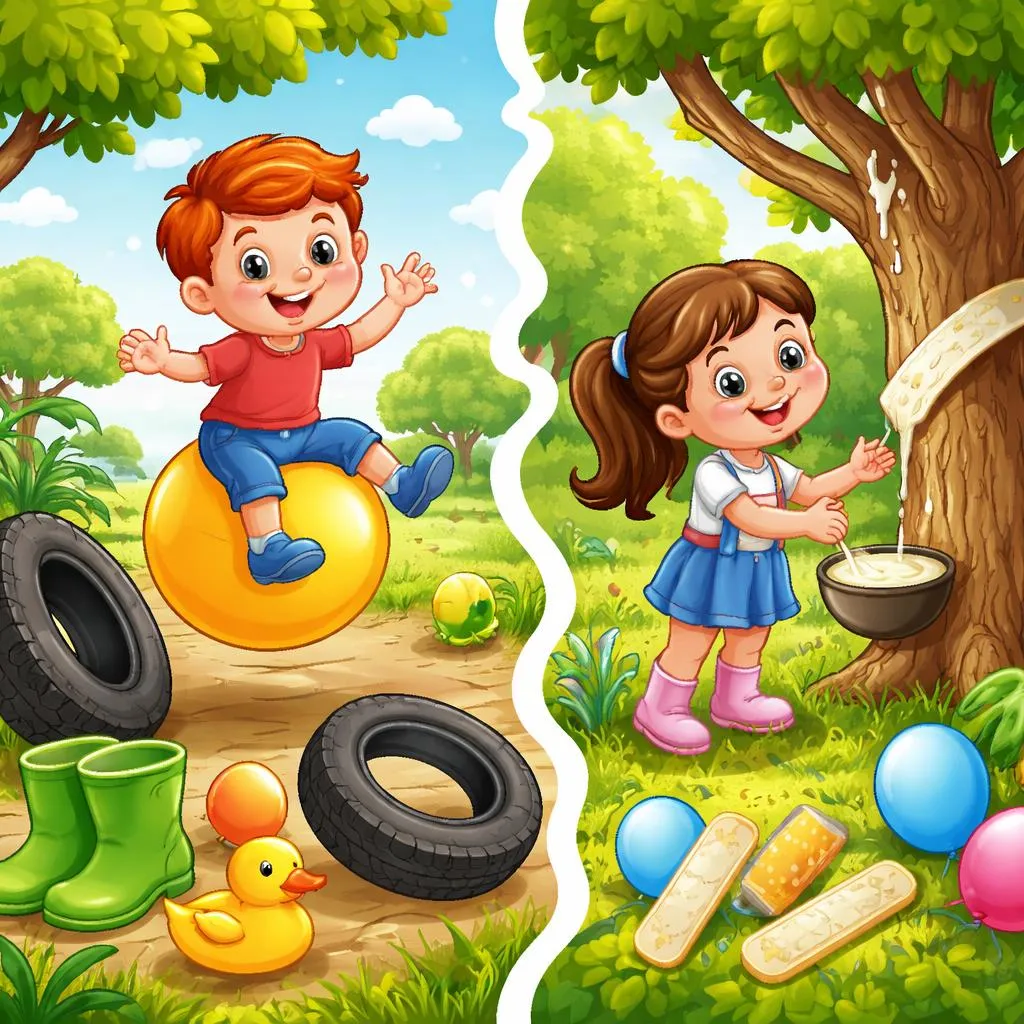

Start! Find a Pair of 'Stretchy Twin' Words
Hello, word explorer! Have you ever bounced a ball? A bouncy ball is made of rubber. Have you seen a gardener wearing stretchy gloves? Those are latex gloves. They are both stretchy and elastic. Are they the same? This is a fun, bouncy puzzle. Today we explore a word pair. We explore rubber and latex. They are like a finished cake and the batter. One is the final product. One is the raw ingredient. Knowing the difference is a superpower. Your talk about stretchy things will be clear and smart. Let us start our word bounce!
Be a Language Observer now. Our first clue is at home. Your car's tires are made of tough rubber. Your mom wears thin, stretchy latex gloves for cleaning. They are both flexible. But are they the same? Let us test with two sentences.
"The old bicycle tire was made of solid black rubber." This is about a durable, bouncy material. "The doctor put on a pair of disposable latex gloves." This is about a thin, stretchy material.
They are both elastic. But one feels tough and for heavy use. One feels thin and for protection. Your observation mission starts. Let us stretch into their word world.
Adventure! Stretch Into the Word World
Feel the Word's Tough and Thin Vibe!
Feel the word rubber. It is a tough, bouncy word. It feels like tires, boots, and erasers. It is strong and can be synthetic. The word latex is a thin, stretchy word. It feels like gloves, balloons, and liquid sap. It is often natural and thin. Rubber is the sturdy tree. Latex is the tree's sticky sap. One is the strong product. The other is the natural source. Let us see this at school.
In a gym class, you play with a big, bouncy rubber ball. This is a solid, durable toy. In an art class, you might use latex paint. This is a type of paint that dries flexible. Saying you play with a "latex ball" is less common. The feeling of the words is different. One is for active play. The other is for coating or protection.
Compare Their Origin and Form!
Think about a block of cheese and a glass of milk. The word rubber is the cheese. It is the solid, finished product. The word latex is the milk. It is the liquid that comes from the source. Their origin is a clue. Latex is the milky, sticky sap from rubber trees. Rubber is the material made by processing that sap. All natural rubber starts as latex. But not all rubber is natural; some is man-made. Let us test this on the playground.
You have a super-bouncy rubber band for a toy plane. It is solid and stretchy. Your friend blows up a latex balloon. It is thin and stretchy. The word rubber describes the solid band material. The word latex describes the thin balloon material. The playground shows the difference.
Meet Their Best Word Friends!
Words have favorite stretchy partners. The word rubber likes bouncy and durable words. It teams up with 'bouncing', 'eraser', 'band', 'tire', 'meet the', and 'duck'. A rubber band. Meet the rubber. The word latex likes medical and natural words. It teams up with 'natural', 'synthetic', 'paint', 'gloves', 'allergy', and 'foam'. Latex gloves. Latex paint. Their partners are different. Let us go back to school.
In a science class, you learn about the rubber tree that produces latex. This shows the relationship. In a health class, you learn about latex allergies. This is about a reaction to the protein in natural latex. You would not usually say "rubber allergy." The word friends set the context.
Our Little Discovery!
We explored the world of stretchy materials. We made a clear discovery. The words rubber and latex are different. Latex is the milky, sticky sap that comes from rubber trees. It is the raw material. Rubber is the strong, elastic material made by processing latex. It is the finished product. Latex is the liquid start. Rubber is the bouncy end. One is often thin and used for gloves or paint. The other is thick and used for tires and boots. This is the main difference.
Challenge! Become a Stretchy Word Expert
"Best Choice" Challenge!
Let us look at a nature scene. A rubber tree is tapped. A white, sticky liquid drips out. This liquid is latex. Is it Rubber or Latex? The champion is Latex! It is the raw, milky sap from the tree. Now, imagine a factory. They process the sap and vulcanize it to make a strong, bouncy material for tires. That material is rubber. Is it rubber or latex? The champion is rubber! It is the processed, durable end product. Excellent!
"My Sentence Show"!
Now, create your own sentences. Here is a fun scene: Imagine a car needs new tires. The tires are made of a very tough, black material. Use the word rubber in one sentence. Now imagine a painter needs a type of paint that stays flexible on wood. Use the word latex in another. Try it! Here is an example. Sentence one: "The mechanic said we need new rubber tires for the car." Sentence two: "The painter chose a white latex paint for the trim." See the difference? The first is about a tough, durable material. The second is about a flexible type of paint.
"Eagle Eyes" Search!
Can you find the word that needs help? Read this sentence: "For the school play, we made fake mustaches by painting a thin layer of white rubber on our upper lips." Hmm. This is a mix. For fake mustaches or special effects, you would use latex, not rubber. Rubber is too thick. A better sentence is: "For the school play, we made fake mustaches by painting a thin layer of white latex on our upper lips." You fixed it!
What a stretchy and bouncy exploration! You started as a curious bouncer. Now you are a word expert. You know the secret of rubber and latex. You can feel their different tough and thin vibes. You see that latex is the raw sap and rubber is the processed material. You know their best word friends. This is a real language superpower.
You can learn amazing things from this article. You now know that 'latex' is the sticky, milky sap from rubber trees, used to make thin, stretchy products like gloves, balloons, and some paints. You understand that 'rubber' is the strong, elastic material made by processing latex, used to make bouncy balls, car tires, and boots. You can explain that latex is the starting liquid, and rubber is the finished, bouncy solid. You learned terms like 'rubber band' and 'latex gloves'.
How can you use this today? It is easy and fun. Look at a car tire. It is made of rubber. Look at a box of disposable gloves. They might be made of latex. Bounce a ball. It is probably rubber. Help with painting. Check if the paint is latex. Draw two pictures. Draw a rubber tree with dripping latex. Draw a car with rubber tires. You are using your new skill every day.
Keep your explorer eyes open. The world is full of amazing rubber and useful latex. You are learning the words to describe them all. Great work, word expert. Your English journey is getting more precise and elastic with every new word pair you discover!