
Start! Find a Pair of 'Sky Twin' Words
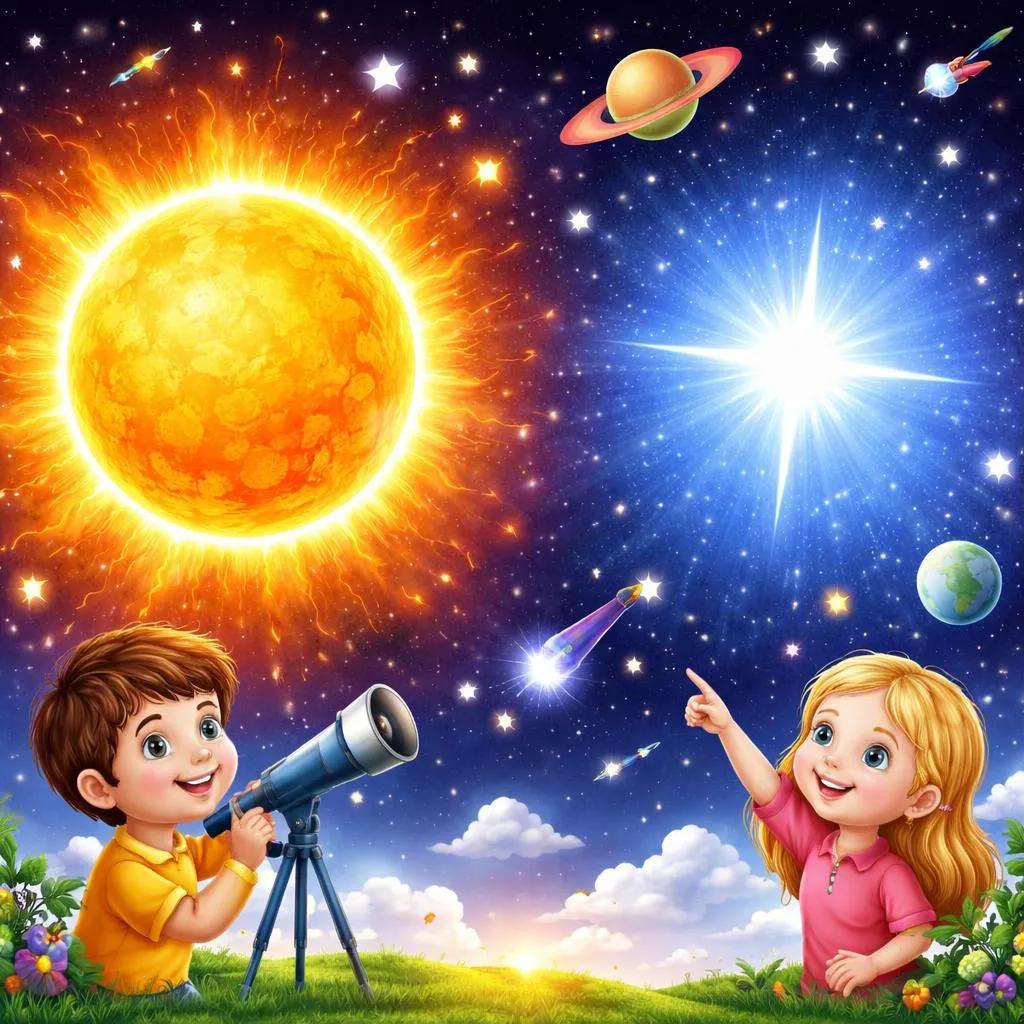
Hello, word explorer! Look up at the daytime sky. What is that big, bright, hot ball of light? It is the sun! Now, look at the night sky. What are all those tiny, twinkling lights? They are stars. They are both bright objects in space. Are they the same? This is a shining space puzzle. Today we explore a word pair. We explore star and sun. They are like a team member and the whole team. One is a player. One is the captain. Knowing the difference is a superpower. Your talk about space will be clear and smart. Let us start our word mission!
Be a Language Observer now. Our first clue is at home. During the day, you feel warm. Your parent says, "The sun is strong today." At night, you go outside. You point and say, "Look at all the stars!" They are both lights in the sky. But are they the same? Let us test with two sentences.
"The sun gives us light and helps plants grow." This is about our own special, close star. "Many stars are much bigger than our sun." This is about all the other suns in the universe.
They both describe huge balls of burning gas. But one is ours. The others are far, far away. Your observation mission starts. Let us blast off into their word galaxy!
Adventure! Blast Off Into the Word Galaxy
Feel the Word's Specific and General Nature!
Feel the word sun. It is a specific, proper name word. It feels like a first name. It is the name of the star at the center of our solar system. The word star is a general, category word. It feels like a job title. It is the name for all objects like our sun. Sun is the specific player. Star is the team. One is a nickname. The other is the group name. Let us see this at school.
In a science class, your teacher says, "Our sun is a medium-sized star." This sentence uses both words perfectly. It shows the sun is one example of a star. Saying "our star is a medium-sized sun" is confusing. The specificity is different. One is the exact one. The other is the type. Let us test this on the playground.
One child stands in the middle of a circle. He says, "I am the sun!" Many other children stand far away. They say, "We are stars!" The word sun is for the one special star in the middle. The word star is for all of them, including the sun. The playground shows the relationship.
Compare Their Distance and Importance to Us!
Think about your own house and all the houses in the world. The word sun is your house. It is the one you live in. It is the most important one to you. The word star is all the other houses. They are very, very far away. Their distance is the key. The sun is close enough to warm us. Other stars are so far they are just dots. Let us see this at school.
In a geography lesson, you learn that the sun causes day and night. This is because Earth orbits our sun. In an astronomy lesson, you learn that the nearest star after the sun is very far. It would take years to reach it by spaceship. The sun's closeness defines our life. Other stars' distance makes them just pretty lights.
Meet Their Best Word Friends!
Words have favorite sky partners. The word sun likes daily and solar system words. It teams up with 'rise', 'set', 'light', 'shine', 'screen', and 'day'. Put on sunscreen. I love the sunshine. The word star likes night, fame, and space words. It teams up with 'movie', 'shooting', 'fish', 'night', 'bright', and 'wish upon a'. Make a wish upon a star. She is a movie star. Their partners are different. Let us go back to school.
In a health class, you learn to protect your skin from the sun. This is about safety. In a biology class, you might learn about a starfish. This is about a sea animal shaped like a star. You would not learn about a "sunfish" in the same way. The word friends set the context.
Our Little Discovery!
We traveled the word solar system. We made a clear discovery. The words star and sun are a family. The word sun is the name of the star that Earth orbits. It is our local star. The word star is the general name for all the huge, glowing balls of gas in space. Our sun is one of billions of stars. Sun is the specific one. Star is the general type. One is the player on our team. The other is the whole league.
Challenge! Become a Sky Word Expert
"Best Choice" Challenge!
Let us look at a nature scene. You are at the beach in the daytime. The light is very bright. You need sunglasses because of the ______. Is it Star or Sun? The champion is Sun! The bright light during the day comes from our sun. Now, imagine a clear night in the countryside. You see thousands of tiny lights. You are looking at the ______. Is it suns or stars? The champion is stars! At night, we see distant stars. Excellent!
"My Sentence Show"!
Now, create your own sentences. Here is a fun scene: Imagine a hot summer afternoon. Use the word sun in one sentence. Now imagine a camping trip with a clear night sky. Use the word star in another. Try it! Here is an example. Sentence one: "The sun was so hot we played in the sprinkler." Sentence two: "We saw a shooting star streak across the dark sky." See the difference? The first is about the heat and light from our local star. The second is about a brief event involving a distant object in space.
"Eagle Eyes" Search!
Can you find the word that needs help? Read this sentence: "In winter, the star sets very early, and it gets dark by 5 p.m." Hmm. This is a mix-up. The object that sets early in winter is our sun, not a distant star. A better sentence is: "In winter, the sun sets very early, and it gets dark by 5 p.m." You fixed it!
What a brilliant journey through the word sky! You started as a curious sky-watcher. Now you are a word astronomer. You know the secret of star and sun. You can feel their specific and general nature. You see their distance and importance. You know their best word friends. This is a real language superpower.
You can learn amazing things from this article. You now know that the 'sun' is the name of the specific star that Earth orbits, giving us day and night. You understand that a 'star' is the general term for any giant ball of burning gas in space, including our sun. You can explain that the sun is a star, but we only call our own star "the Sun". You learned phrases like 'sunrise' and 'shooting star'.
How can you use this today? It is easy and fun. During the day, point to the sky and say, "That is the sun." At night, look up and say, "Those are stars." Remember, each star is a sun for its own solar system. Draw two pictures. Draw the sun with planets around it. Draw a night sky full of stars. You are using your new skill every day.
Keep your explorer eyes on the sky, both day and night. The universe is full of amazing stars, and one of them is your very own sun. You are learning the words to tell them apart. Great work, word expert. Your English journey is shining brighter with every new word pair you discover!