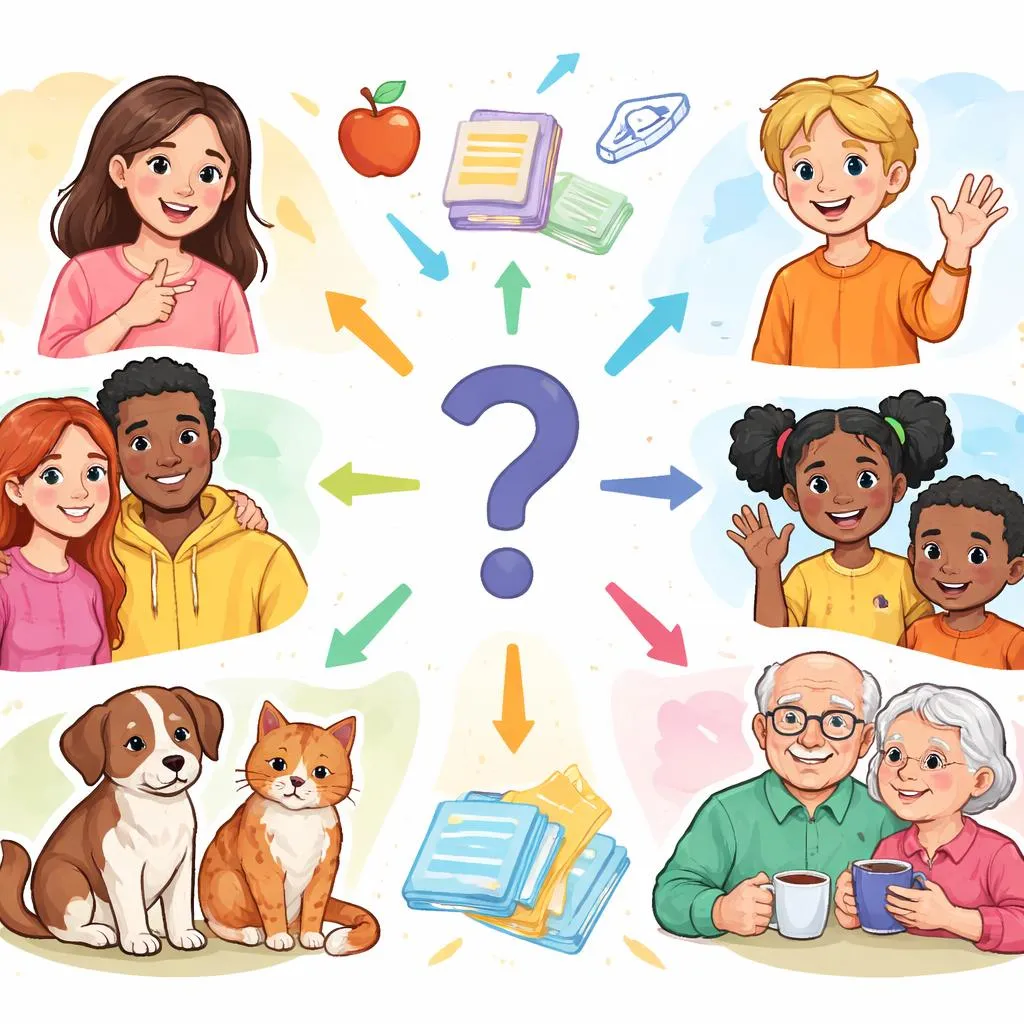

Meaning Let's look at a very useful verb: the present form of have. We use this verb constantly. It primarily shows ownership or possession in the current moment. When we say "I have a pencil," we state a present fact. The present form of have also describes relationships, characteristics, and experiences we hold now. "She has a sister." "This room has a window." It connects a subject to something it possesses or contains. Mastering the present form of have is essential. It allows us to talk about our world, our belongings, and our lives with clarity.
Conjugation Conjugation for the present form of have follows a clear rule. The verb changes based on the subject. We use have with the pronouns I, you, we, and they. We use has with the pronouns he, she, and it. This is the most important rule to remember. I have a book. You have an idea. We have a class. They have toys. He has a ball. She has a plan. The cat has whiskers. The word has is the special present form of have used only for he, she, and it. All other subjects use have.
Present Tense We use the present form of have in the present simple tense. This tense describes general truths, habits, and current states. We talk about what we own or experience as a regular part of life. Here are more examples with have. I have two hands. You have brown hair. We have a dog. They have a new house. Now, examples with has. My father has a car. Maria has a red backpack. The tree has green leaves. That computer has a big screen. We use these forms to make simple, true statements about the present. The verb must always agree with its subject.
Past Tense For talking about the past, we do not use the present form of have. We use the past tense form, which is had. The word had is the same for all subjects. We use it for I, you, he, she, it, we, and they. Yesterday, I had a cookie. Last year, she had short hair. They had a great time at the park. The dog had a bath. In the past tense, the special rule for he/she/it disappears. Everyone uses had. This makes the past tense of this verb easier to learn and use correctly.
Future Tense To talk about future possession, we use the helping verb will. We say will have for every subject. We do not use has in the future tense. Tomorrow, I will have a test. She will have a birthday party. They will have a visitor next week. The garden will have flowers in spring. We can also use am/is/are going to have. He is going to have a turn. We are going to have lunch soon. In the future tense, the main verb have stays in its base form. The helpers will or going to do the grammatical work.
Questions To ask questions in the present, we use the helpers do or does. We use do with I, you, we, they. We use does with he, she, it. A crucial change happens here. When we use does, the main verb reverts to the base form have. The -s from has moves to the helper does. Do you have a brother? Does she have a pencil? Do they have a map? Does the school have a playground? To answer, we can say, "Yes, I do," or "No, he doesn't." We can also give a full sentence answer. "Yes, she has a pencil."
Other Uses The present form of have is used in other important ways. We use it for meals. "I have breakfast at 7 o'clock." We use it for illnesses. "He has a cold." We use it in the phrase have to, meaning must. "We have to clean up." It is also the auxiliary verb used to form the present perfect tense (e.g., "I have eaten"). This is an advanced use. For now, focusing on its role in showing possession ("I have a bike") and basic states ("She has blue eyes") builds a powerful foundation for everyday English.
Learning Tips A great tip is to create a simple chart. Write two columns. Label one "I, You, We, They = HAVE." Label the other "He, She, It = HAS." Keep this chart visible. Practice with a "Look and Say" game. Look around the room. Make sentences about objects. "I have a chair. She has a blue shirt. The clock has two hands." A helpful rhyme is: "With I, you, we, and they, HAVE is what we say. With he and she and it, HAS is always it!" Listen for have and has in songs and stories to reinforce the rule naturally.
Educational Games Games make mastering the present form of have fun and memorable. Play "I Spy with Have." Say, "I spy someone who has glasses." Others look and say, "Maria has glasses!" Another game is "Sentence Sort." Provide cards with subjects (He, The girls, My dog) and verb cards (have, has). Children pick one of each and create a logical sentence. "My dog has a bone." For an active game, try "Has/Have Relay." Teams race to the board to write a correct sentence using a given subject and the correct present form of have.
Understanding the present form of have is about learning a fundamental rule of English. This rule of subject-verb agreement applies to most other verbs in the present tense. If we know "she has," we also know "she runs," "she reads," and "she plays." This one pattern unlocks countless correct sentences. Consistent, positive practice through real-life examples, songs, and games turns this rule into a habit. Soon, choosing between have and has becomes automatic. This allows young learners to describe their world accurately and confidently, forming the bedrock for clear and effective communication in English.