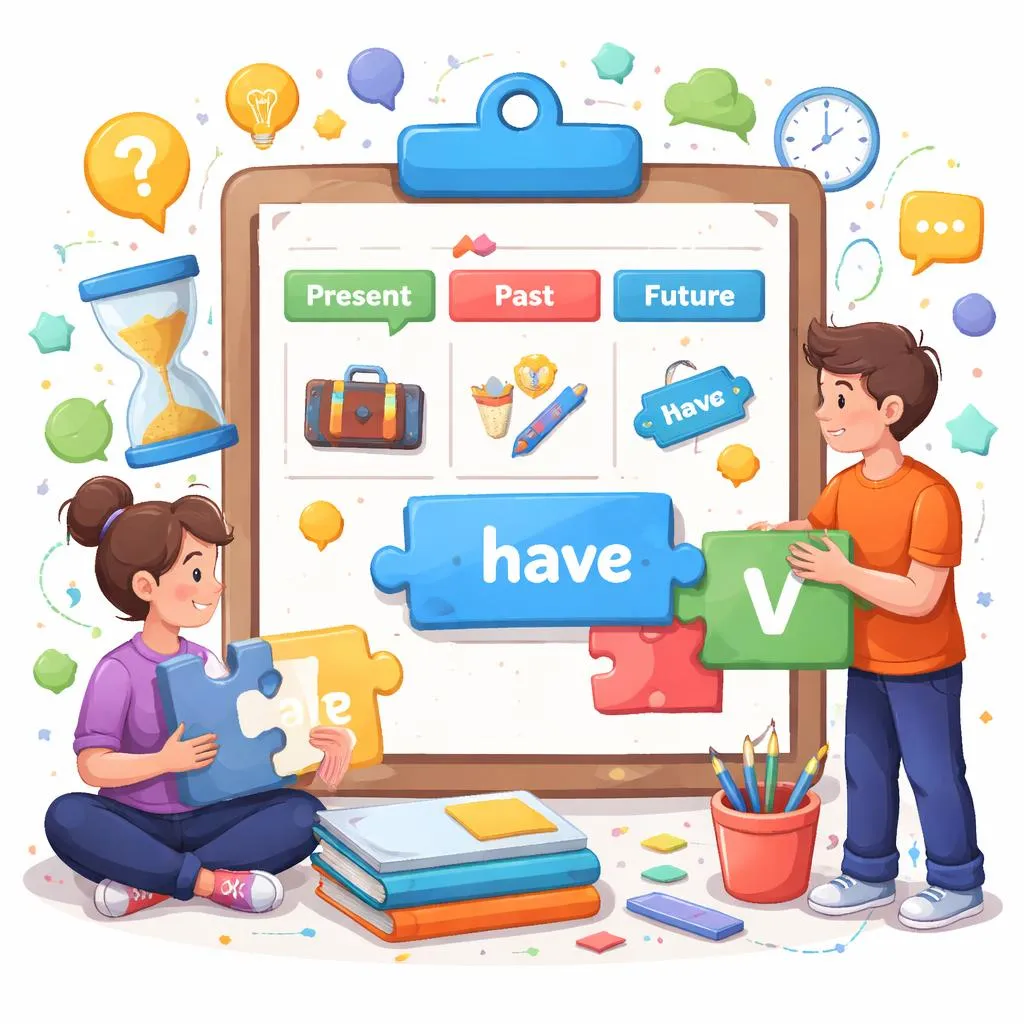

Teaching the past tense of "have" is an essential step in English language learning. This small word appears constantly in conversation. Children need to use it correctly to talk about their experiences and possessions. Today, we are going to explore the have past simple form and discover how to help children master this important verb.
Meaning Let us start with what "have" means. The verb "have" shows possession or ownership. It can also show relationships, experiences, or actions. "I have a dog" means the dog belongs to me. "She has a headache" means she is experiencing pain. "We have breakfast at seven" means we eat breakfast.
In the past simple tense, "have" becomes "had." This form is used for all subjects. There is no difference between I, you, he, she, it, we, or they. Everyone uses "had" in the past simple.
"I had a bicycle when I was young." "She had a cold last week." "We had fun at the park yesterday." "They had pizza for dinner."
The meaning stays the same. "Had" shows that the possession, relationship, or experience happened in the past and is now finished.
Conjugation The verb "have" is irregular. This means it does not follow the regular pattern of adding "ed" for past tense. Children need to memorize its special forms.
Present tense forms: I have You have We have They have He has She has It has
Past tense forms for all subjects: I had You had We had They had He had She had It had
The past tense is much simpler than the present tense. There is only one form to learn. This makes it easier once children understand the rule.
Negative past simple: I did not have You did not have We did not have They did not have He did not have She did not have It did not have
Notice that in negatives, we use "did not" and the base form "have." We do not say "did not had." This is a common mistake to watch for.
Present Tense Before teaching the past tense, children need to understand the present tense. The present tense of "have" changes based on the subject.
"I have a red ball." "You have blue eyes." "We have two cats." "They have a big house." "He has a new bicycle." "She has a pretty dress." "It has a long tail."
We practice these sentences many times. Children need to feel comfortable with "have" and "has" before moving to past tense.
The present tense talks about things that are true now. "I have a cold today." This means right now, I am sick. The feeling is current.
Past Tense Now we focus on the have past simple form: "had." This talks about things that were true in the past but are not true now.
"I had a cold last week, but now I am better." "She had a blue bicycle when she was little." "We had a good time at the party yesterday." "They had a pet rabbit, but it ran away."
The past tense tells us the situation is finished. The cold is gone. The bicycle is no longer hers. The party is over. The rabbit is gone.
We practice contrasting present and past. "Today I have a sandwich. Yesterday I had pizza." "Now she has long hair. Before, she had short hair." These contrasts help children understand the time difference.
Future Tense For future time, we do not use "had." We use "will have" or "going to have." This talks about things that will happen later.
"I will have a birthday party next month." "She will have a new baby sister in the spring." "We will have a test on Friday." "They are going to have a picnic on Saturday."
The future tense is consistent for all subjects. Everyone uses "will have" or "is going to have." There are no changes based on the subject.
We can contrast all three tenses: Past: I had a dog when I was little. Present: I have a cat now. Future: I will have a hamster next year.
This helps children see the full timeline.
Questions Forming questions with "have" in past simple follows regular patterns. We use "did" plus the base form "have."
Present tense questions: "Do you have a pencil?" "Does she have a brother?"
Past tense questions: "Did you have a good time?" "Did she have a cold?" "Did they have enough food?" "Did it have a happy ending?"
The answer uses "did" as well. "Did you have breakfast?" "Yes, I did." "No, I didn't."
Question word questions: "What did you have for lunch?" "Where did they have the party?" "Why did she have to leave early?" "How many pets did he have?"
These questions are very common in daily conversation. Children need lots of practice with them.
Other Uses of Have Beyond possession, "have" has many other uses. Children encounter these in daily language.
Have for Experiences: "We had a great time." "She had a wonderful vacation." "I had a strange dream."
Have for Meals: "We had breakfast at seven." "They had lunch at school." "Let's have dinner together."
Have for Actions: "She had a shower." "He had a nap." "They had a conversation."
Have for Feelings: "I had a headache." "She had fun." "We had a problem."
Have with "Got": "I had got a letter" is less common. Usually we say "I had gotten" in American English, or simply "I got a letter."
In all these uses, the past simple form is always "had." This consistency helps children use it correctly across many situations.
Learning Tips for Have Past Simple Teaching the past simple of "have" requires specific strategies. Here are tips that work well with young learners.
Start with concrete examples from children's lives. "Yesterday, what did you have for breakfast? What toys did you have when you were little?" Personal connections make the grammar meaningful.
Use timelines. Draw a line on the board. Mark "past" on one end and "now" on the other. Place events on the timeline. "I had a baby tooth" in the past. "I have big teeth" now. Visuals help children understand time concepts.
Practice the negative form separately. Children often say "I didn't had" instead of "I didn't have." Drill this pattern with games and repetition. "Did you have pizza?" "No, I didn't have pizza. I had pasta."
Use songs that include "had." "Old MacDonald Had a Farm" is perfect. Children sing "had" repeatedly in a fun context. "Mary Had a Little Lamb" is another excellent example.
Common Mistakes with Have Past Simple Children make predictable mistakes with "have." Knowing these helps us address them gently.
One common mistake is using "has" in the past. "Yesterday she has a cold" should be "Yesterday she had a cold." We explain that "has" is only for present tense with he/she/it.
Another mistake is keeping "have" in negatives without "did." "I not have breakfast" should be "I did not have breakfast." Children need practice with the full negative form.
Some children use "had" with "did." "I did had fun" should be "I did have fun." We explain that "did" already shows past tense, so the main verb stays simple.
Word order in questions can be tricky. "You had a good time?" should be "Did you have a good time?" Practice the question pattern many times.
Educational Games for Have Past Simple Games make grammar practice fun and memorable. Here are some games to practice the past simple of "have."
Memory Chain Game: Start with a sentence using "had." "I had a dog when I was little." The next child repeats and adds their own. "She had a dog, and I had a cat." Continue around the circle, building a chain of memories. This practices the form in a natural way.
What Did You Have? Game: Give each child a picture card showing an object. They walk around and ask each other questions. "What did you have for breakfast?" The child looks at their card and answers. "I had cereal." This practices questions and answers.
Yesterday and Today Sort: Create sentence cards. Some use "have" or "has" for present. Some use "had" for past. Children sort them into two piles. "I have a ball" goes in present. "I had a ball" goes in past. This builds time awareness.
Past Tense Bingo: Create bingo cards with sentences using "had." Call out present tense sentences. Children find the matching past tense. Call "I have a dog" and they look for "I had a dog." This builds transformation skills.
Story Time: Read a simple story that uses "had" many times. "Goldilocks and the Three Bears" works well. "Papa Bear had a big bowl. Mama Bear had a medium bowl. Baby Bear had a small bowl." After reading, children retell the story using "had."
Interview Game: Children interview each other about the past. "What did you have for breakfast? What toys did you have when you were little? Where did you have your last birthday party?" They practice asking and answering with "had."
Using Had in Stories Stories are wonderful for practicing "had." Many children's books use this word frequently.
"We're Going on a Bear Hunt" uses "had" in the refrain. "We're not scared" but also describes what the family had to go through.
"The Very Hungry Caterpillar" uses "had" repeatedly. "On Monday, he had one apple. On Tuesday, he had two pears." This book is perfect for practicing "had" with food and numbers.
After reading, children can create their own "had" stories. "On my birthday, I had cake. I had presents. I had fun." This builds confidence and creativity.
Daily Practice Opportunities The best practice for "had" happens in daily conversation. Throughout the day, we have many opportunities to use past tense.
During morning meeting, ask about the previous evening. "What did you have for dinner last night?" Children answer using "had."
During show and tell, children talk about objects from home. "I had this toy since I was little." "My grandma had this doll when she was a girl."
During reflection time at the end of day, talk about what happened. "We had music class today. We had a fun time at recess."
These natural conversations provide meaningful practice without feeling like lessons.
As we explore the have past simple form with young learners, we help them express themselves about the past. They learn to talk about what they owned, experienced, and did. They gain confidence in telling stories about their lives. Through games, songs, and daily conversations, "had" becomes a natural part of their English. This small word opens up a whole new dimension of communication about time and experience.