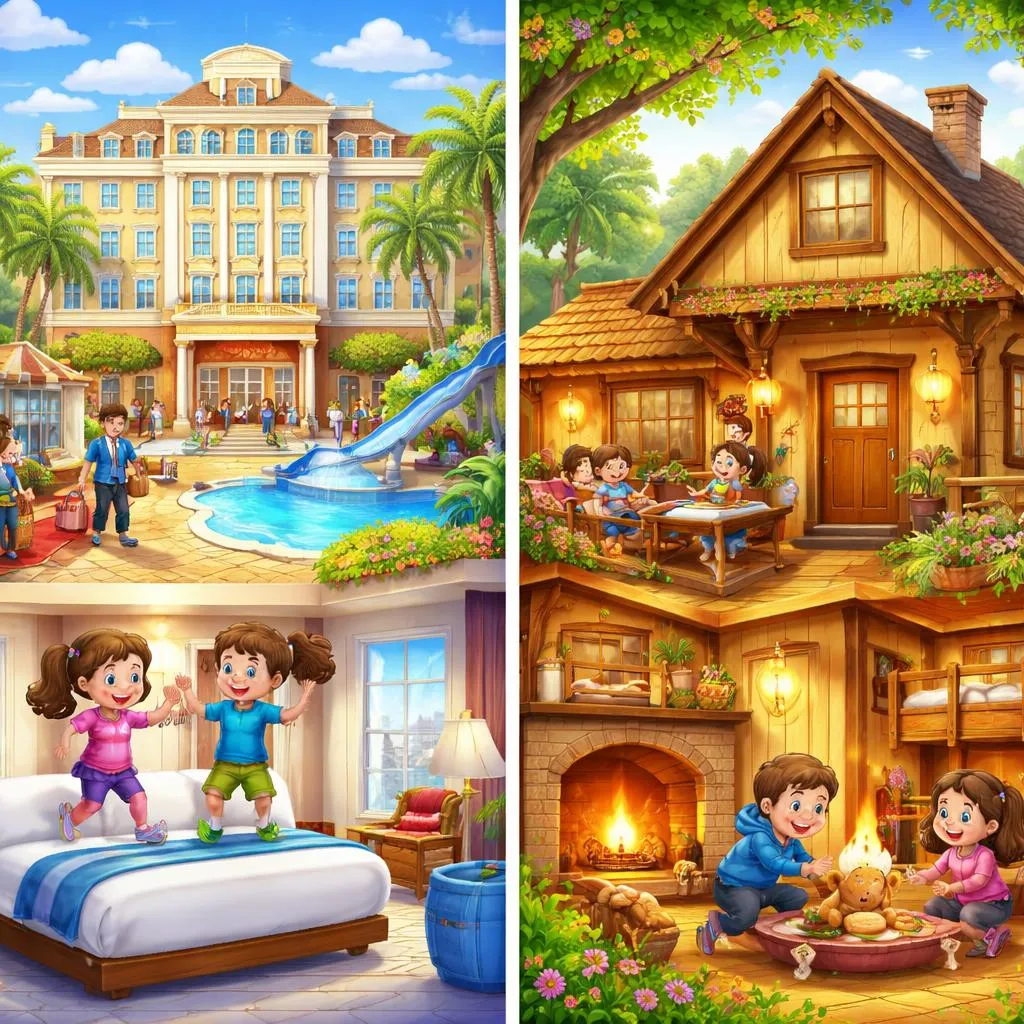

Start! Find a Pair of 'Stay Twin' Words
Hello, word explorer! Have you ever stayed somewhere that was not your home on a trip? What do you call that place? You might say "hotel." Or maybe you have heard of a cozy place called an "inn." They are both places for travelers to sleep. Are they the same? This is a fun travel puzzle. Today we explore a word pair. We explore hotel and inn. They are like two different hosts. One is big and formal. One is small and cozy. Knowing the difference is a superpower. Your travel stories will be clear and smart. Let us start our word journey!
Be a Language Observer now. Our first clue is at home. Your family goes on a big city vacation. You stay in a tall building with many rooms. Your dad says, "Our hotel is near the museum." Another time, you take a road trip. You stop at a charming, small house by the road. The sign says "Country Inn." They are both places to stay. But are they the same? Let us test with two sentences.
"The large hotel in the city had a swimming pool and three restaurants." This sounds big and full of services. "They spent the night at a quiet inn in the mountains." This sounds small, personal, and peaceful.
They both describe lodgings for travelers. But one feels like a big business. One feels like a personal home. Your observation mission starts. Let us check into their word world.
Adventure! Check Into the Word World
Feel the Word's Size and Ambiance!
Feel the word hotel. It is a large, formal word. It feels like a big city. It has many floors, rooms, and staff. The word inn is a small, cozy word. It feels like a small town. It is often family-run and has a personal touch. Hotel is the grand castle. Inn is the charming cottage. One is impressive. The other is intimate. Let us see this at school.
In a geography lesson, you might see a picture of a skyscraper hotel. This is about large-scale tourism. In a history lesson, you learn about old coaching inns where stagecoaches stopped. This is about historical, small-scale lodging. Saying "coaching hotel" is less common. The size and historical feel are different. One is modern and big. The other is often old and small.
Compare Their Services and Feel!
Think about a huge supermarket and a friendly corner store. The word hotel is the supermarket. It offers many services: room service, gym, conference rooms. The word inn is the corner store. It offers basic, cozy lodging, often with a home-cooked breakfast. Their vibe is a clue. A hotel can feel anonymous. An inn feels personal, like visiting someone's home. Let us test this on the playground.
You and friends build a big structure with many blocks. You say, "This is the grand hotel!" Your friend builds a smaller, welcoming structure. She says, "This is the friendly inn where the owner knows your name." The word hotel suggests scale and many services. The word inn suggests personal charm and simplicity. The playground shows the difference.
Meet Their Best Word Friends!
Words have favorite travel partners. The word hotel likes luxury and business words. It teams up with 'five-star', 'boutique', 'resort', 'suite', 'chain', and 'manager'. We stayed at a resort hotel. Ask the hotel manager. The word inn likes cozy and traditional words. It teams up with 'bed and breakfast', 'country', 'historic', 'roadside', 'keeper', and 'tavern'. It is a charming bed and breakfast inn. The inn keeper was nice. Their partners are different. Let us go back to school.
In a math class, you might calculate the cost of a hotel stay for a large group. This is about big numbers. In a creative writing class, you set a story in a mysterious, old inn. This creates a certain mood. You would not usually set a story in a "mysterious, old hotel" for the same cozy, rustic feel. The word friends set the expectation.
Our Little Discovery!
We checked into the word lodging world. We made a clear discovery. The words hotel and inn are different places to stay. The word hotel usually describes a large, formal establishment with many rooms and services. The word inn usually describes a smaller, more personal establishment, often with a cozy or historical feel. Hotel is the big-city option. Inn is the countryside retreat. One is about many amenities. The other is about personal charm.
Challenge! Become a Travel Word Expert
"Best Choice" Challenge!
Let us look at two trips. Read each one. Pick the champion word. Scene one: A family stays at a 20-story building with a concierge, a spa, and four elevators. This is a ______. Is it Hotel or Inn? The champion is Hotel! Its size and many services define it as a hotel. Scene two: On a hiking trip, travelers find a small, wooden building with six rooms and a shared dining table for breakfast. The sign says "Mountain View ______." Is it hotel or inn? The champion is inn! A small, rustic lodging like this is typically an inn. Excellent!
"My Sentence Show"!
Now, create your own sentences. Here is a fun scene: Imagine a buzzing, downtown location with a huge lobby. Use the word hotel in one sentence. Now imagine a quiet, wooden building on a country road. Use the word inn in another. Try it! Here is an example. Sentence one: "The business traveler checked into the downtown hotel for a conference." Sentence two: "The windows of the old inn had flower boxes full of red blooms." See the difference? The first is about a practical, urban stay. The second paints a picture of a quaint, picturesque place.
"Eagle Eyes" Search!
Can you find the word that needs help? Read this sentence: "We needed a place for our company's 500-person meeting, so we booked the conference hall at a small, family-run inn near the lake." Hmm. This is a mismatch. A 500-person meeting requires a large venue, which a small inn is unlikely to have. The correct word is hotel. A better sentence is: "We needed a place for our company's 500-person meeting, so we booked the conference hall at a large hotel near the lake." You fixed it!
What a wonderful check-in to the word world of travel! You started as a curious traveler. Now you are a word concierge. You know the secret of hotel and inn. You can feel their different sizes and ambiance. You see their services and feel. You know their best word friends. This is a real language superpower.
You can learn amazing things from this article. You now know that a 'hotel' is typically a large, formal building with many rooms and services like restaurants and pools. You understand that