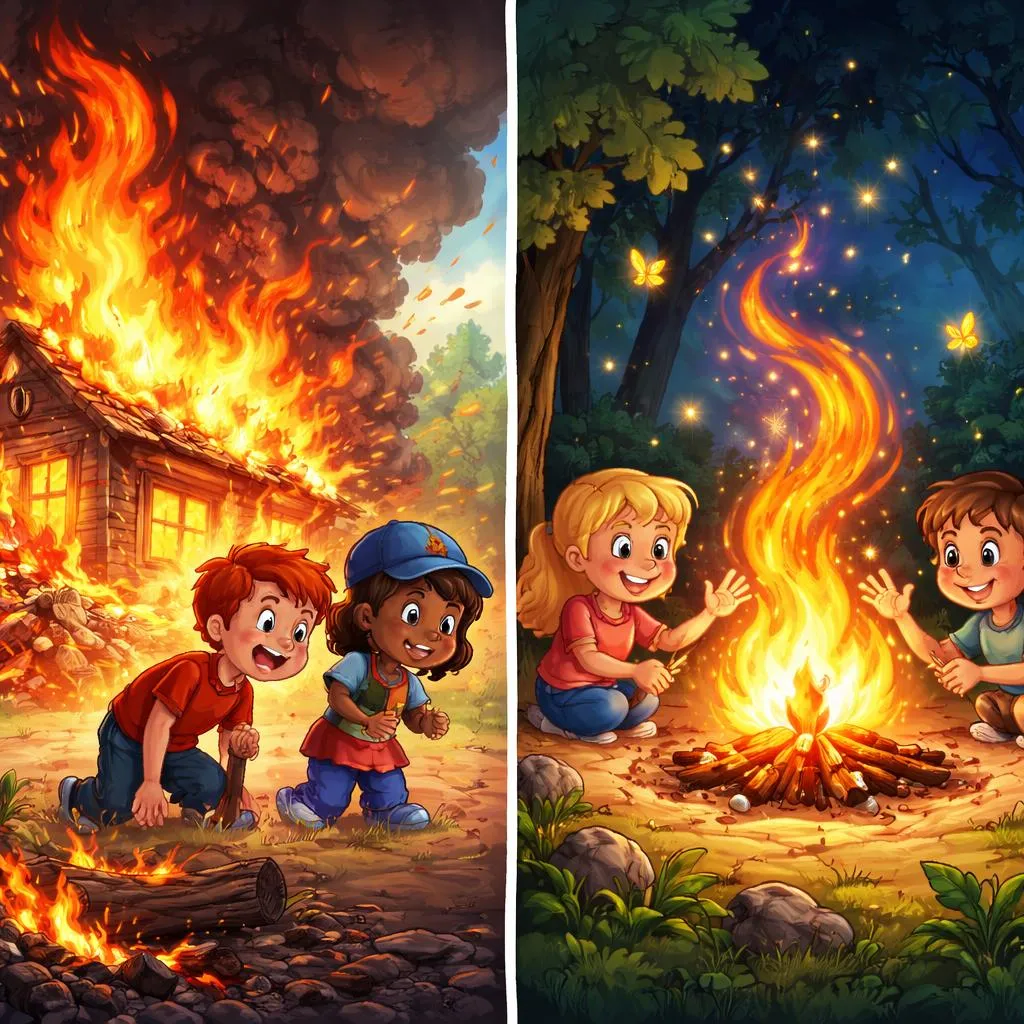

Start! Find a Pair of 'Hot Twin' Words
Hello, word explorer! Do you know about heat and light? A big, dangerous forest fire is scary. The small, dancing flame on a birthday candle is pretty. They are both hot and bright. Are they the same? This is a fascinating puzzle. Today we explore a word pair. We explore fire and flame. They are like a powerful king and a graceful dancer. One is the whole show. One is a single performer. Knowing the difference is a superpower. Your talk about heat and light will be clear and smart. Let us start our fiery word lesson!
Be a Language Observer now. Our first clue is at home. The campfire roared with a large, hot fire. A single, blue flame danced on the gas stove. They are both burning. But are they the same? Let us test with two sentences.
"The firefighters worked hard to put out the house fire." This is about a large, dangerous event. "She watched the tiny flame flicker on the match." This is about a small, individual part of the fire.
They both produce heat. But one feels big and overwhelming. One feels small and specific. Your observation mission starts. Let us light up their word world.
Adventure! Light Up the Word World
Feel the Word's Powerful and Graceful Vibe!
Feel the word fire. It is a powerful, sometimes scary word. It feels like a whole event, an emergency, or a large source of heat. The word flame is a graceful, visual word. It feels like shape, movement, and a single point of light. Fire is the loud roar. Flame is the quiet dance. One commands your attention. The other catches your eye. Let us see this at school.
In a safety class, you learn "Stop, Drop, and Roll" if your clothes catch fire. This is about a dangerous situation. In a science class, you observe the different colors in a Bunsen burner's flame. This is about studying a specific part. You study the properties of a flame. You escape from a fire. The feeling of the words is different. One is an emergency. The other is a subject of study.
Compare Their Size and Relationship!
Think about an ocean and a single wave. The word fire is the ocean. It is the whole burning thing - the heat, the light, the smoke. The word flame is the wave. It is the visible, glowing part you can see. A fire is made of many flames. But a single flame is not the whole fire. Their relationship is the key. Fire is the event or the large phenomenon. Flame is the visible, leaping part. Let us test this on the playground.
Someone shouts, "Fire!" This means there is a dangerous burning situation. You look at a bonfire and see one orange flame leaping high. The word fire describes the whole dangerous situation. The word flame describes that one leaping part. The playground shows the difference.
Meet Their Best Word Friends!
Words have favorite hot partners. The word fire likes big and event words. It teams up with 'catch on', 'wild', 'camp', 'open', 'firefighter', and 'set on'. Catch fire. A campfire. The word flame likes descriptive and shape words. It teams up with 'dancing', 'flickering', 'eternal', 'candle', 'burst into', and 'fan the'. Dancing flame. A candle flame. Their partners are different. Let us go back to nature.
A volcano can spew fire and lava. This describes the powerful, erupting force. A butterfly might be attracted to the bright flame of a lamp. It is drawn to the specific point of light. You would not say a volcano spews "flames and lava" as the main event. The word friends set the scene.
Our Little Discovery!
We explored the world of heat and light. We made a clear discovery. The words fire and flame are different. Fire is the general word for the process of burning that creates heat and light. It often refers to a large, destructive, or useful event. Flame is the visible, glowing, leaping part of a fire. You can have a single, small flame. A fire is made of many flames. One is the whole event. The other is a visible part. This is the main difference.
Challenge! Become a Fiery Word Expert
"Best Choice" Challenge!
Let us look at a nature scene. A volcano erupts violently. Hot lava and burning rocks create a huge, dangerous fire on the mountainside. Is it Fire or Flame? The champion is Fire! This describes the large, dangerous burning event. Now, imagine a firefly at night. Its tail produces a tiny, cool, blinking point of light, like a little flame. Is it fire or flame? The champion is flame! This describes the small, visible point of light, even if it is not hot. Excellent!
"My Sentence Show"!
Now, create your own sentences. Here is a fun scene: Imagine a big, controlled burn to clear a field. It is a large, contained burning area. Use the word fire in one sentence. Now imagine looking closely at a candle. You see its bright, moving tip. Use the word flame in another. Try it! Here is an example. Sentence one: "The rangers set a controlled fire to manage the forest." Sentence two: "The candle's flame flickered in the gentle breeze." See the difference? The first is about the whole planned burning event. The second is about the specific, moving light on the candle.
"Eagle Eyes" Search!
Can you find the word that needs help? Read this sentence: "The little flame from the fallen candle quickly grew into a dangerous house flame that took hours to put out." Hmm. This is a mix. A small "flame" can start a big "fire." But a big, dangerous event in a house is a house fire, not a "house flame." A better sentence is: "The little flame from the fallen candle quickly grew into a dangerous house fire that took hours to put out." You fixed it!
What a bright and exciting exploration! You started as a curious observer. Now you are a word expert. You know the secret of fire and flame. You can feel their different powerful and graceful vibes. You see that fire is the whole event and flame is the leaping part. You know their best word friends. This is a real language superpower.
You can learn amazing things from this article. You now know that 'fire' is the word for the whole burning event, which can be big, dangerous, or useful like a campfire. You understand that a 'flame' is the specific, visible, leaping part of a fire, like on a candle or match. You can explain that a fire is made of many flames, but a single flame is just one part. You learned phrases like 'catch fire' and 'dancing flame'.
How can you use this today? It is easy and fun. Watch a campfire. See the big fire. Look at one leaping part. That is a flame. Light a candle. Watch its small, steady flame. Remember safety: a small flame can start a big fire. Draw two pictures. Draw a big forest fire. Draw a single candle flame. You are using your new skill every day.
Keep your explorer eyes open. The world is full of amazing fires and beautiful flames. You are learning the words to describe them safely and accurately. Great work, word expert. Your English journey is getting more precise and bright with every new word pair you discover!