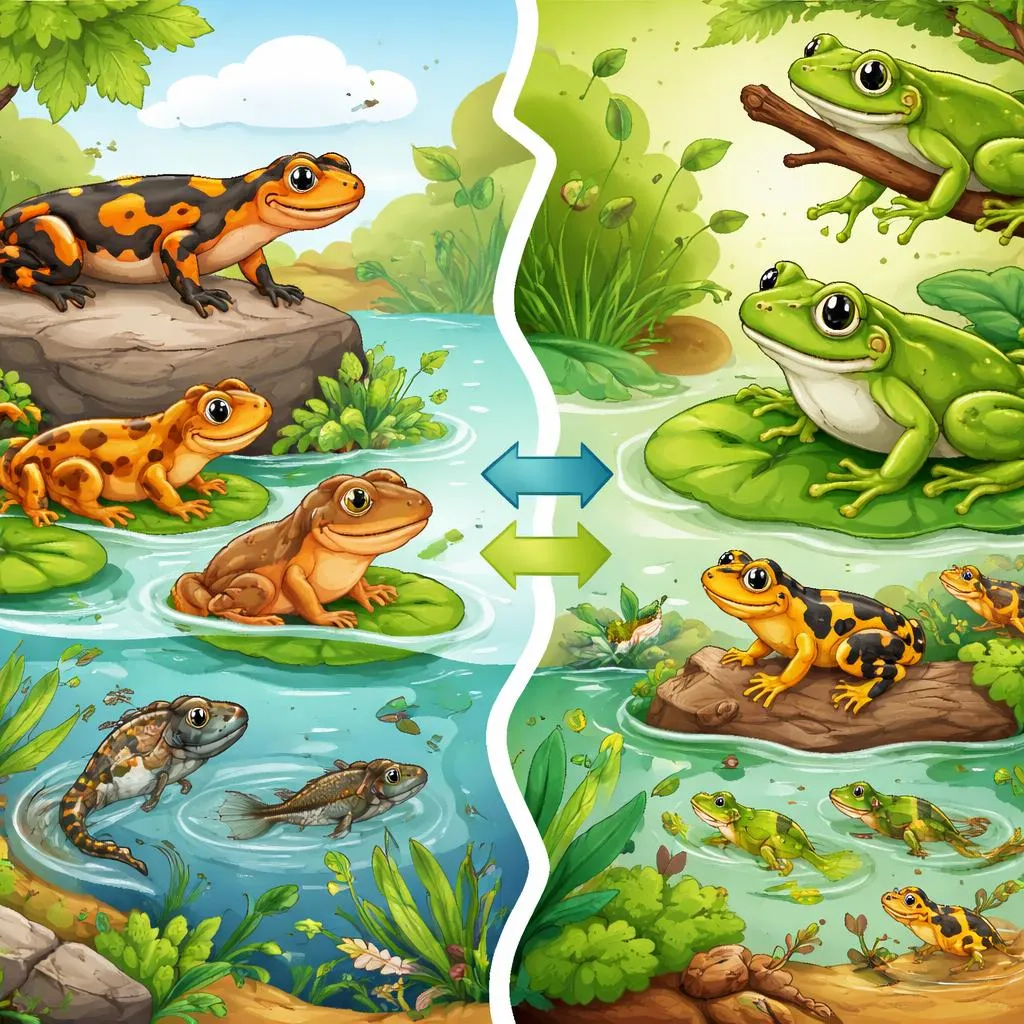

Hello, word explorer! Are you ready for a pond adventure? Imagine you are by a pond. You see a green creature jump. You shout, "Look, a frog!" Your friend points at a long, slippery creature. They say, "Look, a salamander!" Are they both frogs? This is a cool word puzzle. Today we explore a word pair. We explore amphibian and frog. They are like word family members. They live in the same watery world. But they have different jobs! Knowing their secret is a superpower. Your animal facts will be super smart. Let us start our word splash!
Be a Language Scientist now. Our first clue is at home. You watch a nature show. The host says, "A frog is a type of amphibian." This is a science fact. Now, you read a storybook. It says, "The frog said 'ribbit'." This is a fun character. They both talk about pond life. But do they mean the same thing? Let us test with two sentences.
"A toad is also an amphibian, like a frog." This teaches a group. "I heard a frog croak near the pond." This describes a specific sound.
They seem connected. And they are! One is a big group name. The other is a popular member. Your scientific observation starts. Let us hop into their word pond.
Adventure! Dive Into the Word Pond
Feel the Word's Water Temperature!
Feel the word amphibian. It is a cool, clear word. It feels like a science lab. It is calm and factual. It is like a teacher giving a lesson. The word frog is different. It is a lively, splashy word. It feels like a fun story. It is direct and full of life. Amphibian is for thinking and learning. Frog is for seeing and playing. One is a textbook. The other is a cartoon. Let us see this at school.
You are in biology class. Your teacher says, "Salamanders and newts are also amphibians." This is perfect. It explains a category. Now imagine art class. You paint a picture. You say, "I painted a green frog on a lily pad." This is also perfect. It shows a clear image. Saying "I painted a green amphibian" is less fun. It loses the friendly, familiar feeling. The word temperature is different.
Compare Their Group Size and Home!
Think about a big team and a star player. The word amphibian is the whole team. It is a large animal group. Frogs, toads, salamanders, and newts are all on the team. The word frog is the most famous player. It is one type of amphibian. Amphibian is the team name. Frog is one player's name. A frog is always an amphibian. But an amphibian is not always a frog. The group size is different. Let us test this on the playground.
You play a tag game called "Pond Life." You call out, "I am an amphibian!" This could mean many animals. You could hop like a frog. You could crawl like a salamander. Now you shout, "I am a frog!" Now you must hop. The word frog gives a specific action. The word amphibian gives a bigger choice. One is a big home. The other is a specific room inside.
Meet Their Best Word Friends!
Words have favorite buddies. The word amphibian likes science and study words. It teams up with 'class', 'species', 'life cycle', and 'habitat'. You learn about the amphibian life cycle. You protect amphibian habitats. The word frog likes playful and descriptive words. It teams up with 'prince', 'jump', 'pond', and 'legs'. You read a frog prince story. You see frog legs in a pond. Their buddies are different. Let us go back to school.
You write a science report. You write, "Amphibians can live on land and in water." This is correct. Now, you sing a silly song. You sing, "A frog went a-courting, he did ride!" This sounds right. You would not sing "An amphibian went a-courting." It sounds too serious. The word friends help choose the right word.
Our Little Discovery!
We explored the word pond together. We made a great discovery. The words amphibian and frog are a family. But they are not the same animal. The word amphibian is a science group word. It describes animals that live in water and on land. They often have a life cycle with tadpoles. The word frog is a specific animal name. It is one kind of amphibian that jumps and says "ribbit." Amphibian is the whole team. Frog is the jumping champion on the team. One is the category. The other is a famous example.
Challenge! Become a Pond Word Champion
"Best Choice" Challenge!
Let us play in nature. Read each scene. Pick the champion word. Scene one: You visit a nature center. A sign explains animals that start life in water. It says, "______, like frogs, begin as tadpoles." Is it Amphibian or Frog? The champion is Amphibian! The sign talks about the whole group. Scene two: You are exploring a creek. You see a small, green, jumping animal. You tell your dad, "I just caught a ______!" Is it amphibian or frog? The champion is frog! It is the perfect, common name for that animal. Excellent choosing!
"My Sentence Show"!
Now, create your own sentences. Here is a fun scene: Imagine a rainy day in a forest. Use the word amphibian in one sentence. Use the word frog in another. Try it! Here is an example. Sentence one: "The wet forest is home to many amphibians." Sentence two: "A tiny tree frog sat on a leaf." See the difference? The first sentence talks about a whole group of animals. The second sentence paints a picture of one little creature.
"Eagle Eyes" Search!
Can you find the word that needs help? Read this sentence: "My favorite amphibian is the colorful poison dart frog from the rainforest." Hmm. This sentence is factually correct. The poison dart frog is an amphibian. But in everyday talk, the word frog is more direct and common here. "My favorite frog is the colorful poison dart frog from the rainforest." This sounds more personal and friendly. It is a small improvement. You have a good eye!
What a wonderful pond adventure! You started as a curious explorer. Now you are a word biologist. You know the secret of amphibian and frog. You can feel their different temperatures. You see their team size. You know their best word friends. This is a real language superpower.
You can learn amazing things from this article. You now know that 'amphibian' is the science word for animals that live in water and on land. You understand that 'frog' is the name for a specific, jumping type of amphibian. You can explain that all frogs are amphibians, but salamanders are amphibians that are not frogs. You learned to use 'amphibian' for science class and 'frog' for stories and everyday talk.
How can you use this today? It is easy and fun. Next time you are near a pond or park, be a scientist. Look for creatures. Say, "I think that's an amphibian" if it looks like a frog or salamander. If it hops and says "ribbit," say, "That's a frog!" Watch a nature show. Listen for the word 'amphibian'. Read a fun story. Find the word 'frog'. You are using your new knowledge every day.
Keep your explorer eyes open. Language is a big, wonderful pond to explore. You have the tools to understand it. Great work, word scientist. Your English adventure gets more exciting with every new word you master!