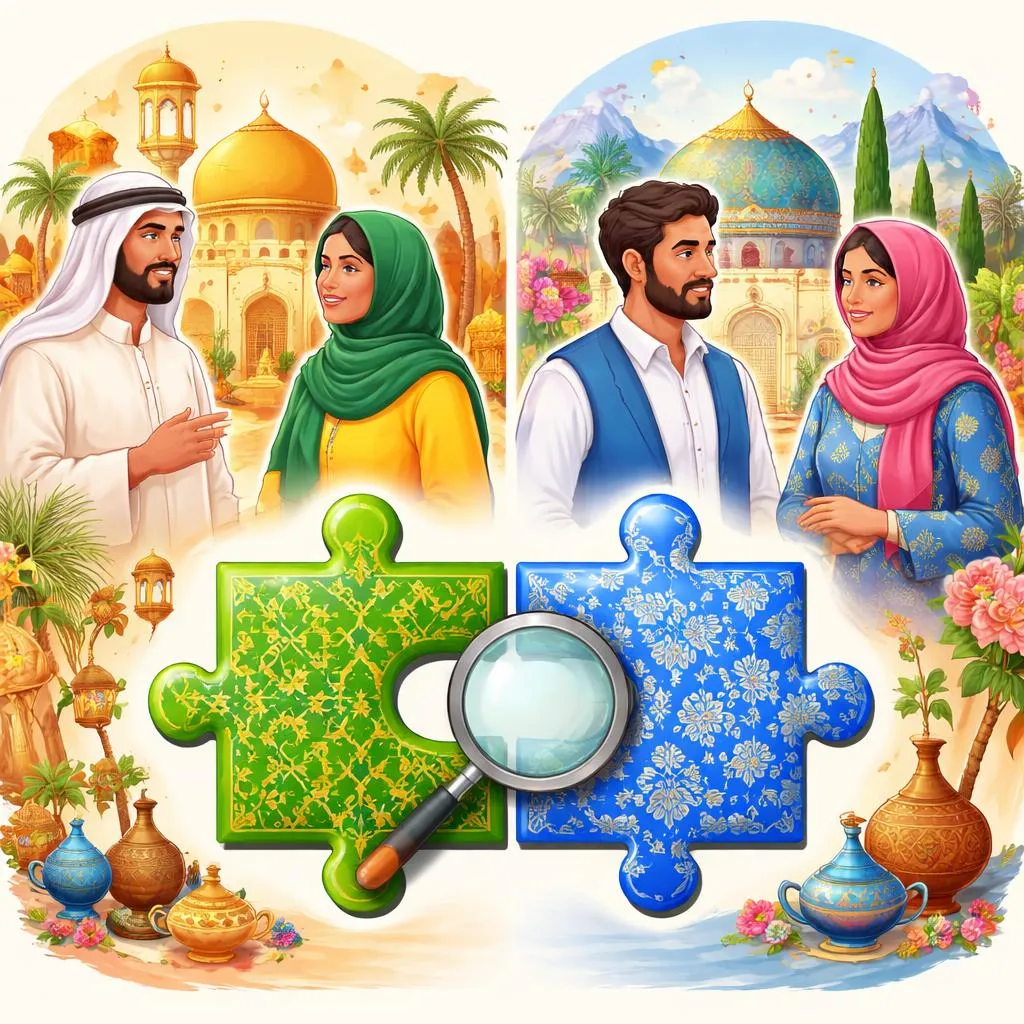

Many people think Arabic and Farsi are the same because they use a similar writing system and are spoken in nearby regions. However, Arabic and Farsi are two completely different languages with different histories, grammar systems, and vocabularies. Understanding the difference between Arabic language and Farsi helps learners avoid confusion and appreciate both languages more clearly.
Language Family
The most important difference is language family.
Arabic belongs to the Semitic language family. Other Semitic languages include Hebrew and Amharic.
Farsi, also called Persian, belongs to the Indo-European language family. This is the same large family that includes English, Spanish, French, and German.
Because they come from different language families, Arabic and Farsi are not directly related, even though they share some vocabulary.
Where They Are Spoken
Arabic is spoken in many countries across the Middle East and North Africa, including Saudi Arabia, Egypt, Iraq, Jordan, and Morocco. It is the official language in more than twenty countries.
Farsi is mainly spoken in Iran, where it is the official language. A closely related variety, Dari, is spoken in Afghanistan, and Tajik is spoken in Tajikistan.
Although the regions are geographically close, the languages are distinct.
Writing System
Both Arabic and Farsi use a script that looks similar because Farsi adopted and adapted the Arabic alphabet after the spread of Islam. However, Farsi added extra letters to represent sounds that do not exist in Arabic.
For example, Farsi includes letters for sounds like “p,” “g,” “ch,” and “zh,” which are not found in standard Arabic pronunciation.
Even though the script looks similar, pronunciation rules differ between the two languages.
Grammar Differences
Arabic grammar is generally more complex than Farsi grammar.
Arabic uses a root system based on three consonants to form many related words. It also has grammatical gender, meaning nouns are either masculine or feminine.
Farsi does not have grammatical gender. Nouns are not marked as masculine or feminine. This often makes Farsi grammar easier for beginners compared to Arabic.
Verb conjugation systems are also different. Arabic verbs change according to person, gender, and number in more detailed ways than Farsi verbs.
Vocabulary
Farsi has borrowed many words from Arabic, especially in formal, academic, and religious contexts. However, the core structure of the language remains Indo-European.
For example, everyday words such as numbers and common verbs in Farsi are very different from Arabic equivalents.
Even when words look similar in writing, their pronunciation may differ.
Pronunciation
Arabic contains some sounds that are difficult for learners, such as deep throat consonants. These sounds do not exist in English or Farsi.
Farsi pronunciation is generally considered softer and easier for English speakers because it does not include as many strong guttural sounds.
Cultural and Historical Influence
Arabic is strongly connected to Islamic religious texts, including the Quran, which was written in Arabic. As a result, Arabic has had a major cultural influence across the Islamic world.
Farsi has a long literary history with famous poets such as Rumi and Hafez. Persian literature has influenced culture across Central and South Asia.
Both languages have rich histories and important cultural roles.
Are They Mutually Intelligible?
No, Arabic and Farsi speakers generally cannot understand each other without study. Despite shared vocabulary and script similarities, they are separate languages with different grammar systems.
Learning one does not automatically mean understanding the other.
Conclusion
Arabic and Farsi may look similar in writing, but they belong to different language families, have different grammar rules, and developed in distinct cultural contexts. Recognizing these differences helps language learners choose the right language for their goals and understand the rich diversity of Middle Eastern languages.
Dialects Within Arabic
When discussing Arabic language vs Farsi, it is important to understand that Arabic itself has many dialects. The Arabic spoken in daily life in Egypt is quite different from the Arabic spoken in Morocco or Lebanon. These regional varieties can differ in pronunciation, vocabulary, and even grammar.
At the same time, there is a standardized form called Modern Standard Arabic, which is used in news, formal writing, and official communication. Speakers across Arabic-speaking countries learn this formal variety in school, but they usually speak a local dialect at home.
Farsi also has regional accents and variations, but the differences are generally smaller compared to the wide range of Arabic dialects. Standard Farsi is widely understood throughout Iran.
Sentence Structure Differences
Another major difference between Arabic and Farsi is sentence structure.
In Arabic, sentences often follow a Verb–Subject–Object order, especially in formal contexts.
In Farsi, the common sentence order is Subject–Object–Verb, which is similar to Japanese or Korean structure and different from English.
For example, in English we say:
I read the book.
In Farsi, the structure is closer to:
I the book read.
This structural difference makes the two languages feel very different when spoken.
Plural Forms
Plural formation is another area where Arabic and Farsi differ significantly.
Arabic has several types of plurals, including what are called “broken plurals,” where the internal structure of the word changes completely. This system requires memorization and practice.
Farsi usually forms plurals by adding a consistent ending to nouns, which is generally easier to learn.
Because of this, many learners find Farsi noun forms more predictable than Arabic ones.
Loanwords and Influence
Although Farsi belongs to the Indo-European family, centuries of cultural contact led to a large number of Arabic loanwords entering Persian vocabulary. Many academic, religious, and formal terms in Farsi come from Arabic.
However, everyday conversation in Farsi often uses native Persian words rather than Arabic borrowings. In contrast, Arabic vocabulary is primarily rooted in its own Semitic system.
This historical exchange shows how languages influence each other without becoming the same language.
Writing and Calligraphy
Both languages have beautiful calligraphic traditions. Arabic calligraphy developed into many artistic styles and became an important form of visual art in Islamic culture.
Farsi developed its own elegant calligraphy styles as well, particularly the flowing Nastaliq script, which is often used in Persian poetry and literature.
Even though both use related alphabets, the visual style and artistic traditions can look quite different.
Learning Difficulty for English Speakers
For English speakers, both Arabic and Farsi present challenges, but for different reasons.
Arabic can be more difficult because of its complex grammar, root system, and unfamiliar sounds. Pronunciation of certain consonants requires practice.
Farsi is often considered slightly easier in grammar because it does not use grammatical gender and has simpler plural rules. Its pronunciation may feel smoother and more accessible to English learners.
However, both languages require dedication and consistent study.
Cultural Identity and Language
Language is deeply connected to identity. Arabic is strongly associated with Arab culture and Islamic religious tradition. It plays a central role in literature, history, and media across many countries.
Farsi is central to Iranian cultural identity and has a long history of poetry, philosophy, and storytelling. Classical Persian literature continues to influence global readers today.
Understanding the difference between Arabic language and Farsi is not only about grammar or vocabulary. It is also about recognizing two distinct cultural heritages that developed over centuries.
Final Comparison Overview
Arabic and Farsi may share a similar script and some vocabulary, but they differ in language family, grammar structure, pronunciation, plural systems, and cultural background. Arabic belongs to the Semitic family and has a complex root-based system, while Farsi belongs to the Indo-European family and has simpler grammatical patterns.
Recognizing these distinctions helps learners make informed decisions and appreciate the linguistic diversity of the Middle East and surrounding regions.