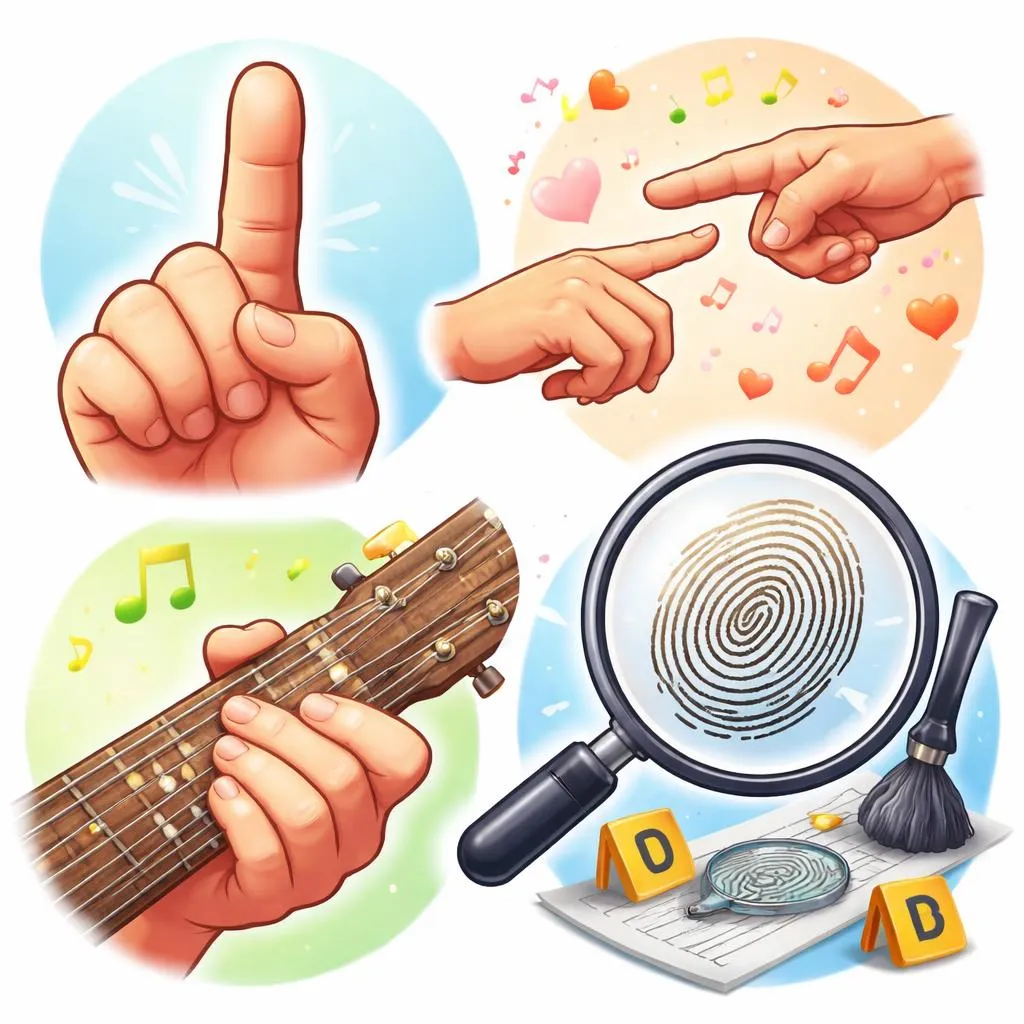

Hey there, word detective! Look at your hand. What do you see? Fingers! But what about these sentences? "She fingered the soft fabric." "He is fingering the guitar strings." "The detective found a fingerprint." They all have "finger" in them. But they are not the same! The words finger, fingered, fingering, and fingerprint are a "Word Hand Team". They all connect to your hand's digits. Each team member has a special job. Your mission is to learn their jobs. Let's see a quick example at home.
At home, you might say: "I hurt my finger." That names a body part. But you could also say: "I am fingering the piano keys." That is an action. Which one is right? They both are! You need the right team member for your sentence. Let's start our handiwork adventure!
Adventure! Decoding the Hand Team
Welcome to the word workshop! Our four hand words are here. They share a root. But they are different. Meet Finger. It is a noun for the body part. It can also be a verb. Meet Fingered. It is the past form of the verb. Meet Fingering. It is the -ing form of the verb. It can also be a noun. Meet Fingerprint. It is a compound noun. Let's examine their uses.
Dimension One: The Role Reveal – Body Part, Action, or Mark?
Every word has a role. Is it a thing? Is it an action? Or is it a special mark?
Finger: The Double-Role Word. This word has two common roles. First, as a noun. It names one of the five digits on your hand. Second, as a verb. It means to touch or feel with your fingers.
As a noun (body part): "My index finger points." Here, "finger" is the body part. As a verb (action): "Do not finger the wet paint." Here, "finger" is the action of touching.
Fingered: The Past Action. This word is the past tense and past participle of the verb "finger". It shows a completed action of touching.
School example: "She fingered the old map carefully." The action of touching is over. It happened before.
Home example: "He fingered the edge of the book nervously." The action is finished.
Fingering: The Ongoing Action or Technique. This word is the -ing form of the verb "finger". It shows the action is happening now. In music, it is a noun for technique.
As a verb (ongoing): "The child is fingering the clay." (With "is", shows ongoing action) As a noun (technique): "Good fingering is key for piano." This names the technique of using fingers.
Fingerprint: The Mark Noun. This word is a compound noun. It names the unique pattern of lines on your fingertip. It is a mark left by a finger.
Playground example: "We made fingerprint art in class." It names the type of art.
School example: "The detective checked the doorknob for a fingerprint." It names the clue.
Dimension Two: The Meaning Focus – Part, Touch, Method, or Evidence?
These words point to different ideas. One is the body part. One is the action of touching. One is the method or ongoing touch. One is the identifying mark.
Finger: The Part or Touch. As a noun, it focuses on the physical digit. As a verb, it focuses on the act of touching with that digit.
Animal example: "A monkey's finger is very dexterous." (Part) Playground example: "Finger the texture of this tree bark." (Action)
Fingered: The Completed Touch. This word focuses on the action of touching that happened in the past. It is a completed event.
Fingering: The Process or Skill. This word focuses on the ongoing process of touching or the skill of placing fingers in music.
Fingerprint: The Unique ID. This word focuses on the pattern that identifies a person. It is about evidence or art.
Dimension Three: The Team-Up – What Words Do They Like?
Knowing their common "partners" helps us use them correctly.
Finger (Noun): It likes articles and adjectives. "A sore finger", "the ring finger", "my little finger".
Finger (Verb): It often takes an object. "Finger the object." It teams with helpers: "don't finger", "might finger".
Fingered (Past): It is used for past actions. It often has an adverb. "She lightly fingered the silk."
Fingering (Verb -ing): It needs a helper verb. "Is/are fingering", "was/were fingering". "He is fingering the lock."
Fingering (Noun): It is used in music contexts. "Correct fingering", "the fingering chart".
Fingerprint (Noun): It likes articles and can be part of compounds. "A clear fingerprint", "the fingerprint powder", "fingerprint analysis".
Our Discovery Map: The Hand Team Guide
Our guide is clear. Do you need to name the body part? Use the noun finger. Do you want to talk about the action of touching with fingers? Use the verb finger. Do you want to talk about that action in the past? Use fingered. Do you want to show the action is happening now? Use fingering with "is" or "are". Do you want to talk about the technique in music? Use the noun fingering. Do you want to talk about the unique mark from a finger? Use the noun fingerprint. Remember, finger is the part or the touch. Fingered is the past touch. Fingering is the ongoing touch or the skill. Fingerprint is the mark.
Challenge! Become a Word Hand Master
-
Best Word Choice: Read the scene. Pick the best word. (Nature/Animal Scene) A forensic scientist at a wildlife crime scene finds a mark on a leaf. The mark is a pattern of lines left by a human fingertip. a) The scientist found a fingerprint. b) The scientist is fingering the leaf. Which one names the unique mark that could identify a person? (Answer: a)
-
Two-Word Sentence Showdown: (School/Music Class Scene) Imagine learning to play the flute. First, use the noun for the technique of placing your fingers. Example: "The teacher showed us the correct fingering." Now, use the verb to describe what your fingers are doing right now. Example: "I am fingering the notes carefully."
-
Eagle Eye! Find the Glitch: Look at this sentence. One word is not quite right for the meaning. Can you fix it? (Home/Art Scene) "My little brother made a beautiful finger painting with his fingerprint." What's wrong? While a fingerprint could be used, "finger painting" is the art of using fingers to paint. The sentence is a bit redundant. Let's create a clearer error: "The police took a fingered from the window." Fixed sentence: "The police took a fingerprint from the window."
Your Takeaway and Mission! Make Your Sentences Skillful
Great work, word hand expert! You learned the special roles of each word. You can now choose the right word for any situation. Your English will be precise and clear.
What you can learn from this article:
You now see that finger, fingered, fingering, and fingerprint are a team. But they have different functions. You learned to use "finger" for the body part or the action of touching. You use "fingered" for a past action of touching. You use "fingering" for an ongoing action or a music technique. You use "fingerprint" for the unique mark. You know that "finger" is a noun or verb. "Fingered" is the past. "Fingering" is ongoing or a noun. "Fingerprint" is a compound noun.
Live Practice Application:
Try this today! Look at your hand. Name the parts: "This is my finger." Touch something soft. Describe the action: "I am fingering this velvet." Talk about a past touch: "I fingered the rough sandpaper." In music, talk about technique: "Practice your fingering." Look at a smooth surface. Talk about evidence: "A fingerprint might be there." When you write or speak, think: Is it the part? Use finger. Is it the action? Use finger, fingered, or fingering. Is it the mark? Use fingerprint. Choosing the right word makes your language accurate. You are now a master of the hand team. Well done!