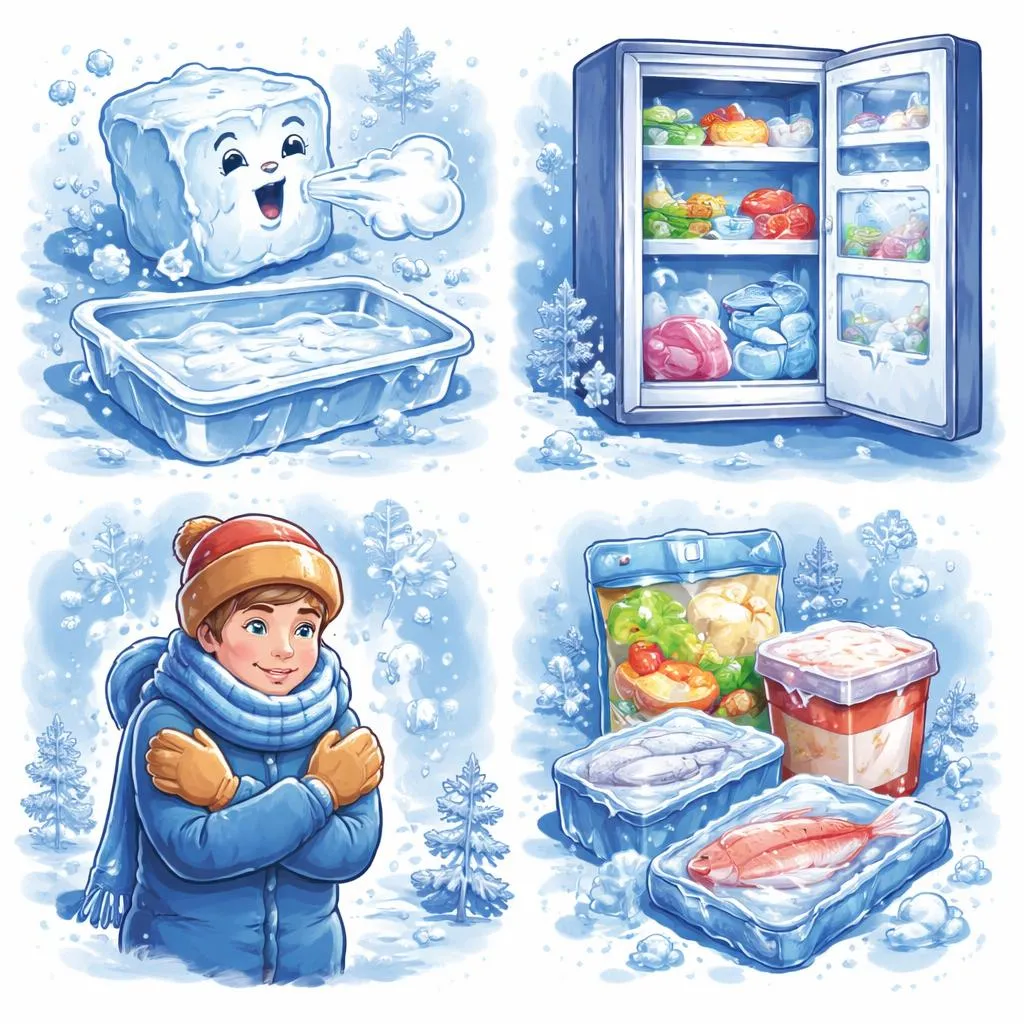

Hey there, word explorer! Have you ever seen a puddle turn to ice? The water will freeze. You put ice cream in the freezer. The cold wind is freezing. The lake is frozen solid. They all talk about turning to ice. But they are not the same! The words freeze, freezer, freezing, and frozen are a "Word Ice Team". They all connect to cold. Each team member has a different chill. Your mission is to learn their chills. Let's see a quick example at home.
At home, you might say: "Do not let the pipes freeze." That is a warning. But you could also say: "The pipes are frozen." That describes the state. Which one is right? They both are! You need the right team member for your sentence. Let's start our cold adventure!
Adventure! Decoding the Ice Team
Welcome to the word ice rink! Our four ice words are here. They share a root idea. But they are different. Meet Freeze. It is a verb for the action. Meet Freezer. It is a noun for the appliance. Meet Freezing. It is the -ing form or an adjective. Meet Frozen. It is the adjective or past form. Let's learn their temperatures.
Dimension One: The Time of Action – When is the Chilling?
Words can show when an action happens. Is it a future event? Is it happening now? Or is it already done? Let's check the ice clock.
Freeze: The "Will Happen" or "Can Happen" Action. This is the basic action. It can happen in the present or future. It is a general fact. Look at "school" and "playground" examples.
School example: "Water will freeze at zero degrees." This is a scientific fact. It is always true.
Nature example: "The pond might freeze tonight." This is a possible future event. It may happen.
Freezing: The "Right Now" Action or Extreme Cold. This word shows the action is in progress. It is turning to ice now. It can also be an adjective for very cold weather.
Home example: "The water in the bowl is freezing." The action is ongoing. We can see it.
Playground example: "It is freezing outside today!" This describes the very cold weather.
Frozen: The "Already Done" Action or State. This form points to the past. The action of freezing is complete. It can also describe the current solid state.
School example: "The science experiment froze yesterday." The action is over. It happened.
Home example: "The vegetables are frozen in the bag." This describes their state now.
Dimension Two: The Role Reveal – Action, Appliance, or Description?
Every word has a role. Is it the main action? Is it a thing? Or is it a description?
Freeze: The Action Verb. This word is a verb. It shows the action of turning into ice. It tells us what something does.
Playground example: "The puddle will freeze in the cold." The word "freeze" is the action.
Nature example: "Some animals freeze to hide from danger." The word "freeze" is what they do.
Freezer: The Appliance Noun. This word is a noun. It names the appliance that keeps food very cold. It is the thing in your kitchen.
Home example: "The ice cream is in the freezer." It names the appliance.
School example: "The lab has a freezer for samples." It names the machine.
Freezing: The Ongoing Action or Extreme Adjective. This word is the -ing form of the verb "freeze". It shows the action is happening now. It can also be an adjective meaning very cold.
As a verb (ongoing): "My computer is freezing again." (With "is", shows ongoing action) As an adjective (very cold): "We wore coats in the freezing wind." It describes the wind.
Frozen: The State Adjective or Past Action. This word is the past participle of the verb "freeze". It shows a completed action. It can also work as an adjective describing something that is solid with ice.
As a past action (verb): "The lake froze last week." But we use "froze" for simple past. "Frozen" is used with helpers: "The lake has frozen." As an adjective (state): "We ate frozen pizza for dinner." This describes the pizza.
Dimension Three: The Team-Up – What Words Do They Like?
Knowing their common "cold friends" helps us use them correctly.
Freeze (Verb): It often stands alone. "It will freeze." It teams with helpers: "might freeze", "going to freeze". "Be careful not to freeze."
Freezer (Noun): It likes articles. "A freezer", "the freezer", "in the freezer".
Freezing (Verb -ing): It needs a helper verb. "Is/are freezing", "was/were freezing". "The pond is freezing."
Freezing (Adjective): It usually comes before a noun or after a linking verb. "Freezing rain", "freezing temperature", "It is freezing."
Frozen (Past/Participle): For the past, we use "froze" for simple past. "Frozen" is used with "has", "have", "had". "The river has frozen." As an adjective: "frozen food", "frozen solid".
Our Discovery Map: The Ice Team Guide
Our ice guide is clear. Do you want to talk about the action of turning to ice? Use the verb freeze. Do you want to name the appliance that makes ice? Use the noun freezer. Do you want to show the action is happening right now? Use freezing with "is" or "are". Do you want to describe very cold weather? Use the adjective freezing. Do you want to talk about a completed action (with "has" or "have")? Use frozen. Do you want to describe something that is solid with ice? Use the adjective frozen. Remember, freeze is the action. Freezer is the appliance. Freezing is the ongoing action or extreme cold. Frozen is the past action with helpers or the icy state.
Challenge! Become a Word Ice Master
-
Best Word Choice: Read the scene. Pick the best word. (Nature/Animal Scene) A scientist in the Arctic observes a small pool of seawater. The water is in the process of turning into ice at this very moment. a) The seawater is in a freezer. b) The seawater is freezing. Which one describes the action happening at this very moment? (Answer: b)
-
Two-Word Sentence Showdown: (Home/Cooking Scene) Imagine you are helping to prepare a meal. First, use the noun to name where you get the cold peas. Example: "The peas are in the freezer." Now, use the adjective to describe the state of the peas. Example: "We will cook the frozen peas for dinner."
-
Eagle Eye! Find the Glitch: Look at this sentence. One word is not quite right for the meaning. Can you fix it? (School/Winter Scene) "During the snow day, it was so cold that my fingers felt freeze." What's wrong? "Freeze" is a verb. Here, we are trying to describe the state of the fingers. We need the adjective. Fixed sentence: "During the snow day, it was so cold that my fingers felt frozen."
Your Takeaway and Mission! Make Your Sentences Cool
Great exploring, word scientist! You learned the special roles of each word. You can now choose the right word for any situation. Your English will be precise and clear.
What you can learn from this article:
You now see that freeze, freezer, freezing, and frozen are a team. But they have different functions. You learned to use "freeze" for the action of turning to ice. You use "freezer" to name the cold appliance. You use "freezing" for an ongoing action or to describe extreme cold. You use "frozen" to talk about a past action (with helpers) or to describe something that is icy. You know that "freeze" is a verb. "Freezer" is a noun. "Freezing" is a verb or adjective. "Frozen" is an adjective or past participle.
Live Practice Application:
Try this today! Talk about weather: "It might freeze tonight." Open the appliance: "Get milk from the freezer." Feel the cold: "My nose is freezing." Eat a snack: "I like frozen grapes." When you write or speak, think: Is it the action? Use freeze. Is it the machine? Use freezer. Is it happening now or very cold? Use freezing. Is it the state or past action? Use frozen. Choosing the right word makes your language cool and accurate. You are now a master of the ice team. Well done!