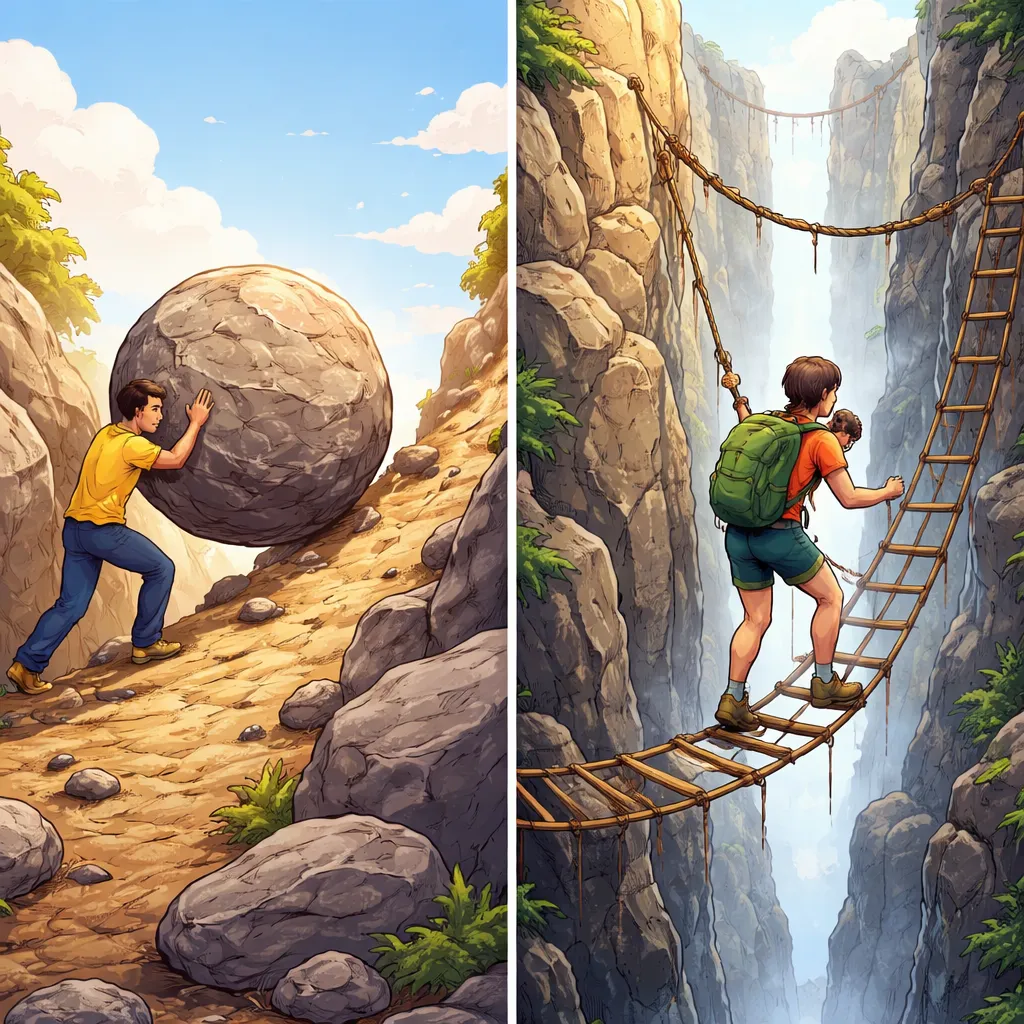

Hello, word explorer! Have you ever tried a tricky math problem? Or tried to open a tight jar lid? How do you describe that challenge? Do you say it is hard? Or do you say it is difficult? People use both words. They seem like twins. But are they exactly the same? They are like two types of tough material. One is solid like a rock. One is tangled like a knot. Let's find out! Today, we explore the word friends "hard" and "difficult". Knowing their secret is a thinking superpower. It helps you explain challenges perfectly. Let's start our adventure!
First, let's be Challenge Detectives. Listen at home. Here are two sentences. "This walnut has a very hard shell." "This Sudoku puzzle is difficult." They both talk about something not easy. A shell. A puzzle. Do they sound the same? One feels physical and solid. One feels mental and tricky. Can you sense it? Great observation! Now, let's look closer with our word microscope.
Adventure! Inside the World of Challenges
Welcome to the world of challenges! "Hard" and "difficult" are two different kinds of toughness. Think of "hard" as a solid, physical wall. Think of "difficult" as a complex, mental maze. Both are obstacles. But they block you in different ways. Let's learn about each one.
The Solid Wall vs. The Tricky Maze Think about the word "hard". "Hard" often feels like a solid, physical wall. It is tough and firm to the touch. It describes something that does not bend or break easily. The ground is hard. This bread is hard. It can also mean needing a lot of effort. That was hard work. Now, think about "difficult". "Difficult" feels more like a tricky, mental maze. It is complicated and not easy to understand or do. It often describes tasks that require thought. A difficult decision. A difficult language to learn. "Hard" is the wall you push. "Difficult" is the maze you think through. One is often physical. The other is often mental.
The General Word vs. The Formal Word Let's listen to how we use them. "Hard" is the everyday, general word. It is very common in casual talk. Kids use it all the time. This game is hard. Life is hard sometimes. It is simple and strong. "Difficult" is a bit more formal. It sounds more serious and precise. It is often used in writing and formal speech. The exam was difficult. We face a difficult situation. "Hard" is for conversation. "Difficult" is for reports and serious talk. One is friendly. The other is proper.
Their Special Word Partners and Fixed Phrases Words have best friends. "Hard" has many common phrases. It is very flexible. It can be an adjective or an adverb. Work hard. Hard feelings. A hard life. It also means the opposite of soft. Hard ice cream. "Difficult" is more specific. It is almost always an adjective. It describes tasks, people, or situations. A difficult child (meaning hard to manage). A difficult question. Note: We say "It's hard to say" but not usually "It's difficult to say" (though it's possible). We say "difficult times" and "hard times". They are often interchangeable, but with different flavors.
Let's visit a school scene. In science class, you learn about diamonds. Your teacher says, "Diamond is the hardest natural material." This is a factual, physical property. Now, in math class, your teacher gives you a problem with many steps. She says, "This is a difficult problem because it requires logic." This describes the mental challenge. Using "difficult" for the diamond is not wrong, but "hard" is the scientific term. Using "hard" for the math problem is very common, but "difficult" highlights the complexity.
Now, let's go to the playground. You try to climb a rope. It hurts your hands. The rope is rough. You say, "This rope is hard to climb!" This focuses on the physical effort and feel. Later, you are learning a new skateboard trick. It has many balance points. Your friend says, "That trick is difficult." This focuses on the skill and coordination needed. The word "hard" paints the physical struggle. The word "difficult" paints the complex skill.
Our Little Discovery So, what did we find? "Hard" and "difficult" both mean "not easy". But they often point to different kinds of challenges. "Hard" is a general, common word. It can be physical (like a hard surface) or about effort (hard work). "Difficult" is a more formal word. It often describes mental challenges, complicated tasks, or tricky situations. "Hard" is used in more casual phrases. "Difficult" is used in more serious descriptions. Knowing this helps you pick the right word for the right challenge.
Challenge! Become a Word Choice Champion
Ready for a fun test? Let's try your new skills!
"The Best Choice" Challenge Let's imagine a nature scene. A tiny seedling is trying to grow. It is under a heavy, packed layer of soil. The soil is very tough and solid. The soil is... what? Hard or difficult? The soil is hard. This describes its physical state. Now, imagine a young bird trying to fly for the first time. It must coordinate its wings and balance. This is a complex skill. Learning to fly is difficult. This describes the challenging task. "Hard" wins for the solid soil. "Difficult" is the champion for the complex skill of flying.
"My Sentence Show" Your turn to create! Here is your scene: Learning to play a song on the piano. Can you make two sentences? Use "hard" in one. Use "difficult" in the other. Try it! Here is an example: "Pressing the piano keys is not hard." This focuses on the physical action. "Reading the sheet music is difficult." This focuses on the mental understanding. Your sentences will show two types of challenges!
"Eagle Eyes" Search Look at this sentence. Can you find the word that could be better? Let's check a home context. "My little brother asked me a very hard question about why the sky is blue, and I had to think a lot." Hmm. The phrase "had to think a lot" suggests a mental challenge. The word "difficult" often fits complex questions better. "My little brother asked me a very difficult question..." sounds more precise. "Hard" is not wrong, but "difficult" matches the thoughtful challenge. Did you spot it? Excellent word work!
Harvest and Action! Turn Knowledge Into Your Superpower
Great exploring! We started thinking "hard" and "difficult" were the same. Now we know they are close friends with different personalities. We can feel the solid wall of "hard". We can navigate the tricky maze of "difficult". You can now describe challenges with perfect accuracy. This is a great thinking and writing skill.
What you can learn from this article: You can now feel that "hard" is a general, common word for physical toughness or great effort. You can feel that "difficult" is a more formal word often used for mental challenges, complex tasks, or tricky situations. You know that a rock is "hard", but a riddle is "difficult". You learned to match the word to the type of challenge: "hard" for physical and casual, "difficult" for mental and formal.
Life practice application: Try your new skill today! Do a chore. Was it hard (needing effort) or difficult (complicated to do)? Try a brain teaser. Is it hard or difficult? Tell a friend about a hard thing you did. Tell a teacher about a difficult concept. Listen to how people use these words. You are now a master of challenge words! Keep exploring the wonderful world of language.