
Start! Find a Pair of 'Material Twin' Words
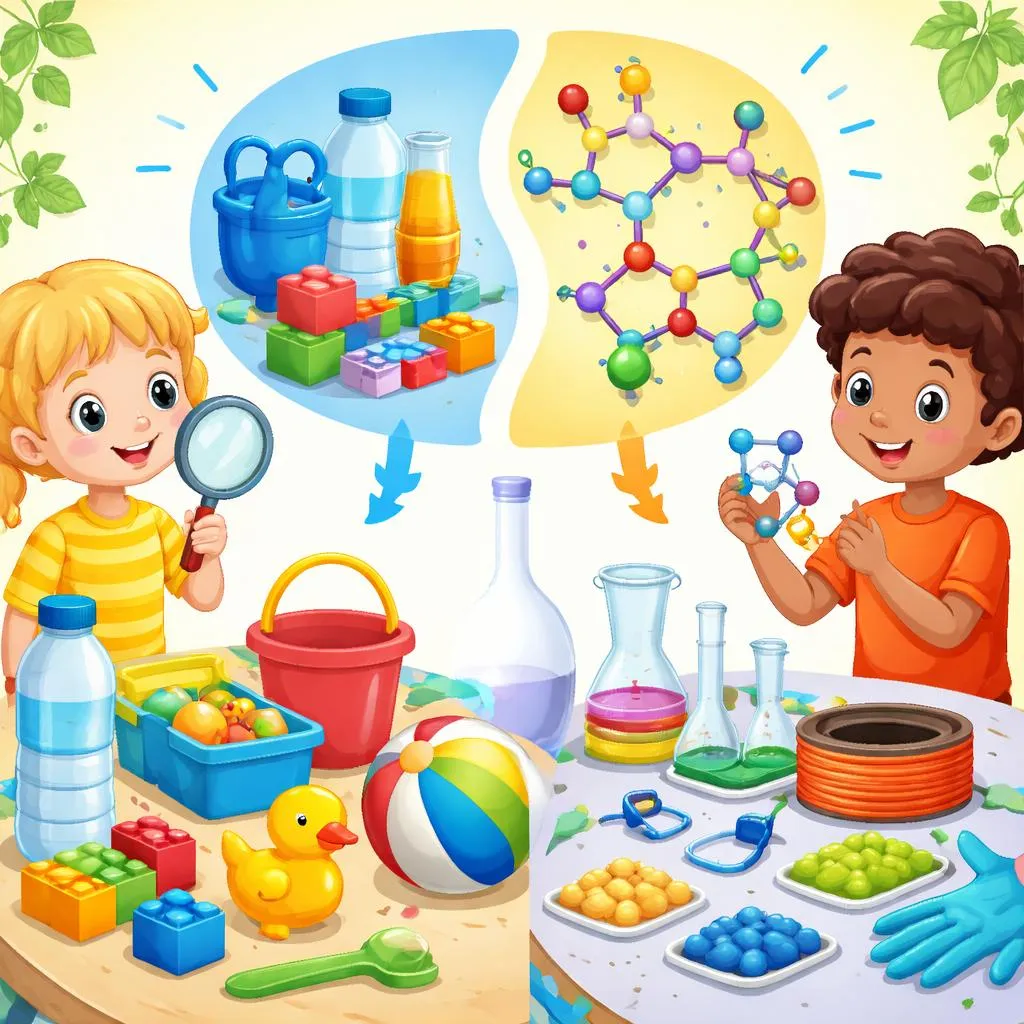
Hello, word scientist! Look at your toy. It might be made of colorful plastic. Think about what that plastic is made of. It is a polymer! They are both about man-made stuff. Are they the same? This is a cool science puzzle. Today we explore a word pair. We explore plastic and polymer. They are like a finished toy and the toy bricks that built it. One is the product. One is the ingredient. Knowing the difference is a superpower. Your talk about materials will be clear and smart. Let us start our word building!
Be a Language Observer now. Our first clue is at home. Your water bottle is made of lightweight plastic. A scientist says that plastic is a type of polymer. They are connected. But are the words the same? Let us test with two sentences.
"Please recycle that empty plastic bottle." This is about the everyday object you can hold. "Nylon is a strong synthetic polymer used in clothes." This is about the scientific material category.
They are both man-made. But one is a common word for things. One is a science word for the stuff inside. Your observation mission starts. Let us build into their word world.
Adventure! Build Into the Word World
Feel the Word's Everyday and Science Vibe!
Feel the word plastic. It is an everyday, common word. It feels like toys, bottles, bags, and things you use. The word polymer is a science, ingredient word. It feels like chemistry, long chains, and the building blocks of materials. Plastic is the finished car. Polymer is the engine and frame inside. One is the object. The other is what it's made of. Let us see this at school.
Your pencil case is made of plastic. This is the common name for the material. In a science class, you learn that polymers are long chains of molecules. This is the big science idea. Saying you have a "polymer pencil case" is not common. The feeling of the words is different. One is practical. The other is technical.
Compare Their Relationship: The Product vs. The Material!
Think about a chocolate chip cookie and the flour inside. The word plastic is the cookie. It is the final product you eat. The word polymer is the flour. It is the main ingredient. Plastic is one type of man-made polymer. But not all polymers are plastic. Their relationship is the key. Plastic is a common name for certain synthetic polymers. Polymer is the scientific name for all long-chain molecules, natural or man-made. Let us test this on the playground.
You have a colorful plastic jump rope. It is the object. The material that makes it flexible is a polymer. The word plastic names the jump rope's material. The word polymer names the science of its stretchy chains. The playground shows the difference.
Meet Their Best Word Friends!
Words have favorite material partners. The word plastic likes product and everyday words. It teams up with 'credit card', 'bottle', 'bag', 'toy', 'wrap', and 'surgery'. A credit card. Plastic surgery. The word polymer likes science and chemistry words. It teams up with 'chain', 'synthetic', 'natural', 'chemistry', 'clay', and 'polymerase'. Polymer clay. Polymer chemistry. Their partners are different. Let us go back to school.
In a health class, you talk about reducing plastic waste. This is about the common pollution problem. In a biology class, you learn DNA is a natural polymer. This is about a scientific fact. You would not say "DNA is a plastic." The word friends set the right context.
Our Little Discovery!
We explored the world of man-made stuff. We made a clear discovery. The words plastic and polymer are different. Plastic is a common name for many synthetic, moldable materials. We use it for bottles, toys, and bags. Polymer is the scientific term for all materials made of long, repeating chains of molecules. Plastics are one type of synthetic polymer. One is a common product. The other is a scientific category. This is the main difference.
Challenge! Become a Material Word Expert
"Best Choice" Challenge!
Let us look at a nature scene. A spider makes silk. The silk is a very strong natural polymer. Is it Plastic or Polymer? The champion is Polymer! Spider silk is a natural protein polymer, not a plastic. Now, imagine a seagull finds a discarded water bottle. The bottle is made of plastic. Is it plastic or polymer? The champion is plastic! This is the common name for the synthetic material of the bottle. Excellent!
"My Sentence Show"!
Now, create your own sentences. Here is a fun scene: Imagine a toy store full of colorful action figures. Describe what they are made of. Use the word plastic in one sentence. Now imagine a science lab. They are studying the stretchy material in a bouncy ball. Use the word polymer in another. Try it! Here is an example. Sentence one: "Most toys in the store are made of bright, colorful plastic." Sentence two: "The bouncy ball's stretchiness comes from its polymer chains." See the difference? The first is about everyday objects. The second is about the scientific material property.
"Eagle Eyes" Search!
Can you find the word that needs help? Read this sentence: "For the craft project, we needed a soft, moldable plastic like clay, so we used a special kids' polymer from the art store." Hmm. This sentence is actually correct! It uses both words well. The "special kids' polymer" is the scientific material, and it is being used like a moldable plastic. Good job spotting a correct use!
What a fantastic exploration of materials! You started as a curious user. Now you are a word expert. You know the secret of plastic and polymer. You can feel their different everyday and science vibes. You see that plastic is a common product and polymer is the science behind it. You know their best word friends. This is a real language superpower.
You can learn amazing things from this article. You now know that 'plastic' is the common name for many synthetic, moldable materials used to make toys, bottles, and bags. You understand that a 'polymer' is the scientific term for materials made of long, repeating molecule chains, which can be natural like silk or man-made like plastic. You can explain that plastic is a type of polymer, but polymers can be many other things too. You learned terms like 'credit card' and 'polymer clay'.
How can you use this today? It is easy and fun. Look at a toy. It is made of plastic. Look at a rubber band. It is made of a natural polymer. Help with recycling. Sort the plastic bottles. Do a craft. Use polymer clay. Draw two pictures. Draw a collection of plastic objects. Draw a science diagram of long polymer chains. You are using your new skill every day.
Keep your explorer eyes open. The world is full of useful plastics and amazing polymers. You are learning the words to describe them all. Great work, word expert. Your English journey is getting more precise and scientific with every new word pair you discover!