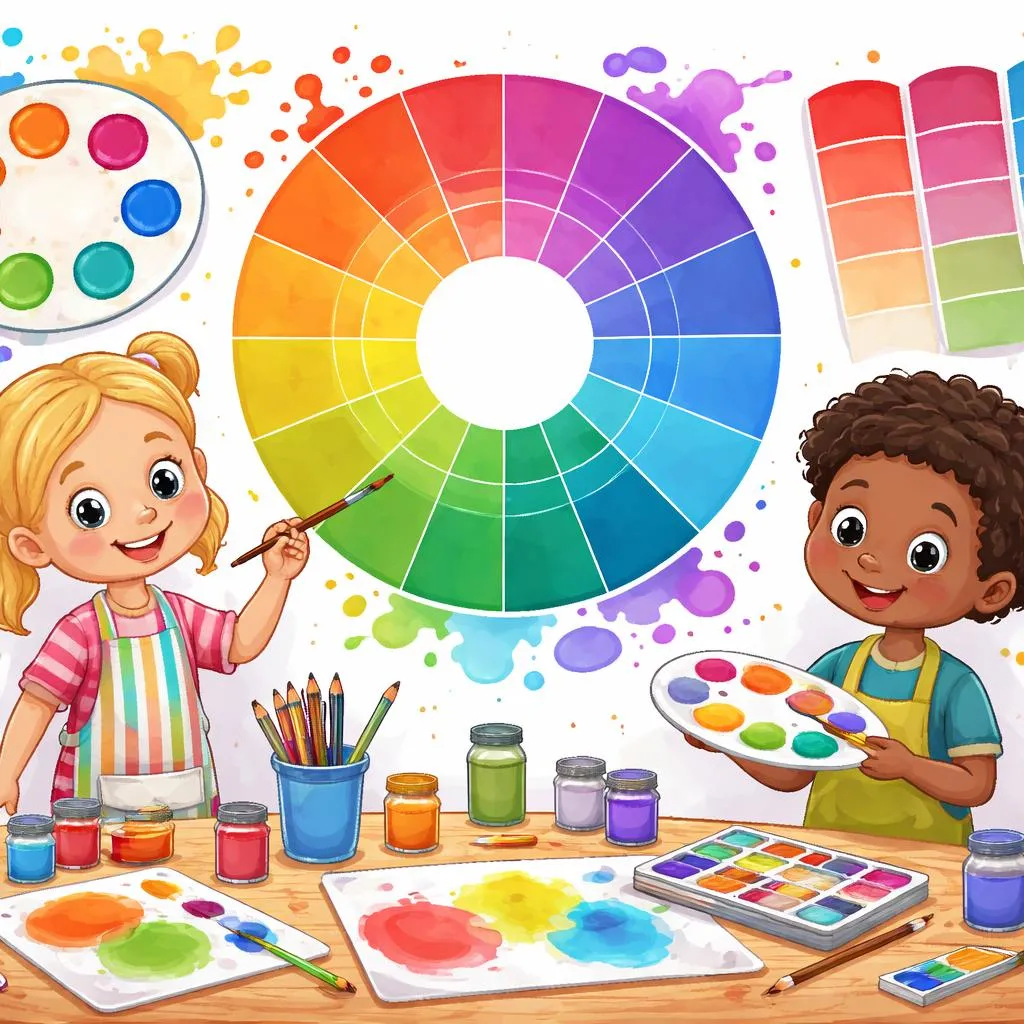

Start! Find a Pair of 'Color Twin' Words
Hello, word explorer! Do you love to draw and paint? What do you use to make your pictures bright? You use color! Now, imagine an artist looking at a sunset. She says, "Look at that beautiful hue of orange." They are both about reds, blues, and greens. Are they the same? This is a colorful word puzzle. Today we explore a word pair. We explore color and hue. They are like a big box of crayons and one special crayon. One is the whole box. One is a single stick. Knowing the difference is a superpower. Your talk about art will be clear and smart. Let us start our word painting!
Be a Language Observer now. Our first clue is at home. You show your mom a drawing. You say, "I used my favorite color, blue." Your sister is painting. She says, "I need to mix paints to get the right hue." They are both about shades. But are they the same? Let us test with two sentences.
"My favorite color is green." This is a common, everyday way to talk about shades. "The artist mixed red and white to create a pink hue." This sounds more specific and artistic.
They both describe how things look. But one is the general word we use every day. One is a more precise word for a specific shade. Your observation mission starts. Let us paint our way into their word world.
Adventure! Paint Your Way Into the Word World
Feel the Word's Common and Artistic Vibe!
Feel the word color. It is a common, friendly word. It feels like a big box of crayons. Everyone uses it. The word hue is a more artistic, precise word. It feels like an artist's palette. It is for specific shades. Color is the playground. Hue is the art studio. One is for everyone. The other is for careful looking. Let us see this at school.
In a kindergarten class, you learn the names of colors. This is about basic words like red and blue. In an advanced art class, you study the hue of a painting. This is about the exact shade used. Saying "the hue of your shirt" is less common. The vibe of the words is different. One is simple. The other is detailed.
Compare Their General and Specific Scope!
Think about a big family and one family member. The word color is the big family. It includes all shades, tones, and tints. The word hue is one family member. It means the pure color itself, like red, without light or dark added. Their scope is the clue. Color is the general idea. Hue is a specific part of that idea. Let us test this on the playground.
You point to a big rainbow drawing. You say, "Look at all the colors!" Your friend points to one stripe. He says, "This hue is pure red, with no white mixed in." The word color describes the whole rainbow. The word hue describes one specific pure color in it. The playground shows the difference.
Meet Their Best Word Friends!
Words have favorite shade partners. The word color likes everyday and descriptive words. It teams up with 'favorite', 'bright', 'full', 'blind', 'wheel', and 'pencil'. I have a color pencil. She is color-blind. The word hue likes artistic and technical words. It teams up with 'different', 'same', 'subtle', 'slight', 'range of', and 'saturated'. The room had a blue hue. The hue is too saturated. Their partners are from different worlds. Let us go back to school.
In a science class, you learn that white light splits into colors. This is about the spectrum. In a computer class, you adjust the hue setting on a photo. This is about changing the color balance. You would not adjust the "color setting" in the same technical way. The word friends set the activity.
Our Little Discovery!
We painted a picture with words. We made a clear discovery. The words color and hue are different. The word color is the common, general word for all shades we see. The word hue is a more specific, artistic word. It means the pure color, like red, blue, or yellow, without white or black added. Color is the big family. Hue is a close family member. One is for everyday talk. The other is for art and precision.
Challenge! Become a Color Word Expert
"Best Choice" Challenge!
Let us look at a nature scene. A child looks at a flower garden. She says, "I love all the colors!" Is it Colors or Hues? The champion is Colors! She is talking about the general variety. Now, a painter looks at a single rose petal. He tries to match the exact shade. He is mixing paints to get the right hue. Is it color or hue? The champion is hue! He is focused on the precise shade. Excellent!
"My Sentence Show"!
Now, create your own sentences. Here is a fun scene: Imagine a big, bright rainbow. Use the word color in one sentence. Now imagine an artist trying to match the exact shade of a leaf. Use the word hue in another. Try it! Here is an example. Sentence one: "The rainbow showed every color I could name." Sentence two: "The exact hue of the leaf was hard to copy with paint." See the difference? The first is about the whole, wonderful range. The second is about the challenge of matching one precise shade.
"Eagle Eyes" Search!
Can you find the word that needs help? Read this sentence: "The sky at dusk was filled with amazing colors of purple and pink." Hmm. This is a common mix. When describing the specific shades of purple and pink in a sunset, the word hues is more vivid and precise. A better sentence is: "The sky at dusk was filled with amazing hues of purple and pink." You made it more artistic!
What a colorful adventure in the word world! You started as a curious artist. Now you are a word painter. You know the secret of color and hue. You can feel their different common and artistic vibes. You see their general and specific scope. You know their best word friends. This is a real language superpower.
You can learn amazing things from this article. You now know that 'color' is the common word for all the shades we see, like in a rainbow or a crayon box. You understand that a 'hue' is the pure color itself, often used in art and design to describe a specific shade. You can explain that color is the big idea, and hue is a precise part of that idea. You learned terms like 'color wheel' and 'range of hues'.
How can you use this today? It is easy and fun. Look at a box of crayons. Name the colors. Then, look at two blue crayons. Are they the same hue? Probably not! One might be a different hue of blue. In art class, try using the word hue when you talk about mixing paints. Draw two pictures. Draw a rainbow with many colors. Draw a single object, like an apple, and try to show its exact hue. You are using your new skill every day.
Keep your explorer eyes open. The world is a masterpiece of colors and hues. You are learning the words to describe it all. Great work, word expert. Your English journey is getting more colorful and precise with every new word pair you discover!