
Start! Find a Pair of 'Earth Twin' Words
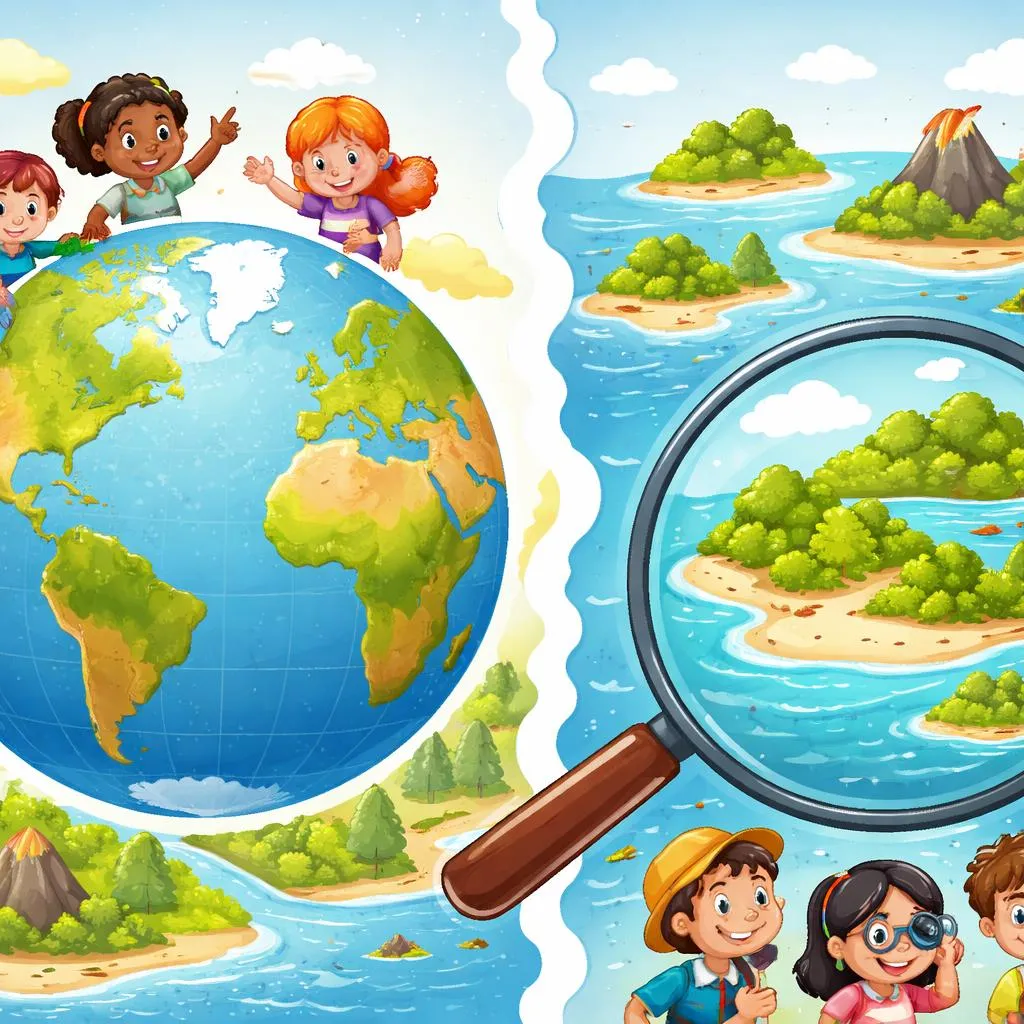
Hello, word explorer! Look at a globe or a world map. What are the biggest pieces of land you see? You might name them: Africa, Asia, Australia. These are continents! Now, look at any huge area of land surrounded by water. That is a landmass. They are both enormous areas of land. Are they the same? This is a giant geography puzzle. Today we explore a word pair. We explore continent and landmass. They are like two different ways to look at Earth's puzzle. One is a specific, named piece. One is a general, physical piece. Knowing the difference is a superpower. Your talk about Earth will be clear and smart. Let us start our word adventure!
Be a Language Observer now. Our first clue is at home. You watch a nature show. The host says, "The continent of Africa is home to many animals." Then, you read a science book. It says, "Greenland is the world's largest island landmass." They are both about large land areas. But are they the same? Let us test with two sentences.
"Australia is both a country and a continent." This is about one of the seven main land divisions on Earth. "Antarctica is a frozen landmass at the South Pole." This is about a very large area of land.
They both describe huge stretches of land. But one is a special, counted category. One is a general description of size. Your observation mission starts. Let us explore their word world.
Adventure! Explore the Word World
Feel the Word's Specificity and Count!
Feel the word continent. It is a specific, counted word. It feels like a member of an exclusive club. There are only seven continents. You can list them. The word landmass is a general, descriptive word. It feels like a measurement. It describes any large area of land. A continent is a type of landmass. But a landmass is not always a continent. Continent is the superstar. Landmass is the team. One is a famous name. The other is a size category. Let us see this at school.
In a geography class, you memorize the seven continents. This is a standard list. In a geology lesson, you learn that a landmass can break apart over millions of years. This is about physical geography. Saying "the seven landmasses" is not common. The feeling of the words is different. One is a defined set. The other is a scientific description.
Compare Their Definition and Membership!
Think about a professional sports league and the sport itself. The word continent is the league. It has fixed members (like teams). The word landmass is the sport. Any large area of land can be called a landmass. Their definitions are the key. A continent is defined by convention (agreement) and has cultural/historical meaning. A landmass is defined purely by geography: a large, continuous area of land. Let us test this on the playground.
You and six friends stand in a special line. You say, "We are the seven continents!" A bigger group of friends gathers in a large cluster. They say, "We are a huge landmass!" The word continent suggests a specific, limited group. The word landmass suggests a large, physical grouping of any size. The playground shows the difference.
Meet Their Best Word Friends!
Words have favorite Earth partners. The word continent likes specific and cultural words. It teams up with 'seven', 'drift', 'Asian', 'African', 'continental', and 'shelf'. We learned about continental drift. The continental shelf is underwater. The word landmass likes scientific and descriptive words. It teams up with 'large', 'major', 'eurasian', 'super', 'ancient', and 'forms'. The superlandmass was called Pangaea. A new landmass formed. Their partners are different. Let us go back to school.
In a social studies class, you learn about the cultures of a continent. This is about people and history. In an earth science class, you study how a landmass affects climate. This is about physical processes. You would not usually study the "cultures of a landmass." The word friends set the topic.
Our Little Discovery!
We explored the word Earth. We made a clear discovery. The words continent and landmass are different. The word continent refers to one of the seven main land areas on Earth. These are Europe, Asia, Africa, North America, South America, Antarctica, and Australia. The word landmass is a general term for any very large area of land. It can be a continent, a large island, or even a connected group of continents. Continent is a specific, named member. Landmass is a physical description. One is a club. The other is a size.
Challenge! Become an Earth Word Expert
"Best Choice" Challenge!
Let us look at a nature scene. A documentary talks about Earth's history. It shows an ancient, connected world. The narrator says, "Over 200 million years ago, all the Earth's major land areas formed one giant super______." Is it Continent or Landmass? The champion is Landmass! The term "supercontinent" (Pangaea) is actually more specific, but the general scientific term for such a huge area is a superlandmass. Now, the documentary lists today's divisions: "Now, Earth is divided into seven distinct ______s." Is it continent or landmass? The champion is continent! We count seven specific continents. Excellent!
"My Sentence Show"!
Now, create your own sentences. Here is a fun scene: Imagine a map of the whole world. Use the word continent in one sentence. Now imagine a satellite picture of a huge island. Use the word landmass in another. Try it! Here is an example. Sentence one: "The continent of South America has the Amazon rainforest." Sentence two: "From space, you can see the green landmass of the island of Borneo." See the difference? The first names one of the seven major divisions. The second describes the physical appearance of a large island.
"Eagle Eyes" Search!
Can you find the word that needs help? Read this sentence: "Scientists say that India, which is a very large landmass, is actually its own continent because it is on a separate tectonic plate." Hmm. This is tricky. India is a subcontinent, not one of the seven continents. Calling it a "continent" is not standard. It is, however, a landmass. A better sentence is: "Scientists say that India, which is a very large landmass, is actually a subcontinent because it is on a separate tectonic plate." You fixed it!
What a monumental tour of the word planet! You started as a curious explorer. Now you are a word geologist. You know the secret of continent and landmass. You can feel their different specificity and count. You see their definition and membership. You know their best word friends. This is a real language superpower.
You can learn amazing things from this article. You now know that a 'continent' is one of the seven major land divisions of Earth, like Africa or Europe. You understand that a 'landmass' is any very large area of land, which can include continents and large islands. You can explain that all continents are landmasses, but not all landmasses are continents. You learned terms like 'continental drift' and 'superlandmass'.
How can you use this today? It is easy and fun. Look at a world map. Point to each of the seven continents. Then, look at Greenland or Madagascar. They are huge islands, or large landmasses, but not continents. When you read about dinosaurs, you might hear about the ancient superlandmass Pangaea. Draw two pictures. Draw the seven continents on a globe. Draw a single, giant landmass like Pangaea. You are using your new skill every day.
Keep your explorer eyes on the world. Our planet is an amazing puzzle of land and water. You are learning the words to describe its biggest pieces. Great work, word expert. Your English journey is getting more global and precise with every new word pair you discover!