
Start! Find a Pair of 'Map Twin' Words
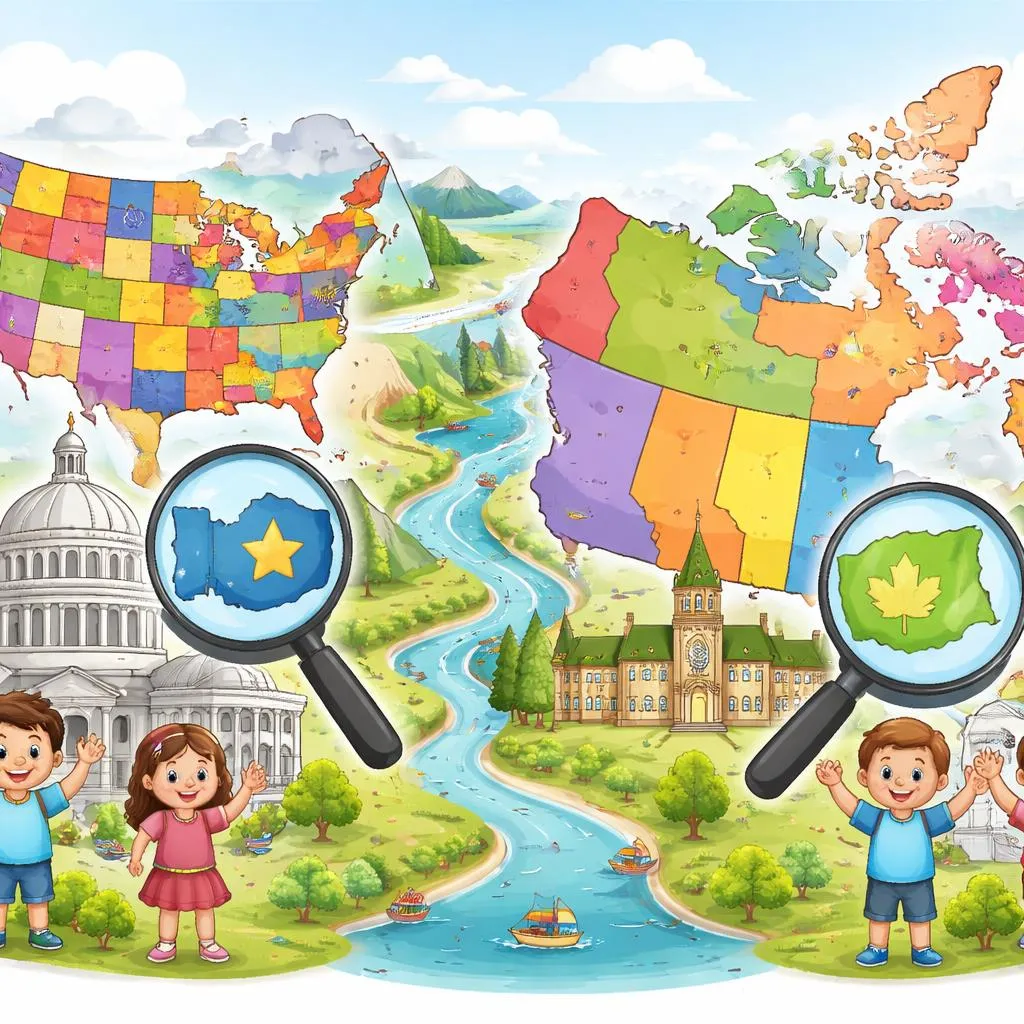
Hello, word explorer! Look at a big country on a map. How is it divided? In the United States, you see places like California and Texas. They are called states. Now, look at a map of Canada. You see places like Ontario and British Columbia. They are called provinces. They are both parts of a bigger country. Are they the same? This is a smart geography puzzle. Today we explore a word pair. We explore state and province. They are like two different names for similar pieces. One name is used in some countries. The other name is used elsewhere. Knowing the difference is a superpower. Your talk about the world will be clear and smart. Let us start our word map tour!
Be a Language Observer now. Our first clue is at home. You watch a weather report for America. The map shows Florida. The reporter says, "The state of Florida is sunny." Then, you watch a different channel. It shows a map of Canada. The reporter says, "The province of Quebec is cold." They are both sub-divisions of a country. But are they the same? Let us test with two sentences.
"Texas is the second-largest state in the USA." This is about a region in America. "Shanghai is a direct-controlled municipality, not a province, in China." This is about a region in China.
They both describe major areas inside a nation. But the word choice depends on the country. Your observation mission starts. Let us travel into their word world.
Adventure! Travel Into the Word World
Feel the Word's National Association!
Feel the word state. It is strongly linked to certain countries. It feels like the United States of America, Australia, or Mexico. The word province is linked to other countries. It feels like Canada, China, or South Africa. State is the term for some federations. Province is the term for other nations. One says "Uncle Sam." The other says "Maple Leaf." The difference is mostly about which country you are talking about. Let us see this at school.
In a class about American history, you learn about the 50 states. This is specific to the USA. In a class about world geography, you learn that Canada has ten provinces. This is specific to Canada. Saying "Canada has 50 states" is wrong. The national association is the key. The word tells you about the country's system.
Compare Their Political Similarities!
Think about two different board games. Both have game pieces. But the pieces have different names. The word state and province are like those game pieces. They are very similar. Both have their own local governments. Both are part of a larger federal or national government. Their size and power can be similar. The main difference is the name the country chooses. Let us test this on the playground.
You and your friends divide into two teams. One team calls its groups "states." The other team calls its groups "provinces." Both groups do the same thing: they make small team decisions. But they use different titles. The word state and province function similarly. But they belong to different "teams" (countries). The playground shows they are similar in role.
Meet Their Best Word Friends!
Words have favorite country partners. The word state teams up with names and terms from certain nations. It partners with 'of the Union', 'sovereign', 'department of', 'New York', and 'California'. He works for the state government. I live in the state of Georgia. The word province teams up with names from other nations. It partners with 'Canadian', 'capital', 'of Guangdong', 'autonomous', and 'premier'. The province capital is Halifax. It is an autonomous province. Their partners are from different parts of the world. Let us go back to school.
In a civics lesson, you study your own state's governor. This is if you live in a country that uses states. In a different civics lesson, you might study a province's premier. This is if you live in a country that uses provinces. The word friends lock in the location.
Our Little Discovery!
We explored the word political map. We made a clear discovery. The words state and province are very similar. They both mean a main territorial and political division within a country. The biggest difference is which country uses the word. The United States, Mexico, and Australia have states. Canada, China, and Spain have provinces. State is the common term in some federations. Province is the common term in others. One is not bigger or more powerful. It is just a different label used by different nations.
Challenge! Become a Geography Word Expert
"Best Choice" Challenge!
Let us look at two scenes. Read each one. Pick the champion word. Scene one: You are addressing a letter to Melbourne. You write the address: Victoria, ______ of Australia. Is it State or Province? The champion is State! Australia uses the term "state." Scene two: You are learning about a region in Italy. Your book says, "The ______ of Tuscany is known for its art." Is it state or province? The champion is province! Italy divides its country into provinces. Excellent!
"My Sentence Show"!
Now, create your own sentences. Here is a fun scene: Imagine you are talking about a place in America. Use the word state in one sentence. Now imagine you are talking about a place in South Africa. Use the word province in another. Try it! Here is an example. Sentence one: "The state bird of Hawaii is the nene goose." Sentence two: "The province of Gauteng is the economic heart of South Africa." See the difference? The first uses the term for a US region. The second uses the term for a South African region.
"Eagle Eyes" Search!
Can you find the word that needs help? Read this sentence: "My pen pal lives in the beautiful state of British Columbia, where he likes to ski." Hmm. This is a common mix-up. British Columbia is in Canada. Canada uses provinces, not states. A better sentence is: "My pen pal lives in the beautiful province of British Columbia, where he likes to ski." You fixed it!
What a wonderful trip around the word globe! You started as a curious map reader. Now you are a word geographer. You know the secret of state and province. You can feel their different national associations. You see their political similarities. You know their best word friends. This is a real language superpower.
You can learn amazing things from this article. You now know that a 'state' is a main division of a country, used in nations like the USA, Australia, and Mexico. You understand that a 'province' is a main division of a country, used in nations like Canada, China, and Italy. You can explain that they mean very similar things, but the correct word depends on which country you are talking about. You learned to match the word to the country.
How can you use this today? It is easy and fun. Look at a world map or globe. Pick a big country. Does it use states or provinces? You can research it! When you hear about a place in the news, listen: do they say "state" or "province"? This tells you about that country's system. Draw two maps. Draw a simple map of the USA and label some states. Draw a simple map of Canada and label some provinces. You are using your new skill every day.
Keep your explorer eyes on the map. The world is full of amazing countries with different systems. You are learning the words to describe their parts correctly. Great work, word expert. Your English journey is getting more global and precise with every new word pair you discover!