
Start! Find a Pair of 'Invisible Twin' Words
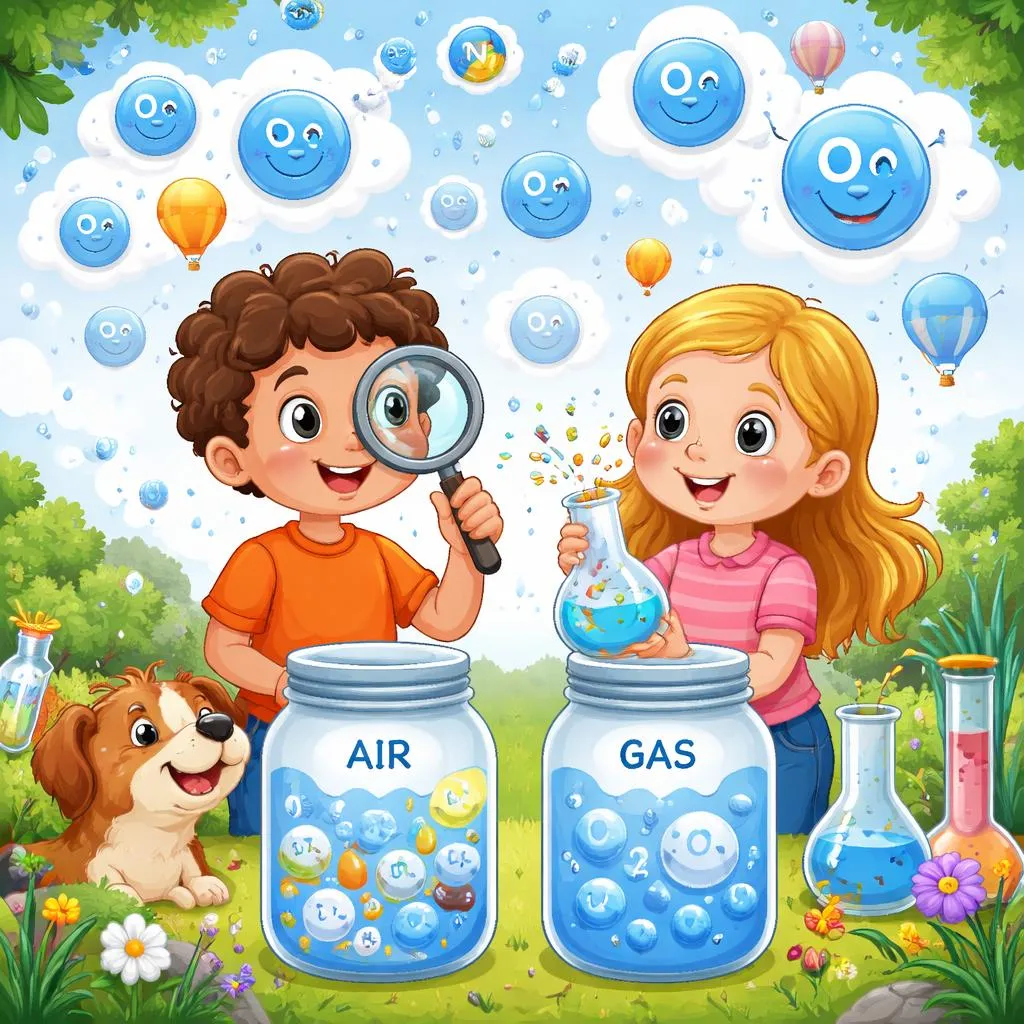
Hello, word explorer! Take a deep breath. What fills your lungs? The air around you! Now, think about a birthday balloon. It is filled with a light gas called helium. They are both invisible and all around. Are they the same? This is a fun science puzzle. Today we explore a word pair. We explore air and gas. They are like the whole ocean and the water in it. One is the mixture we live in. One is a type of substance. Knowing the difference is a superpower. Your talk about science will be clear and smart. Let us start our word journey!
Be a Language Observer now. Our first clue is at home. You open a window for fresh air. Your mom uses a gas stove to cook pasta. They are both invisible. But are they the same? Let us test with two sentences.
"The cool morning air felt wonderful on her face." This is about the general atmosphere we breathe. "The balloon floated because it was filled with helium gas." This is about a specific, lighter-than-air substance.
They are both around us. But one feels like the general stuff we breathe. One feels like a specific scientific thing. Your observation mission starts. Let us breathe into their word world.
Adventure! Breathe Into the Word World
Feel the Word's General and Specific Vibe!
Feel the word air. It is a general, everyday word. It feels like the sky, wind, and breathing. It is the invisible "ocean" we live in. The word gas is a specific, scientific word. It feels like chemistry, tanks, and one part of the air. Air is the whole pizza. Gas is one topping. One is the mixture. The other is an ingredient. Let us see this at school.
In a sports class, you run and feel the air in your lungs. This is about breathing and atmosphere. In a science class, you learn that oxygen is a gas we need to live. This is about a specific component. Saying you breathe "gas" sounds odd. The feeling of the words is different. One is about the environment. The other is about a scientific element.
Compare Their Mixture and Ingredient Nature!
Think about a smoothie and a single strawberry. The word air is the smoothie. It is a mixture of many gases like nitrogen, oxygen, and carbon dioxide. The word gas is the strawberry. It is one single part of the mixture. Their relationship is the key. The air is made of many different gases. But a gas can exist alone, not in the air. Let us test this on the playground.
You fly a kite in the air. The wind (moving air) lifts it. Your friend has a balloon filled with a special gas that makes it sink. The word air describes the general atmosphere. The word gas describes the specific content of the balloon. The playground shows the difference.
Meet Their Best Word Friends!
Words have favorite invisible partners. The word air likes weather and general words. It teams up with 'fresh', 'open', 'thin', 'put on', 'clear the', and 'up in the'. Fresh air. Up in the air. The word gas likes science and fuel words. It teams up with 'natural', 'greenhouse', 'noble', 'step on the', 'run out of', and 'gasoline'. Step on the gas. Natural gas. Their partners are different. Let us go back to school.
In a geography lesson, you talk about air pollution. This is about the atmosphere's quality. In a chemistry lesson, you might experiment with carbon dioxide gas. This is about a specific substance. You would not usually say "air pollution" for a tank of helium. The word friends set the context.
Our Little Discovery!
We explored the invisible world. We made a clear discovery. The words air and gas are different. Air is the mixture of gases that surrounds the Earth, which we breathe. It is a specific mixture. Gas is one of the three states of matter. It is also any substance in that state, like oxygen or helium. Air is a type of gas mixture. But a gas can be many things, not just air. One is the atmosphere. The other is a scientific state or a pure substance. This is the main difference.
Challenge! Become an Invisible Word Expert
"Best Choice" Challenge!
Let us look at a nature scene. A fish breathes oxygen dissolved in water. It does not breathe air like we do. Is it Air or Gas? The champion is Air! This refers to the atmospheric mixture that the fish does not use. Now, imagine a plant uses carbon dioxide, a specific gas, to make food. Is it air or gas? The champion is gas! The plant uses a specific ingredient (carbon dioxide) from the air. Excellent!
"My Sentence Show"!
Now, create your own sentences. Here is a fun scene: Imagine a windy day at the beach. You feel the strong breeze. Use the word air in one sentence. Now imagine a scientist studying a very light element for balloons. Use the word gas in another. Try it! Here is an example. Sentence one: "The sea air smelled salty and fresh." Sentence two: "Helium is a gas that is lighter than air." See the difference? The first is about the atmosphere at a location. The second is about a specific scientific substance.
"Eagle Eyes" Search!
Can you find the word that needs help? Read this sentence: "The deep-sea diver carried a tank of compressed air so he could breathe the special gas mixture underwater." Hmm. This sentence is actually correct! It uses both words well. The tank holds "air" (a mixture). The "gas mixture" refers to the specific blend of gases. Good job spotting a correct use!
What a breath of fresh word exploration! You started as a curious breather. Now you are a word scientist. You know the secret of air and gas. You can feel their different general and specific vibes. You see that air is a mixture and gas is a state or a pure substance. You know their best word friends. This is a real language superpower.
You can learn amazing things from this article. You now know that 'air' is the mixture of gases in our atmosphere that we breathe and that surrounds the Earth. You understand that 'gas' is one of the states of matter, and it can also mean a specific substance like oxygen, helium, or carbon dioxide. You can explain that air is made of many gases, and a gas is a scientific category. You learned terms like 'fresh air' and 'natural gas'.
How can you use this today? It is easy and fun. Take a deep breath. That is air. Blow up a balloon. Your breath has carbon dioxide gas. Look at a stove. It might use natural gas. Feel the wind. That is moving air. Draw two pictures. Draw a person breathing air. Draw a balloon filled with a light gas. You are using your new skill every day.
Keep your explorer mind open. The world is full of amazing air and many different gases. You are learning the words to describe them all. Great work, word expert. Your English journey is getting more precise and insightful with every new word pair you discover!