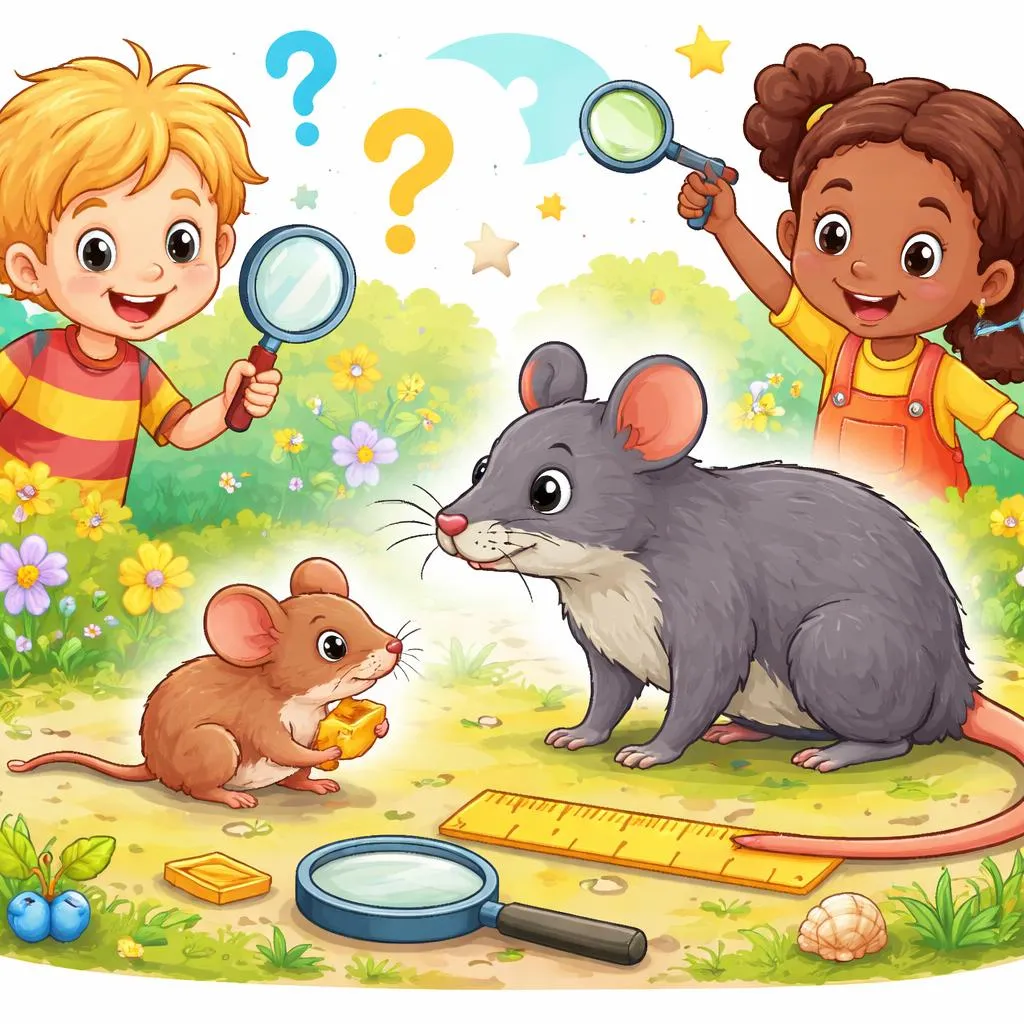

Hello, word detective! Have you ever seen a small, furry creature? It has a long tail. It scurries quickly. What do you call it? You might say "mouse." Someone else might say "rat." They look quite similar. Are they the same? This is a common puzzle. Today we explore a word pair. We explore mouse and rat. They are like word cousins. They are both rodents. But they are different animals! Knowing the difference is a superpower. Your animal descriptions will be accurate and clear. Let us start our investigation!
Be a Language Observer now. Our first clue is at home. You see a tiny grey creature. It is near the pantry. It has large ears and a thin tail. This is likely a mouse. Now, imagine a bigger, thicker creature. It is near a city dumpster. This is likely a rat. They are related. But are they the same word? Let us test with two sentences.
"A little mouse ate the cheese in the trap." This sounds like a small pest. "A large rat scurried down the alley." This sounds bigger and tougher.
They seem to describe similar scenes. But the feeling is different. One seems small. One seems large. Your observation starts. Let us scurry into their word world.
Adventure! Scamper Into the Word World
Feel the Word's Vibe!
Feel the word mouse. It can feel small and quick. Sometimes it feels cute, like in cartoons. Sometimes it feels like a tiny pest. The word rat has a stronger vibe. It often feels tougher, smarter, or more threatening. It is rarely seen as cute. Mouse can be neutral or even positive. Rat is often negative. One is a tiny squeak. The other is a bold scratch. Let us see this at school.
You read a fairy tale. It says, "A tiny mouse helped the lion." This sounds kind. Now, you read a mystery book. It says, "The villain hid in the rat-infested basement." This sounds scary. Saying "mouse-infested" is less common. The vibe of the words is very different. The feeling temperature is not the same.
Compare Their Size and Context!
Think about a small button and a large remote. The word mouse is the small button. It usually means a smaller rodent. It has a pointed nose and large ears. The word rat is the larger remote. It means a bigger, stockier rodent. It has a blunter nose and smaller ears. But the context matters most. A pet store sells fancy mice. A city sewer has rats. The size of the animal and the setting are clues. Let us test this on the playground.
You play an imagination game. You pretend to be animals. You say, "I am a quick, little mouse!" You scamper fast. Your friend says, "I am a big, strong rat!" He moves with more weight. The word rat implies more size and strength. The word mouse implies agility and smallness. The playground shows the difference.
Meet Their Best Word Friends!
Words have common partners. The word mouse has some fun friends. It teams up with 'computer', 'trap', 'Mickey', and 'field'. You use a computer mouse. You set a mouse trap. The word rat has different partners. It teams up with 'lab', 'race', 'pack', and 'sewer'. Scientists use a lab rat. You hear about a rat race. Their partnerships are very different. Let us go back to school.
In computer class, you learn about the mouse. You never call it a computer "rat." In science class, you learn about lab rats in experiments. You do not say lab "mice" for all tests. The word friends lock in the meaning. They tell us the usual context.
Our Little Discovery!
We investigated the word trail. We made a clear discovery. The words mouse and rat are different. They are two distinct animals. The word mouse usually means a smaller rodent. It often has a more pointed face. The word rat means a larger, stockier rodent. It has a blunter face. But the biggest difference is feeling. Mouse can be neutral or cute. Rat is almost always negative or tough. One is often a pet or a tiny pest. The other is seen as a street-smart survivor.
Challenge! Become a Rodent Word Expert
"Best Choice" Challenge!
Let us look at nature. Read each scene. Pick the champion word. Scene one: You are in a pet store. You see small, white rodents with pink eyes. The sign says, "Fancy ______ for Sale." Is it Mice or Rats? The champion is Mice! These are a common pet breed. Scene two: You watch a documentary. It shows large rodents thriving in city tunnels. The narrator says, "City ______ are very adaptable." Is it mice or rats? The champion is rats! This is the common term for these urban animals. Great thinking!
"My Sentence Show"!
Now, create your own sentences. Here is a scene: Imagine an old, quiet barn. Use the word mouse in one sentence. Use the word rat in another. Try it! Here is an example. Sentence one: "A field mouse built a nest in the hay." Sentence two: "A barn rat looked for grain on the floor." See the difference? The first feels like a natural, small creature. The second feels like a tougher, opportunistic animal.
"Eagle Eyes" Search!
Can you find the word that needs help? Read this sentence: "The scientist used a white mouse for the important laboratory experiment." Hmm. This is not wrong. But in science, the specific animal is very important. For many major experiments, scientists use rats. They are larger. "The scientist used a white rat for the important laboratory experiment." This is more accurate for a classic lab animal. You have a sharp eye!
What a thorough investigation! You started as a curious observer. Now you are a word zoologist. You know the secret of mouse and rat. You can feel their different vibes. You see their size and context. You know their best word friends. This is a real language superpower.
You can learn amazing things from this article. You now know that 'mouse' usually refers to a smaller, more pointed-nose rodent. You understand that 'rat' refers to a larger, stockier rodent. You can see that 'mouse' can be neutral or even cute, while 'rat' often has a negative feeling. You learned that a computer uses a 'mouse' and a scientist might use a lab 'rat'. Your word choices are now much more precise.
How can you use this today? It is easy and fun. Next time you read a book or watch a cartoon, notice the animal. Is it a friendly mouse character? Is it a scary rat villain? Look at pictures of real rodents. Try to decide: is that a mouse or a rat? Tell a story about an adventure. Use the right word for the size and feeling you want. You are using your new skill every day.
Keep your detective eyes open. The world is full of word pairs like this. You have the tools to tell them apart. Great work, word detective. Your English adventure is becoming more detailed and accurate with every new discovery!