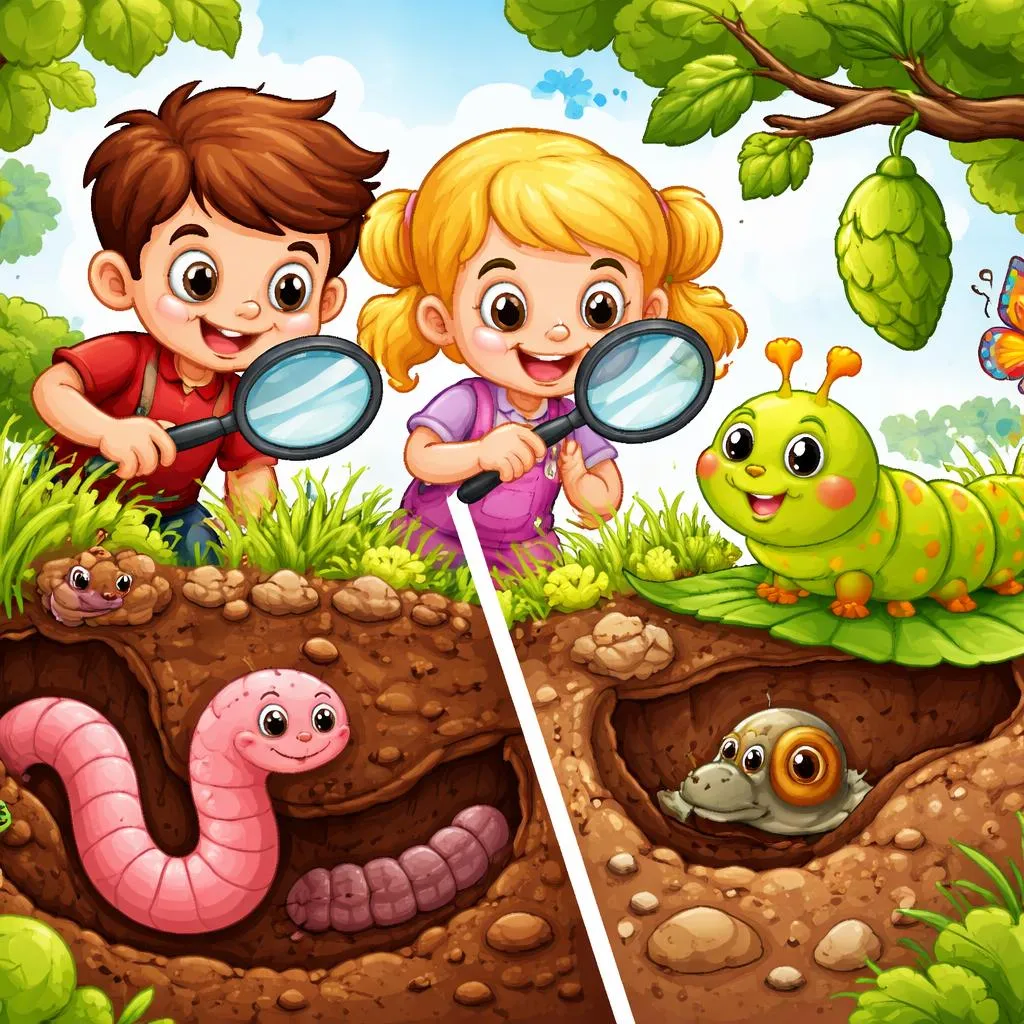

Start! Find a Pair of 'Garden Twin' Words
Hello, word explorer! Have you ever dug in the dirt? You see a long, wiggly creature. It has no legs. What do you call it? You probably say "worm." Now, imagine a tiny, wiggly creature on a leaf. It might become a butterfly. What is that? It is a "larva." They both look soft and wiggly. Are they the same? This is a fun nature puzzle. Today we explore a word pair. We explore worm and larva. They are like two wiggly mysteries. But they are very different! Knowing the secret is a superpower. Your nature talk will be smart and clear. Let us start our underground word adventure!
Be a Language Watcher now. Our first clue is at home. You help in the garden. You see a pink creature in the soil. Your dad says, "An earthworm is good for the soil." Then, you see a small white creature in the trash. Your mom says, "That maggot is a fly larva." They are both wiggly. But are they the same? Let us test with two sentences.
"The worm wiggled back into the damp earth." This is about a full-grown animal. "The larva ate leaves all day, getting ready to change." This is about a baby stage.
They both describe long, soft creatures. But one is a complete animal. One is just a phase. Your watching mission starts. Let us dig into their word world.
Adventure! Dig Into the Word World
Feel the Word's Life Story!
Feel the word worm. It is a simple, complete word. It feels like a whole animal. Think of an earthworm. It is born a worm. It stays a worm. The word larva is a temporary, changing word. It feels like a step in a story. A larva is a baby that will change completely. Worm is the whole book. Larva is just one chapter. One is an end. The other is a beginning. Let us see this at school.
In a general science class, you learn: "The earthworm has no bones." This is a fact about an animal. In a biology lesson, you learn: "A caterpillar is the larva of a butterfly." This is a fact about a life stage. Saying "A caterpillar is a worm" is not accurate. The life story of the words is different.
Compare Their Biology and Growth!
Think about a person and a baby. The word worm is like a person. It is a whole animal. It does not change into something else. The word larva is like a baby. It will grow up and change. A larva becomes a pupa, then an adult. A worm stays a worm. Their life cycles are different. An earthworm is an adult. A maggot is a baby fly. Let us test this on the playground.
You play a game. You wiggle on the ground. You say, "I am a worm!" You are just a worm. Your friend wiggles, then stops and wraps up. She says, "I was a larva, now I am a pupa!" The word larva means a stage of change. The word worm means the animal itself. The playground shows the difference in life cycle.
Meet Their Best Word Friends!
Words have favorite nature partners. The word worm likes simple and common words. It teams up with 'earth', 'book', 'can of', 'hole', and 'fishing'. You use a worm for fishing. You are a bookworm. The word larva likes scientific and change words. It teams up with 'insect', 'stage', 'maggot', 'caterpillar', and 'grub'. A maggot is a fly larva. The larva stage comes first. Their partners are different. Let us go back to school.
In a reading class, you are called a bookworm if you love books. This is a fun nickname. In a science project, you watch the larva become a beetle. This is an observation. You would not call a book lover a "book larva." The word friends set the right meaning.
Our Little Discovery!
We dug deep into the word garden. We made a wiggly discovery. The words worm and larva are not the same. The word worm describes a whole type of animal. It stays a worm all its life. The word larva describes a baby stage of an insect. It will change into an adult. Worm is the final form. Larva is a temporary form. One is a noun for an animal. The other is a noun for a life stage.
Challenge! Become a Nature Word Expert
"Best Choice" Challenge!
Let us look at nature. Read each scene. Pick the champion word. Scene one: You are fishing with your grandpa. He puts a wiggly creature on the hook. He says, "This is a good ______ for catching fish." Is it Worm or Larva? The champion is Worm! We use worms as bait. Scene two: You watch a butterfly egg hatch. A tiny creature comes out. Your book says, "The butterfly starts as a ______." Is it worm or larva? The champion is larva! This is the correct scientific term. Great choice!
"My Sentence Show"!
Now, create your own sentences. Here is a scene: Imagine a rich, dark garden soil. Use the word worm in one sentence. Now imagine a green leaf on a tree. Use the word larva in another. Try it! Here is an example. Sentence one: "The worm helped make the soil healthy." Sentence two: "The larva spun a cocoon around itself." See the difference? The first is about a worm's job in the soil. The second is about a larva's step to become an adult.
"Eagle Eyes" Search!
Can you find the word that needs help? Read this sentence: "My sister is afraid of all worms, especially the worm of a mosquito that lives in water." Hmm. The "worm of a mosquito" is not correct. Mosquito babies are called larvae. A better sentence is: "My sister is afraid of all worms, especially the larva of a mosquito that lives in water." You fixed it!
What a wonderful digging adventure! You started as a curious gardener. Now you are a word scientist. You know the secret of worm and larva. You can feel their different life stories. You see their biology and growth. You know their best word friends. This is a real language superpower.
You can learn amazing things from this article. You now know that a 'worm' is a type of animal that stays a worm, like an earthworm. You understand that a 'larva' is the baby stage of an insect that will change, like a caterpillar. You can explain that a worm is an animal, but a larva is a life stage. You learned the phrase 'bookworm' and that larvae become pupae.
How can you use this today? It is easy and fun. Next time you are in the garden, look for earthworms. Call them worms. When you see a caterpillar, remember it is a larva. Watch a nature show about insects. Listen for the word 'larva'. Draw two pictures. Draw an earthworm. Draw a caterpillar and write 'butterfly larva'. You are using your new skill every day.
Keep your explorer eyes open. The world is full of amazing life cycles. You are learning the words to describe them. Great work, word expert. Your English journey is getting more detailed and exciting with every new word pair you discover!