
Start! Find a Pair of 'Magic Twin' Words
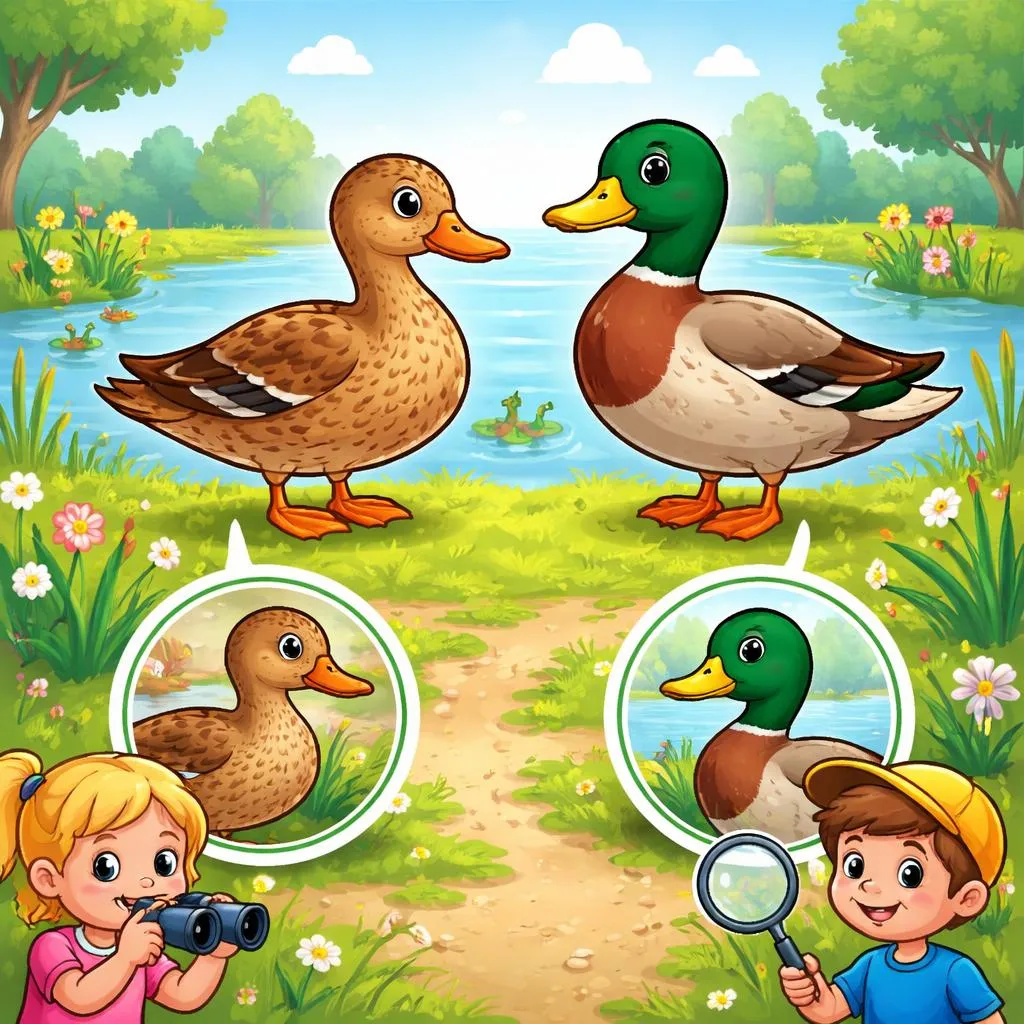
Hello, word explorer! Have you ever fed birds at a pond? You see a bird swimming. It has a flat bill and webbed feet. What do you call it? You probably say "duck." Now, imagine you see two ducks together. One has very colorful feathers. The other is plainer. Are they both just "ducks"? English has a special secret. It has two words for this. Today we explore a word pair. We explore duck and drake. They are like word brothers. They are the same kind of bird. But they are different genders! Knowing the difference is a superpower. Your birdwatching stories will be detailed and smart. Let us start our word pond adventure!
Be a Language Watcher now. Our first clue is at home. You read a children's book. It shows a mother duck with her ducklings. Then, you see a picture of a bird with a shiny green head. The caption says, "A drake." They are the same species. But are they the same word? Let us test with two sentences.
"The duck quacked loudly at the pond." This could be any duck. "The drake had beautiful, colorful plumage." This describes a specific male.
They seem to be in the same family. And they are! One is the general word. One is the specific word for the boy. Your watching mission starts. Let us waddle into their word world.
Adventure! Waddle Into the Word World
Feel the Word's Feathers!
Feel the word duck. It is a friendly, common word. It feels soft and familiar. It is the general word for the whole species. The word drake is a more specific, fancy word. It feels a bit more scientific. It is the term for a male duck. Duck is the big, cozy nest. Drake is one type of bird in that nest. One is the everyday word. The other is the special term. Let us see this at school.
In a general science lesson, you learn: "A duck is a waterfowl." This is a broad fact. In a more detailed biology class, you might learn: "A male duck is called a drake." This is a specific fact. Saying "A male duck is called a duck" is not precise. The feeling of the words is different. One is common, the other is technical.
Compare Their General and Specific Use!
Think about a big toy box and one special action figure. The word duck is the big toy box. It holds all ducks: males, females, and babies. The word drake is the special action figure. It is only for the male ducks. A drake is always a duck. But a duck is not always a drake. The specificity is the key. The word duck is for everyone. The word drake is for the boys. Let us test this on the playground.
You play a duck-duck-goose game. You call everyone "duck." That is correct. Now, if you play a game about bird families, you might say, "The drake protects the nest." This is a specific role. The word drake gives a clear gender clue. The word duck is the general, safe choice. The playground shows the difference in detail.
Meet Their Best Word Friends!
Words have favorite buddies. The word duck likes common and water words. It teams up with 'pond', 'quack', 'feather', 'soup', and 'tape'. You feed the ducks at the pond. You use duck tape. The word drake likes specific and bird-watching words. It teams up with 'mallard', 'male', 'plumage', and 'display'. The mallard drake has a green head. The drake shows off his feathers. Their buddies are different. Let us go back to school.
In an art class, you draw a duck on a pond. This is a general drawing. In a nature journal, you might write: "Observed a drake in breeding plumage today." This is a specific observation. You would not usually write "duck in breeding plumage" without being clear. The word friends help set the scene.
Our Little Discovery!
We waddled around the word pond. We made a clear discovery. The words duck and drake are a family. But they are not the same. The word duck is the general word. It is for the whole species. It can be male, female, or baby. The word drake is a specific word. It is only for a male duck. Duck is the big category. Drake is a member of that category. One is for everyday talk. The other is for precise description.
Challenge! Become a Pond Word Expert
"Best Choice" Challenge!
Let us look at the pond. Read each scene. Pick the champion word. Scene one: You are at a city park. A child throws bread to a group of birds. He yells, "Look at all the ______!" Is it Ducks or Drakes? The champion is Ducks! He is talking about the whole group, not just the males. Scene two: A birdwatcher points through binoculars. She says, "See that one with the iridescent green head? That's a mallard ______." Is it duck or drake? The champion is drake! She is specifically identifying the male. Great job!
"My Sentence Show"!
Now, create your own sentences. Here is a fun scene: Imagine a peaceful lake at sunrise. Use the word duck in one sentence. Use the word drake in another. Try it! Here is an example. Sentence one: "A duck dove under the water to find food." Sentence two: "The drake's feathers looked very bright in the sun." See the difference? The first sentence is about any duck's action. The second sentence focuses on the male's appearance.
"Eagle Eyes" Search!
Can you find the word that needs help? Read this sentence: "At the farm, the children loved watching the drake and his ducklings swim in the pond." Hmm. This is a bit tricky. A drake is a male duck. He does not have ducklings by himself. Ducklings are cared for by the mother duck, the hen. A better sentence would mention the mother. "At the farm, the children loved watching the duck and her ducklings swim in the pond." Or, if you want to include the male: "At the farm, the children loved watching the drake and the duck with her ducklings." You spotted the family mix-up!
What a lovely pond adventure! You started as a curious visitor. Now you are a word birdwatcher. You know the secret of duck and drake. You can feel their different feathers. You see their general and specific uses. You know their best word friends. This is a real language superpower.
You can learn amazing things from this article. You now know that a 'duck' is the general word for the water bird. You understand that a 'drake' is the specific word for a male duck. You can explain that all drakes are ducks, but not all ducks are drakes. You learned to use 'duck' for the whole group and 'drake' when you want to be precise about a male. Your bird vocabulary is now more accurate.
How can you use this today? It is easy and fun. Next time you visit a park with a pond, be a detective. Look at the ducks. Can you see a colorful one? You can say, "That's a drake." The plainer ones are likely hens. Read a book about birds. See if you can find the word 'drake'. Draw a picture of a duck family. Label the colorful one "drake" and the others "duck". You are using your new skill every day.
Keep your birdwatcher's eyes open. Words help us see the world in more detail. You are learning to see those details. Great work, word expert. Your English journey is getting more colorful and precise with every new word pair you understand!