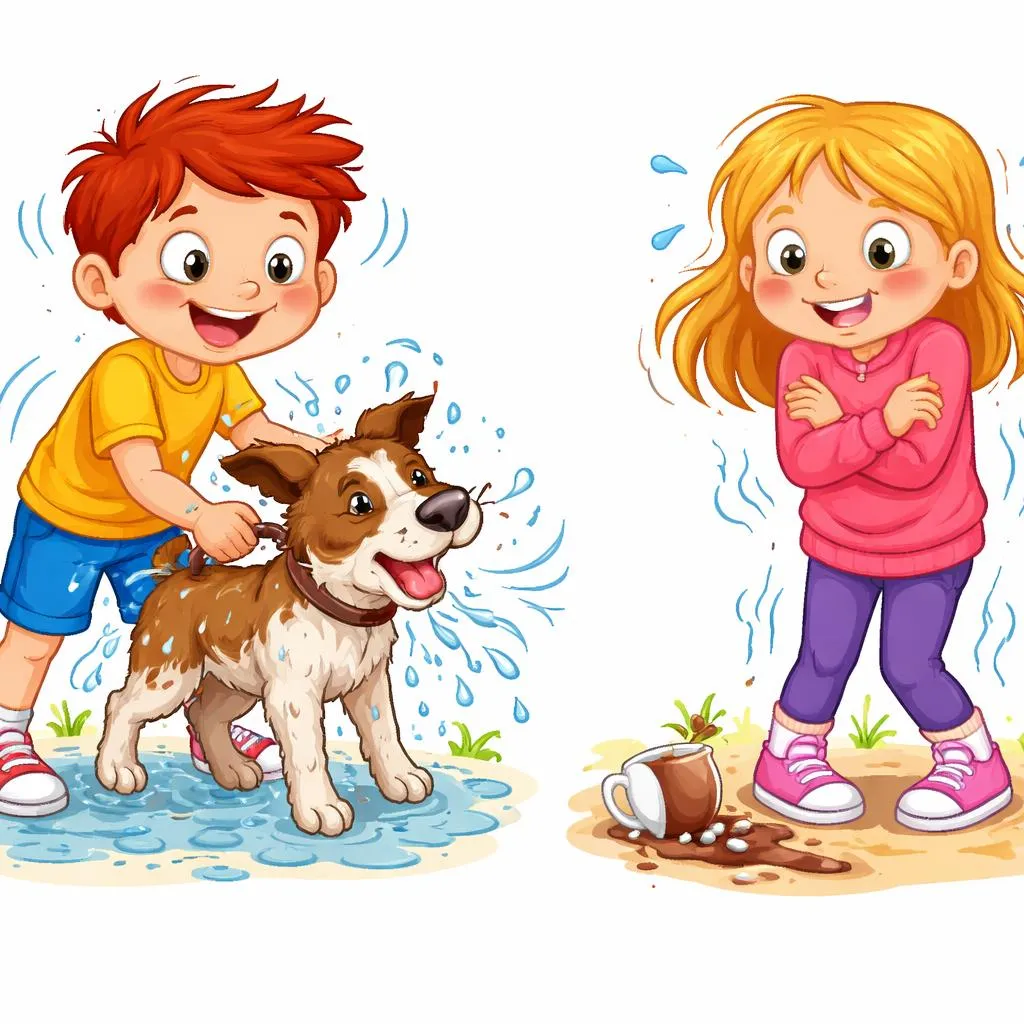

Hello, word detective! Have you ever seen something move back and forth? What do you do with a juice box? Do you shake it up and down? What does a scared puppy do? Does it tremble in the corner? They both seem to be about quick movements. But are they the same? They are like two different kinds of shivers. One is like a big, strong wobble. One is like a tiny, fast quiver. Let's find out! Today, we explore the word friends "shake" and "tremble". Knowing their secret is a superpower. It makes you describe feelings and actions perfectly. Let's begin our shivery adventure!
First, let's be Movement Detectives. Listen at home. Here are two sentences. "I had to shake the blanket hard to get all the crumbs off." "The little kitten was so cold, it started to tremble by the fireplace." They both involve quick, back-and-forth motion. A blanket. A kitten. Do they sound the same? One feels like a big, active motion you do. One feels like a small, delicate motion that happens. Can you sense it? Great observation! Now, let's look closer.
Adventure! Into the World of Shivery Motion
Welcome to the world of vibrations! "Shake" and "tremble" are two different kinds of shaking. Think of "shake" as a big, active, and often deliberate movement. You make it happen. Think of "tremble" as a small, light, and often uncontrollable shaking. It happens to you. Both mean to move quickly. But one is the "big action shake". One is the "tiny feeling tremble". Let's learn about each one.
The Big Action vs. The Tiny Feeling Think about the word "shake". "Shake" feels strong, active, and sometimes loud. It is a broad movement you can do on purpose. You can shake a bottle. You can shake someone's hand. The ground can shake in an earthquake. It is a powerful action. Now, think about "tremble". "Tremble" feels light, delicate, and quiet. It is a small, fast shaking you often cannot stop. You might tremble from fear. A leaf can tremble in the wind. Your voice can tremble when you are nervous. "Shake" is like a big, stomping dinosaur. "Tremble" is like a tiny, scared mouse. One is big and bold. One is small and subtle.
Strong and Active vs. Light and Uncontrollable Let's compare their force. "Shake" is for strong, often intentional movements. It can be big or small, but it is usually active. You shake a present to guess what's inside. You shake a tree to get apples down. "Tremble" is for light, involuntary movements. It is usually a reaction to cold, fear, or strong feelings. Your hands might tremble with excitement. A rabbit might tremble when it sees a fox. You shake the sand from your towel. You tremble at a scary movie. "Shake" is the action you choose. "Tremble" is the feeling that chooses you. One is power. One is emotion.
Their Special Word Partners and Common Uses Words have best friends. "Shake" loves actions, objects, and force. Shake hands. Shake your head. Shake the dust off. Shake a habit. "Tremble" loves feelings, body parts, and nature. Tremble with fear. Tremble with excitement. A trembling voice. Leaves tremble. Note: You "shake up" a drink. You "shake off" water. You can be "shaken up". You can be "all of a tremble".
Let's visit a school scene. In music class, you are learning about maracas. Your teacher says, "Hold the instrument and shake it to the beat of the song!" Everyone makes a strong, rhythmic sound. This is a deliberate, controlled action. Later, you are giving a speech in front of the class. You feel very nervous. Your legs feel weak and wobbly. After, your friend says, "I saw your knees tremble a little up there!" The word "shake" fits the active music-making. The word "tremble" fits the nervous, involuntary wobble.
Now, let's go to the playground. You are on a rope bridge. Your friends jump on it, making the whole bridge move wildly from side to side. The bridge starts to shake a lot! This is a big, strong, back-and-forth motion. Later, you are waiting for your turn on the tall slide. You are high up and feel a little scared. You look at your hands holding the rail. You see them making tiny, fast movements. Your hands are starting to tremble. The word "shake" fits the big motion of the bridge. The word "tremble" fits the small, scared movement of your hands.
Our Little Discovery So, what did we find? "Shake" and "tremble" are both about quick movement. But they are used for different things. "Shake" is a general word for moving something back and forth or up and down. It can be big or small, on purpose or not. "Tremble" is a specific word for a light, quick shaking you cannot easily control. It is often from cold, fear, or strong feelings. You shake a bottle of salad dressing. A frightened animal will tremble. Knowing this helps you describe actions and feelings with perfect accuracy.
Challenge! Become a Shivery Word Champion
Ready for a nature test? Let's try your new skills!
"The Best Choice" Challenge Let's imagine a nature scene. A big, wet dog comes out of a lake. It stands on the shore. It moves its whole body violently from side to side. Water flies everywhere in big droplets. The dog needs to shake itself dry. This is a big, strong, full-body action. Now, look at a small bird on a branch. A cold wind blows. The bird fluffs up its feathers. You see its tiny body make quick, slight movements. The little bird begins to tremble in the chilly air. "Shake" wins for the dog's powerful, deliberate action to get dry. "Tremble" is the word for the bird's light, uncontrollable reaction to the cold. "Shake" is the big action. "Tremble" is the delicate reaction.
"My Sentence Show" Your turn to create! Here is your scene: A dark and stormy night at home. Can you make two sentences? Use "shake" in one. Use "tremble" in one. Try it! Here is an example: "The thunder was so loud it made the windows shake in their frames." This is a big, strong movement caused by an outside force. "I hid under my blanket, and I could feel myself tremble a little." This is a small, involuntary movement from a feeling. Your sentences will show two very different kinds of movement!
"Eagle Eyes" Search Look at this sentence. Can you find the word that could be better? Let's check a home context. "My brother was so angry that his voice started to shake with emotion." Hmm. A voice shaking from strong emotion is usually a light, quivering, hard-to-control sound. The word "shake" is a bit too strong and broad for this delicate sound. The more precise word for a voice affected by feelings is "tremble". "My brother was so angry that his voice started to tremble with emotion." Using "shake" here is not wrong, but "tremble" is the champion for describing that specific, emotional quiver. Did you spot it? Excellent word work!
Harvest and Action! Turn Knowledge Into Your Superpower
Great exploring! We started thinking "shake" and "tremble" were similar. Now we know they are two different movement heroes. "Shake" is the big, active, general word for moving back and forth. "Tremble" is the small, delicate word for an uncontrollable quiver. You can now talk about actions and feelings with perfect accuracy. This is a great skill for a storyteller.
What you can learn from this article: You can now feel that to "shake" is a general, often strong word for moving something back and forth or up and down, like shaking a rug or feeling the ground shake, and it can be something you do on purpose. You can now feel that to "tremble" is a specific word for a light, fast, and often uncontrollable shaking, usually from cold, fear, or strong feelings, like trembling hands or a trembling voice, and it is something that happens to you. You know that you shake a present to guess what's inside, but your hands might tremble with excitement when you open it. You learned to match the word to the motion: "shake" for big, active movements; "tremble" for small, emotional quivers.
Life practice application: Try your new skill today! Be a movement word expert. Watch for shaking things. Do you shake a bottle of juice? Does a leaf tremble in the breeze? Next time you feel a strong feeling, name it. Say, "I had to shake the sand out of my shoe!" or "The puppy made me tremble with joy!" Tell a friend about a time you made something shake. Describe a time you saw something tremble. You are now a master of shivery words! Keep observing and feeling.